Written by Matthew Gutierrez



Accessing Europe Through Investment: Comparing Maltese Citizenship and Italian Residency
Accessing Europe Through Investment: Comparing Maltese Citizenship and Italian Residency
A practical comparison of Malta citizenship and Italian residency for high-net-worth individuals seeking European access, mobility, tax planning, and long-term optionality.
Matthew Gutierrez
What high-net-worth individuals need to know before choosing a European pathway.
2026 High-Net-Worth Asset Allocation Report
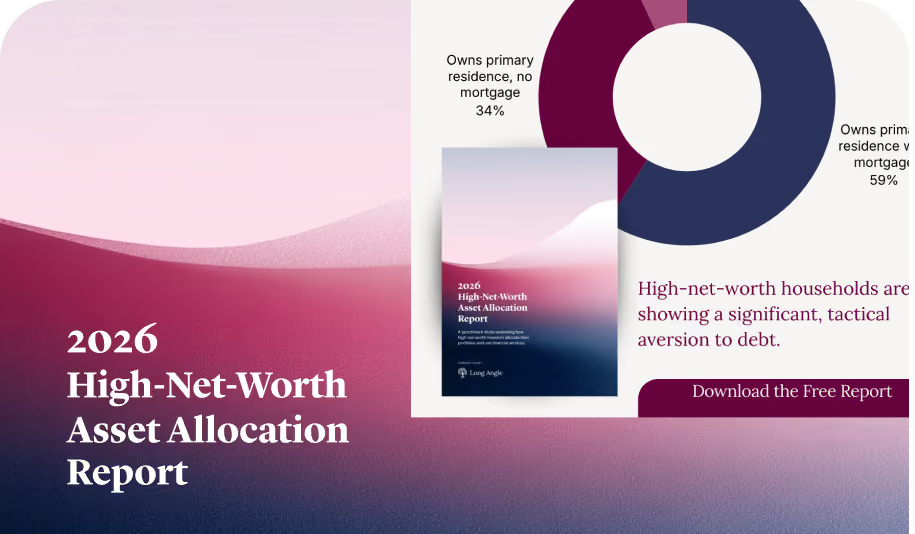
See how high-net-worth investors with an average net worth of $17M are allocating across public equities, private markets, real estate, bonds and cash. Based on benchmark data from 230+ respondents.
Why More Wealthy Families Are Looking at Europe
For many high-net-worth individuals, a second foothold in Europe is no longer only a lifestyle choice. It’s an exercise in optionality.
That idea matters more than ever as people diversify portfolios because concentration creates risk. The same logic increasingly applies to where a family can live, work, study, and seek stability. A residency permit or second citizenship can function as a form of long-term insurance. In other words: Not insurance against one specific event, but against uncertainty itself.
That’s part of what makes European residency and citizenship programs so compelling. They offer more than travel, because they can create flexibility for children, access to education and healthcare, lifestyle choices, and in some cases, tax planning opportunities. For some families, the attraction is immediate relocation while, for others, it’s simply the comfort of having a Plan B.
In that context, Italy and Malta stand out for different reasons. Italy offers a relatively low-cost route to residency, while Malta offers a more ambitious outcome: citizenship in an EU country. One is about access, the other is about permanence.
Residency and Citizenship Are Not the Same Thing
The first distinction matters most: Italian investor immigration is a residency program. Malta’s offering is a citizenship pathway.
Residency gives you the legal right to live in a country. In Italy’s case, that means the right to reside in Italy and spend time throughout the Schengen Zone. It’s meaningful. It can unlock time in Europe and a base inside the EU, but it is still residency. It ‘ not a passport, and it’s not full political membership in the country.
Citizenship is different. Citizenship is permanent status, which comes with a passport and the rights of a national. In Malta’s case, that also means EU citizenship, which brings the right to live in other EU countries.
That difference shapes the entire decision. Someone choosing Italy is typically looking for a lower-cost, more flexible way to gain European access. Someone pursuing Malta is usually thinking bigger: legacy, permanent status, and a direct route into Europe through citizenship rather than temporary permission.
The question is not about which one is better in the abstract, because for many high-net-worth individuals and their families, the question centers on what problem you’re trying to solve.
Why Italy Appeals to Practical Investors
Italy’s investor residency program is attractive because it combines emotional appeal with relatively straightforward economics.
The emotional appeal is obvious: Italy has what many families want from Europe in the first place: culture, food, weather, history, beauty, and quality of life. It does not need much marketing. It sells itself.
The practical appeal is equally as strong, as Italy offers one of the lowest entry points for a European residency-by-investment route. The lowest threshold discussed in the webinar was €250,000, usually through an innovative startup investment. Other options include €500,000 into a company or investment vehicle, €1 million as a philanthropic contribution, or €2 million in government bonds.
For many applicants, the €250,000 route is the headline. It’s lower than many competing European programs. Just as important, the investment is made only after approval. That point matters because, in some other programs, an investor must commit capital first and then wait. Italy flips that order. Approval comes first, and then the applicant has 90 days to make the investment.
That design reduces uncertainty. Today, that’s not a small advantage.
The Underlying Value of Italian Residency
Italian residency is not only about living in Italy. It’s about gaining legal access to the Schengen area.
That means an investor can live in Italy and also spend substantial time across Europe. For families who want a base in Europe without immediately relocating full time, that can be highly valuable, and the program also allows spouses and children to be included, which turns an individual strategy into a family strategy.
Another major attraction is flexibility. There’s no minimum stay requirement to maintain the Italian residency permit. That makes the program useful for people who want optionality without forcing a lifestyle change. You can secure the status first and decide later how much to use it.
There’s also a long runway for those who eventually want something more permanent. Permanent residency may become available after five years, and citizenship after 10, but only if the applicant actually lives in Italy, which is an important caveat. Italy can be a bridge to something deeper, but only for families that truly intend to relocate and follow through.
For many people, though, that’s not the immediate goal. The value is simpler: legal presence in Europe, family inclusion, and flexibility without a rigid physical stay requirement.

What Investors Should Know About the Italy Investment Options
The Italian program is not one investment. It’s a menu.
The lower-cost route is the €250,000 startup path. At first glance, that can sound risky, as startup investing usually does. But one of the more interesting points discussed at Long Angle was that some investment structures do not place all of the capital directly into a single operating startup. Sometimes, there’s a structure where only part of the capital is allocated to the startup itself, while the remainder is invested in other instruments such as high-grade Italian corporate bonds and alternative assets.
That helps explain why the route has been popular. It may not behave the way many people imagine when they hear the phrase startup investment.
There were also hospitality and portfolio-based options discussed. One hotel-backed investment was framed as a lower-risk, lower-return path, with a 3 percent annual return and eventual exit options. Another €500,000 structure used a diversified portfolio of Italian public equities, alternative assets, and cash.
Still, a takeaway is not that one option is best. It’s that investors need to understand what they are actually buying. Immigration structure and investment quality are not the same thing. A residency permit may be the goal, but the money still needs to live somewhere. That means due diligence matters, especially if the residency status depends on maintaining the investment.
Malta Is a Different Kind of Decision
Malta belongs in a different category than Italy.
This is not simply a residency program with nice tax features. It’s a route to citizenship, and that changes the psychology of the decision. You are not securing permission to stay; you are pursuing a second nationality.
That comes with more scrutiny, and a higher bar. Malta’s updated framework is citizenship by merit rather than citizenship by investment. Malta’s prior citizenship-by-investment model faced legal pressure from the European Commission, which objected to the idea of a straightforward transaction for citizenship. The redesigned structure now operates on a more selective, case-by-case basis.
In plain English, Malta is no longer about writing a check and moving through a standardized process. It’s about presenting a persuasive case that an applicant is exceptional and can provide tangible value to the country.
That usually means the program is best suited for entrepreneurs, business leaders, philanthropists, academics, researchers, and others with a substantial profile. The financial contribution still matters. So does real estate, and so does philanthropy, but the core of the application is no longer purely transactional.
That makes Malta less predictable than Italy. It also makes the upside potentially greater.
Why Malta Remains So Attractive
Malta can still be the most attractive route to EU citizenship for the right person.
The appeal starts with speed: Malta requires a period of residency first before becoming eligible to apply for citizenship. The citizenship application itself can then take several additional months. The overall timeline is roughly 18 months, sometimes less.
That is extraordinarily fast in a European context. It’s especially notable when compared with programs that involve multi-year waits and ongoing uncertainty.
The second attraction is what happens at the finish line. A Maltese citizen can live not just in Malta, but in any EU country. That transforms the benefit from local access into continental flexibility.
The third attraction is that the program does not appear to demand the same sort of ongoing investment retention that residency programs often require. There are still obligations. Applicants may need to maintain a primary residence in Malta for five years through ownership or rental. There may also be ongoing commitments related to whatever tangible contribution formed part of the application, but this is still a fundamentally different proposition from remaining tied to an investment purely to preserve immigration status.
For people who qualify, Malta offers what Italy does not: finality.
The Cost Question Is Really a Fit Question
At first glance, the Italy-versus-Malta comparison looks like a budget comparison. Italy starts at €250,000. Malta is far higher, with Daniel suggesting that applicants should generally expect to have at least €1 million plus in investable assets for Malta to make sense.
That gap is real, but cost alone does not settle the issue.
Italy is a lower-cost path to residency. It’s ideal for families who want European access, Schengen mobility, and flexibility without the pressure of full relocation. Malta is a higher-cost, higher-bar path to citizenship for people with the profile, means, and motivation to pursue something permanent.
In other words, these are not really substitute products. They solve different problems. Italy is for the investor who wants a foothold. Malta is for the investor who wants a second home in the deepest legal sense of the word.
That is why the more useful framework is not affordability alone. It’s fit. How much permanence do you want? How much optionality do you need? How much capital are you willing to commit? And are you looking for access, or identity?


Frequently Asked Questions
What is the main difference between Italian residency and Maltese citizenship?
Italian residency gives you the legal right to live in Italy and spend time in the Schengen Zone. Maltese citizenship gives you a passport and full EU citizenship rights, including the ability to live in other EU countries.
Q: How much do you need to invest for Italy’s investor residency program?
The lowest threshold discussed in the Long Angle webinar was €250,000, typically through an innovative startup route. Other options included €500,000, €1 million, and €2 million depending on the investment type.
Q: Do you have to live in Italy to keep the residency permit?
There is no minimum stay requirement applies to maintain the Italian residency permit. However, living in Italy is required if you want to pursue permanent residency or citizenship later.
Q: How long does it take to get Maltese citizenship?
Usually it’s considered an 18-month path, including an initial residency period of at least eight months followed by the citizenship application process.
Q: Is Malta still a citizenship-by-investment program?
Not in the old sense. Many describe Malta’s current route as citizenship by merit, meaning applicants are assessed case by case and must demonstrate exceptional value or a meaningful contribution to the country.
Can U.S. citizens keep their American citizenship if they pursue one of these paths?
Yes. Dual nationality is permitted, so applicants do not have to give up U.S. citizenship in order to obtain Maltese citizenship or pursue a European path. Some may later choose to renounce U.S. citizenship for tax reasons, but that is a separate decision.
Can U.S. citizens keep their American citizenship if they pursue one of these paths?
It depends on the goal. Italy may be better for those who want a relatively lower-cost foothold and flexibility. Malta may be better for those who want full EU citizenship, broader rights, and a more permanent solution.
Final Thoughts
The smartest investors rarely think in terms of one outcome; they think in terms of optionality.
That’s what makes this conversation bigger than visas, permits, or passports. For high-net-worth families, a second route into Europe can reshape long-term planning. It can affect where children study, where a family can relocate during uncertainty, how time is spent across countries, and how wealth is structured over decades.
Italy and Malta both offer access to Europe, but they do so in very different ways. Italy is the more modest move, lower cost, more flexible, and easier to understand. Malta is the bigger leap, more selective, more expensive, and far more powerful if the application succeeds.
Neither is universally better, as each reflects a different philosophy, and some families want an open door. Others want a second key.
Ready to connect with like-minded peers navigating similar wealth decisions?
Join Long Angle, a private community where successful entrepreneurs, executives, and professionals collaborate on wealth strategies, investment opportunities, and life's next chapter.
More From Long Angle
Beyond Wealth Newsletter
Navigating Wealth Podcast
Research & Studies
Alternative Investment Education
Blog