Recent Conversations
How to Make Friends as an Adult: The Two-Hour Cocktail Party
Serial entrepreneur Nick Gray's tested system for making friends as an adult: the two-hour cocktail party framework and how to use it.
How to Invest in Oil and Gas: Private vs. Public, Unit Economics, and the Supply Non-Response
A private oil and gas operator with $3B raised and 70,000 barrels per day of production explains the real mechanics of upstream investing, why there has been no supply response to the largest disruption in history, and how cash-flow-focused private funds differ from owning Exxon.
What Is a Lobbyist - Tom Manatos
A Capitol Hill veteran explains what lobbyists do, how political access works, and what business owners can do to influence the policies that affect them.
Teaching Kids Money Management: The Invisible Allowance Problem
Financial parenting expert Joline Godfrey on why affluent parents accidentally undermine their kids' financial judgment — and what to do about it at every age.
How to Invest in Private Credit: What the Headlines Are Getting Wrong About the Selloff
Blue Owl Capital principal Katie Fowler explains why the 2025 private credit selloff reflects narrative contagion more than loan deterioration, how redemption gates work, and what falling yields really mean for allocators evaluating a private credit position.
Hedge Fund Strategies: What Institutional Allocators Know That Most Investors Don't
A capital introductions veteran explains how hedge fund strategies actually work, what fee structures really cost, and how HNW investors should evaluate managers.
Oura Ring Accuracy: What a Sleep Doctor Who Worked at Apple Says
A Stanford-trained sleep physician who designed Apple's employee sleep program breaks down what Oura Ring and Apple Watch actually measure, where they fall short, and what to do about it.
Founder Second Act: Why the Exit Isn't the Finish Line
Dave Nemetz co-founded Bleacher Report and sold it to Turner for $200M at 30. The financial outcome was clean. The years of drift that followed weren't. He explains what most founders get wrong about the second act and how to design one that doesn't default to drift.
How Does the College Football Transfer Portal Work? A Power Four Head Coach Explains the New Operating Model
Texas Tech head coach Joey McGuire walks through how a Power Four program evaluates transfers, manages NIL and revenue share, and competes for talent in college football's chaotic new economy. A sitting coach's view of the operating model.
What the Disney-OpenAI Deal Collapse Reveals About AI IP Licensing
Michael Sapherstein, former in-house counsel at Marvel and Disney, breaks down what the Disney-OpenAI deal collapse signals about the structural fragility of AI-IP licensing arrangements and what it means for underwriting IP-rich businesses.
How to Get on a Board of Directors (and the Portfolio Life That Should Come With It)
Tom O'Toole, former CMO of United and Hyatt, on how public board seats actually get filled. Why the first one has to come before you leave your corporate role, why most LinkedIn placement services are not legitimate, and how boards fit into a portfolio life that has to be designed.
Franchise Investing: How to Build Real Wealth With Multi-Unit Ownership
Andy Louis-Charles spent eight years as Chief Strategy Officer at Custom Ink, helped navigate a 2019 private equity liquidity event, and has spent the years since building a specific thesis: franchising is where product-market fit has already been solved, and the only risk left to underwrite is execution.
Award Travel: When Points Still Beat Cash (And When They Don't)
Award travel rewards the patient more than the prepared. Most people search for award seats the moment they decide on a trip, find nothing available, and conclude the system doesn't work. Chris Hutchins argues the real game is probabilistic - availability exists, you just don't control when it surfaces.
Selling a SaaS Business: What Actually Drives Value
Software M&A hit record deal volume in 2025 at roughly 5,000 transactions - a thousand more than 2022, the prior high-water mark - but that headline obscures what is actually happening to valuations. What it does not mean is that every SaaS business going to market is getting a strong outcome.
Single Family Office: What It Is, What It Costs, and When It Makes Sense
A single family office is a private company that centralizes investment management, tax planning, estate administration, trust services, and family governance for one bloodline. It operates as a cost center — not a profit center — with no outside clients and no revenue stream beyond the family's own capital.
Selling to Private Equity: What Founders Should Actually Expect
ALS has resisted meaningful treatment for over a century because most cases do not trace back to a single genetic cause, which made traditional drug targeting approaches applicable to only a small minority of patients.
ALS Gene Therapy: How a Genomic Discovery Becomes a Drug
ALS has resisted meaningful treatment for over a century because most cases do not trace back to a single genetic cause, which made traditional drug targeting approaches applicable to only a small minority of patients.
Cybersecurity for High Net Worth Individuals: What the Criminal Underground Reveals About Your Real Risk
If you recently had a transaction announced publicly — a company sale, a PE exit, an executive appointment — your name is now searchable, and your wealth is attached to it. The question a lot of people in that position ask is whether that visibility creates real risk, and if so, what to do about it.
Invest in Music Royalties: What a $1B Catalog Operator Actually Thinks
Most investors who encounter music royalties treat them as a fan play. Jason Peterson, founder and CEO of Go Digital, runs the business differently. His company manages nearly $1B in music IP across several hundred thousand copyrights, with no institutional equity, and has been inside every major industry inflection since Napster.
Buy and Build Private Equity: What the Strategy Actually Looks Like From the Inside
Most of what gets written about private equity focuses on the investor side — how firms raise capital, source deals, and generate returns for LPs. The operator's view is harder to find, and it tends to contradict the assumptions executives bring when they first consider making the move.
Meet the Hosts
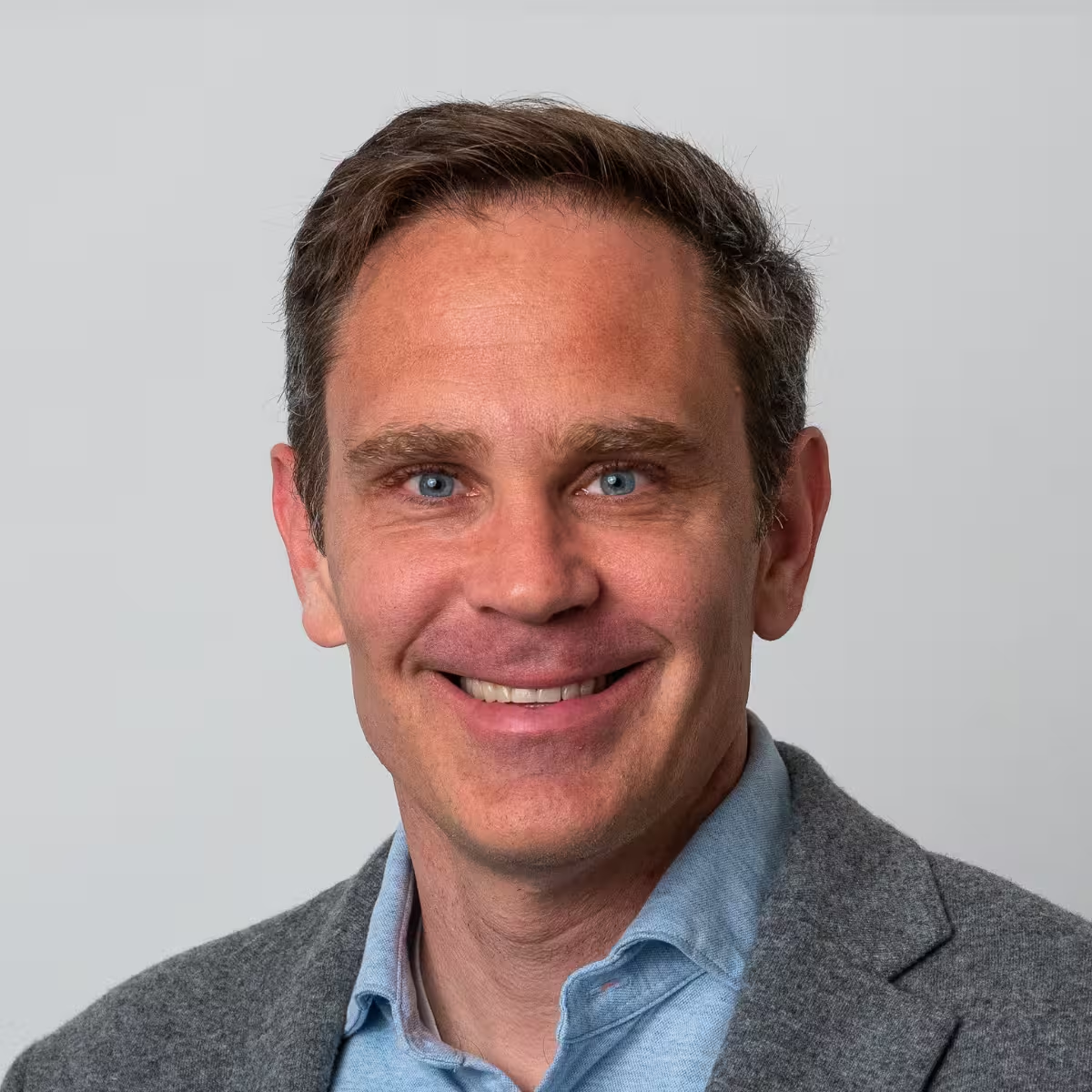
Tad Fallows
CEO and Co-Founder of Long Angle, a peer community for first-generation wealth-creators. He previously co-founded iLab Solutions and bootstrapped the software company to serve 80% of world’s leading research universities. Tad started his career as a consultant at McKinsey & Company. He studied economic history at Harvard, graduating Magna Cum Laude.
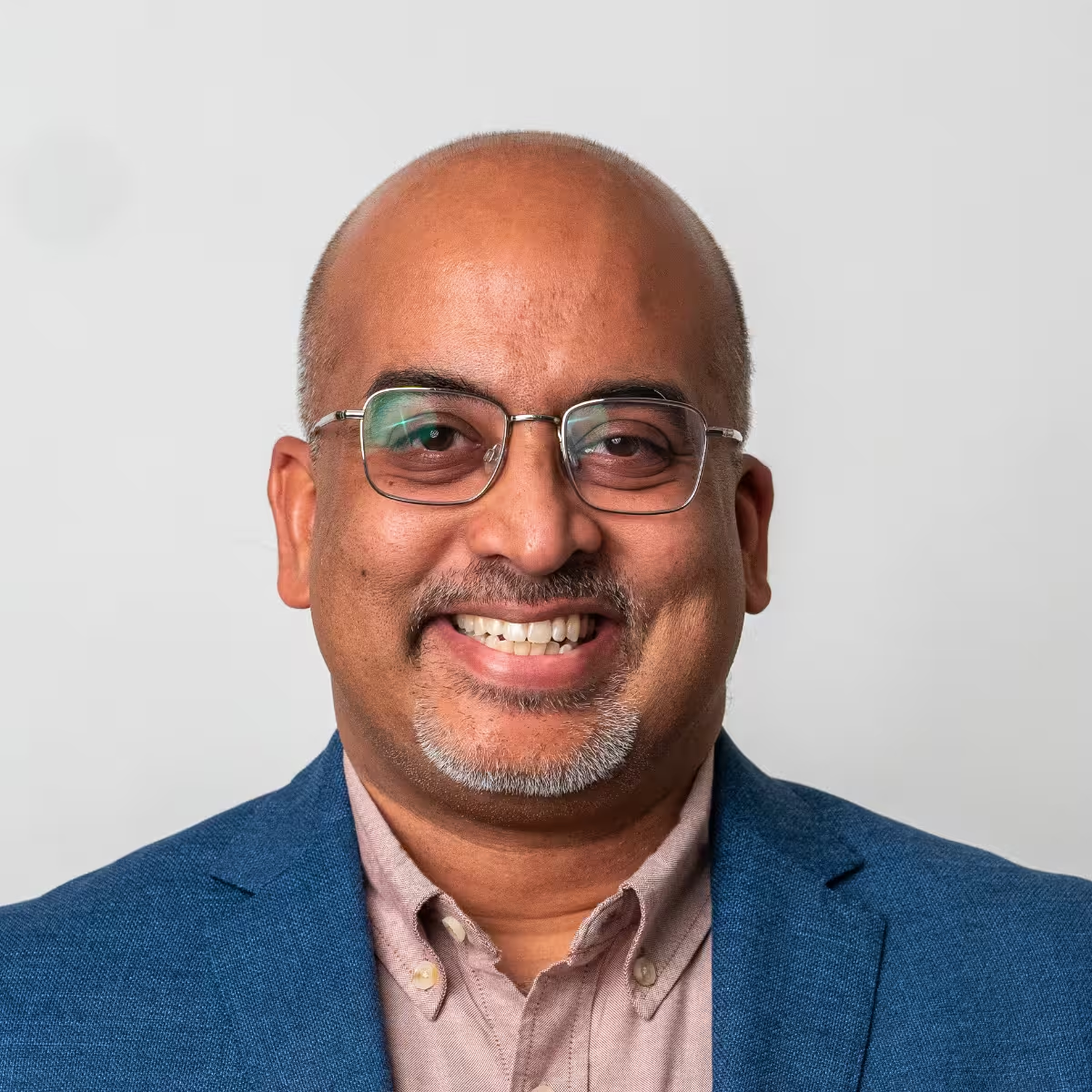
Sriram Gollapalli
President and Co-Founder of Long Angle, helping guide the community’s focus on personal finance, investing, and peer learning. He previously co-founded iLab Solutions, later acquired by Agilent, where he led enterprise SaaS and cloud operations. Sriram is also an active angel investor and mentor with interests in enterprise SaaS, healthcare, and education.
Matt Shechtman
CEO of Long Angle Management, where he oversees strategy and institutional investments. His work spans sourcing, diligence, and execution across private equity, credit, real estate, and other assets. Before Long Angle, Matt founded and exited two companies, practiced real estate finance at Jones Day, and clerked on the United States Court Court of Appeals (5th Circuit).