Written by Chris Bendtsen

What Asset Allocation Do FIRE Investors Actually Hold?
What Asset Allocation Do FIRE Investors Actually Hold?
FIRE-identifying high-net-worth investors hold 62% in public equities and just 8% in real estate. See the full breakdown from Long Angle's 2026 report.
Chris Bendtsen
Research Findings
FIRE-identifying investors hold 62% of their portfolio in public equities, the most equity-heavy allocation of the three financial-objective groups, and 8% in investment real estate, the least. Investors maximizing net worth sit in between at 57% public equities but hold the most real estate at 15%. Those focused on leaving a legacy to heirs hold the least in public equities (42%) and the most in private company equity (21%), a more conservative, estate-oriented mix. Findings come from Long Angle's 2026 High-Net-Worth Asset Allocation Report, based on 233 Long Angle member respondents surveyed December 2025 to January 2026.
Key Takeaways
- FIRE-identifying high-net-worth investors hold 62% of their portfolio in public equities, the highest concentration of any financial-objective group in the study.
- They hold just 8% in investment real estate, about half the 15% held by investors focused on maximizing net worth.
- Private company equity (12%) and bonds and cash combined (13%) round out the FIRE portfolio.
- Investors who prioritize leaving a legacy to heirs run the opposite pattern: the lowest public equity allocation (42%) and the highest bonds allocation (10%) of any group.
- This describes already-wealthy, self-identified FIRE investors inside Long Angle, not the broader and often pre-wealth online FIRE community, and individual group sizes within the 233-respondent sample are not published.
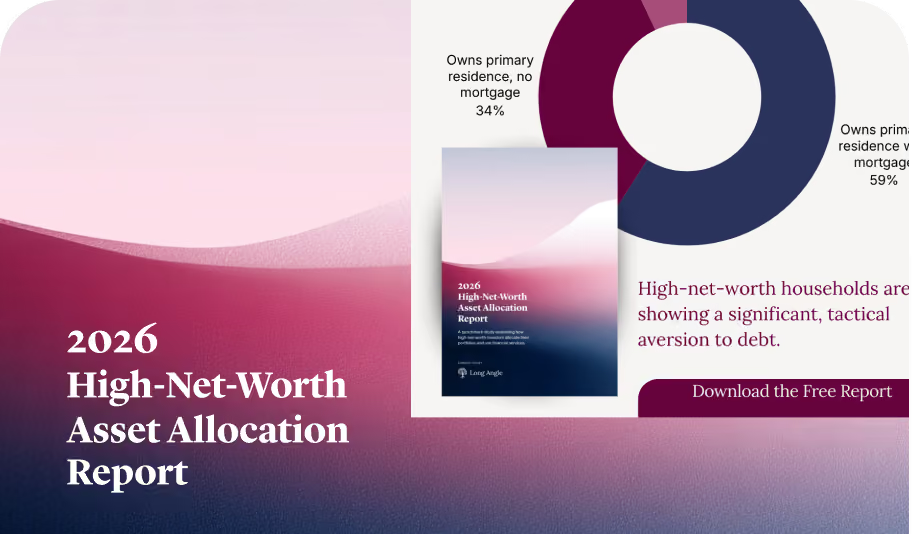
2026 High-Net-Worth Asset Allocation Report
See how high-net-worth investors with an average net worth of $17M are allocating across public equities, private markets, real estate, bonds and cash. Based on benchmark data from 230+ respondents.
FIRE investors run the most equity-heavy portfolio in the study
Long Angle asked respondents to identify their primary financial objective: FIRE, maximizing net worth, or leaving a legacy to heirs. The three groups look meaningfully different.
Source: Long Angle 2026 High-Net-Worth Asset Allocation Report, 233 respondents, average net worth $17M, fielded December 2025-January 2026. Individual group sample sizes are not published.
FIRE-identifying investors hold the most public equity and the least real estate of the three groups. Investors focused on maximizing net worth sit in the middle on most measures but hold the most real estate. Investors focused on leaving a legacy hold the most private company equity, the most bonds, and the least public equity, a materially more conservative and estate-oriented mix.
Why the FIRE allocation looks the way it does
A portfolio built to fund an early, multi-decade retirement has a different job than one built to be handed down. FIRE investors are still generating income or recently stopped, have a long time horizon ahead of them, and are optimizing for growth over current yield, which is consistent with the 62% public equity concentration and the comparatively low real estate allocation (real estate produces income but ties up capital that a public equity allocation keeps liquid and growing).
The legacy-focused group's pattern points the opposite direction. A higher bond allocation and higher private company equity concentration suggest investors thinking about estate value and income stability for heirs rather than growth for their own future consumption.
None of this describes a target allocation. It describes what investors who have already reached a high-net-worth stage and identify with each objective are actually doing.
About this data
This finding is drawn from Long Angle's 2026 High-Net-Worth Asset Allocation Report, the fifth annual edition of the study. The report surveyed 233 Long Angle members with an average net worth of $17M (range: $2M to over $100M), fielded between December 2025 and January 2026. Just over a third of respondents identified FIRE as their primary financial objective; individual sample sizes for each of the three objective groups are not published separately. Respondents are Long Angle members, not a representative sample of the broader FIRE community, and 71% self-identify as having high investment expertise.
See the full 2026 High-Net-Worth Asset Allocation Report for the complete dataset, including allocation by net worth, risk tolerance, and source of wealth.
Frequently Asked Questions
What portfolio allocation do FIRE investors use?
High-net-worth investors who identify with FIRE hold 62% of their portfolio in public equities, 12% in private company equity, 8% in investment real estate, 5% in alternative investments, 6% in bonds, and 7% in cash, according to Long Angle's 2026 report of 233 respondents.
Is a FIRE portfolio too risky?
This data does not evaluate risk directly. It shows that FIRE-identifying high-net-worth investors run a more equity-heavy, less real-estate-heavy portfolio than peers focused on maximizing net worth or leaving a legacy, consistent with a longer time horizon and a growth priority.
How much real estate do FIRE investors own?
FIRE-identifying high-net-worth investors hold 8% of their portfolio in investment real estate, about half the 15% held by investors whose primary objective is maximizing net worth.
How is a FIRE portfolio different from one built to leave a legacy?
Legacy-focused investors hold more private company equity (21% versus 12%) and more bonds (10% versus 6%), and less in public equities (42% versus 62%), than FIRE-identifying investors, a more conservative, estate-oriented mix.
Financially independent and wondering what's next?
Long Angle's FIRE Trusted Circle is a small peer group for members navigating early retirement and family life together, matched by life stage.
Research