Written by Chris Bendtsen

How Much Cash Do High-Net-Worth Households Hold?
How Much Cash Do High-Net-Worth Households Hold?
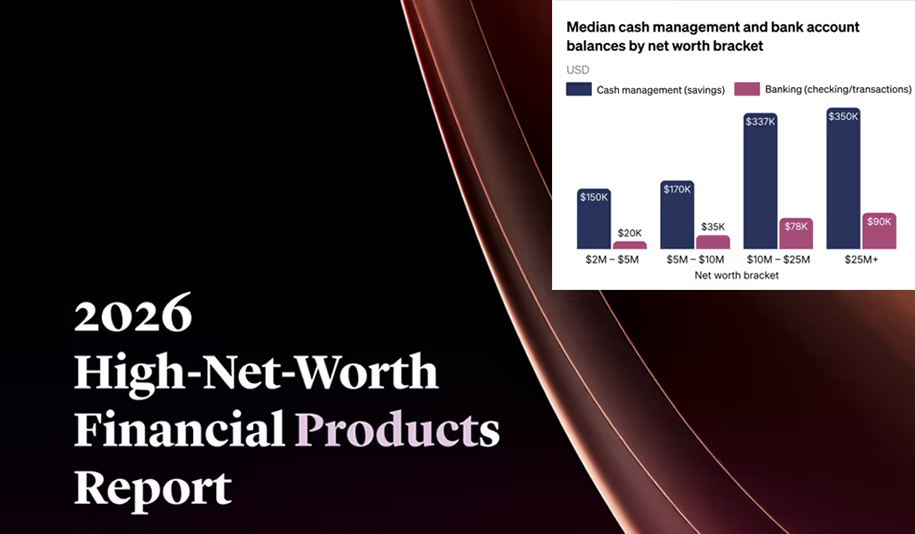
Checking balances stay modest even at $25M+. Savings and cash management balances roughly double between $5-10M and $10-25M in net worth, then flatten.
Chris Bendtsen
Research Findings
High-net-worth households keep most of their cash outside the bank. Among respondents to Long Angle's 2026 High-Net-Worth Financial Products Study, median cash management balances ran $170,000 for those worth $5-10 million and $337,000 for those worth $10-25 million, while median checking balances stayed at $35,000 and $78,000. Fidelity and Schwab were the two most-used cash management providers, recommended by 91% and 88% of their users against 48% for Bank of America. Figures are self-reported medians from 165 voluntary Long Angle respondents, July 2026.
Key Takeaways
- Median cash management balances run roughly four to seven times median checking balances, and the multiple narrows as wealth rises.
- Checking stays modest as wealth grows: $20,000 at $2-5 million net worth, $90,000 above $25 million.
- Cash management roughly doubles between $5-10 million ($170,000) and $10-25 million ($337,000), then flattens at $350,000.
- Fidelity (28% share, 91% recommend) and Schwab (27%, 88%) lead cash management; Bank of America recommends at 48%.
- Self-reported medians from 165 voluntary respondents, July 2026, rather than averages.
2026 High-Net-Worth Financial Products Report
See which banks, credit cards, brokerages, lenders and insurers high-net-worth households actually use and which they recommend. Based on insights from 165 investors, entrepreneurs and executives.

Two pools, not one
Cash at this wealth level splits into a transactional account and a savings or cash management account, and the two behave differently.
Median checking balances run $20,000 for respondents worth $2-5 million and $90,000 for those above $25 million. Over a wealth range spanning more than five times, the transactional balance rises 4.5x and stays modest in absolute terms.
Cash management balances move further and faster. They run $150,000 at $2-5 million, $170,000 at $5-10 million, then jump to $337,000 between $10 and $25 million before flattening at $350,000 above that.
| Net worth | Cash management (savings) | Banking (checking) |
|---|---|---|
| $2M - $5M | $150,000 | $20,000 |
| $5M - $10M | $170,000 | $35,000 |
| $10M - $25M | $337,000 | $78,000 |
| $25M+ | $350,000 | $90,000 |
Source: Long Angle 2026 High-Net-Worth Financial Products Report, 165 respondents, 81% with net worth over $5M, fielded July 2026. Self-reported medians rather than averages.
The step between $5-10 million and $10-25 million is the largest in the table, close to a doubling. The study does not establish what drives it.
The money sits at brokerages
Fidelity and Schwab hold the largest shares of cash management at 28% and 27%, with recommend rates of 91% and 88%. Vanguard follows at 13% and 75%.
Banking, meaning the checking and transactional account, still belongs to the large banks. Chase holds 22%, Bank of America 20% and Wells Fargo 11%. Their recommend rates run 70%, 48% and 39%, the three weakest figures among widely-used providers anywhere in the study. Fidelity and Schwab, used by 10% and 7% of respondents for banking, recommend at 93% and 90%.
| Provider | Cash management share | Cash mgmt. % recommend | Banking share | Banking % recommend |
|---|---|---|---|---|
| Fidelity | 28% | 91% | 10% | 93% |
| Schwab | 27% | 88% | 7% | 90% |
| Vanguard | 13% | 75% | - | - |
| Chase | 4%* | 40%* | 22% | 70% |
| Bank of America | - | - | 20% | 48% |
| Wells Fargo | - | - | 11% | 39% |
| Wealthfront | 7% | 89% | - | - |
| Capital One | 6% | 71% | 5% | 75% |
| Ally | 5% | 50% | 6% | 78% |
| Marcus* | 4% | 100% | - | - |
Source: Long Angle 2026 High-Net-Worth Financial Products Report, 165 respondents, 81% with net worth over $5M, fielded July 2026. Shares are of all respondents and a respondent may name more than one provider, so shares are not additive. Figures marked with an asterisk sit on a low respondent count.
What they are buying
Respondents named rate first and consolidation second, which is the order that explains the table above.
68% cited a high interest rate as a benefit they use, and 62% cited having cash consolidated with the brokerage. Both favour a brokerage cash account over a large-bank checking account. 58% named ATM fee reimbursement, 53% free wire transfers, and 36% a brokerage cash sweep.
Branches still matter. 61% named branch access, ranking it third, which is the one line in this section that runs against the rest. Wealth management and private banking relationships came last, at 21% and 19%; the report notes most respondents are self-managed investors.
| Benefit | % of respondents |
|---|---|
| High interest rate | 68% |
| Consolidated with brokerage | 62% |
| Branches | 61% |
| ATM fee reimbursement | 58% |
| Free wire transfers | 53% |
| Brokerage cash sweep | 36% |
| Wealth management relationship | 21% |
| Private banking relationship | 19% |
Source: Long Angle 2026 High-Net-Worth Financial Products Report, 165 respondents, 81% with net worth over $5M, fielded July 2026. Multiple response, so shares do not total 100%.
The exception sits at the top of the wealth range. The report identifies the largest median balances at J.P. Morgan and J.P. Morgan Private Bank, PNC and PNC Private Bank, and Morgan Stanley, all serving the highest brackets.
There is no published benchmark for a cash reserve at this level.
Long Angle is a vetted community of high-net-worth founders, executives and investors who compare reserve sizing, sweep rates and where they hold operating cash, with their real names attached.
Two numbers are worth separating before deciding anything: what the household spends from, and what it holds against a commitment. The respondents here keep those in different places, and the gap between a $78,000 checking balance and a $337,000 cash management balance at the same net worth is that separation made visible. Where the second pool sits is a rate question. How large it needs to be is a spending and commitment question this study does not answer.
Frequently Asked Questions
How much cash do high-net-worth households keep?
Among Long Angle respondents worth $10-25 million, the median cash management balance was $337,000 and the median checking balance $78,000. At $5-10 million the figures were $170,000 and $35,000.
Do wealthy people keep their cash at a bank?
Mostly not. Fidelity, at 28%, and Schwab, at 27%, were the two most-used cash management providers, while Chase at 22% and Bank of America at 20% led transactional banking.
Why do high-net-worth households use brokerages for cash?
Rate and consolidation. 68% of respondents named a high interest rate as a benefit they use, and 62% named having cash held alongside the brokerage account.
How much should someone with $10 million keep in cash?
The study reports what respondents hold rather than what they should. Median cash management balances in the $10-25 million bracket were $337,000. Appropriate reserves depend on spending, income volatility and capital commitments the study did not measure.
Research