Written by Ryan Morrison


Family Office Trends 2025
Family Office Trends 2025
As 2025 draws to a close, many family offices have continued to professionalize, expanded into private markets, and experimented with AI integration while navigating geopolitical uncertainty and regulatory shifts.
Ryan Morrison

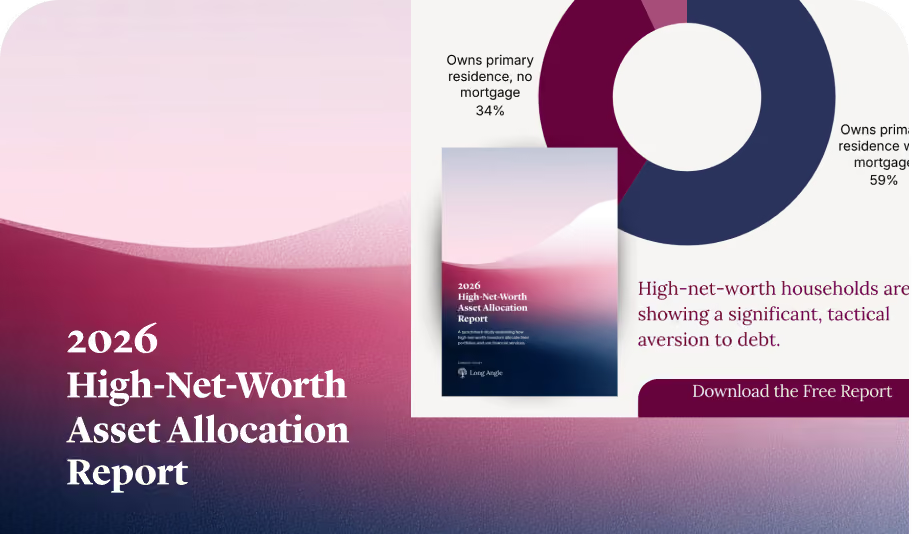
2026 High-Net-Worth Asset Allocation Report
See how high-net-worth investors with an average net worth of $17M are allocating across public equities, private markets, real estate, bonds and cash. Based on benchmark data from 230+ respondents.
The Macro Context: How Family Offices Positioned in 2025
Recent global family office and institutional surveys describe a “cautious but opportunity‑seeking” stance in 2025. Across these studies, the macro environment included: geopolitical risk and trade tensions as top concerns, a higher‑for‑longer rate regime reshaping fixed income, political and fiscal uncertainty, and rapid technological change, especially around AI.
Instead of making all‑or‑nothing macro bets, many sophisticated family offices diversified by region and sector, stress‑tested portfolios for downside scenarios, and used active strategies selectively. At the 5–50 million dollar level, the same risk‑management principles apply at a smaller scale: scenario testing, clarity on developed‑ versus emerging‑market exposure, and explicit assumptions about inflation and liquidity needs.
The Professionalization Wave
Multiple 2024–2025 reports from large wealth managers and consultants describe an ongoing professionalization trend, with family offices evolving from “administrative hubs” toward more institutional investment platforms. Common features include more formal governance, clearer investment policies, professional deal sourcing, and institutional‑grade reporting. (Source examples: UBS Global Family Office Report 2025, PwC Global Family Office studies, Deloitte and Citi family office insights.)
This does not mean every family needs a large in‑house office, but it does provide practical benchmarks for what “professionalization” can look like at different asset levels.
For roughly 5–20 million dollars:
- A concise, written investment philosophy and decision framework.
- Annual portfolio reviews with clear, agreed‑upon performance and risk metrics.
- Current estate planning documents and coordinated beneficiary designations.
- Defined scopes and fee structures for external advisors.
For roughly 20–50+ million dollars:
- A formal investment policy statement.
- Regular investment committee meetings, even if the “committee” is family plus advisors.
- A documented succession roadmap and simple governance charter.
- Basic cybersecurity and data‑protection policies.
- Consideration of outsourced CIO or multi‑family office services as complexity grows.
These practices narrow the gap between ad‑hoc management and institutional standards through documentation, process, and intentionality rather than headcount.
Tax Planning: 2025 as a Staging Year for 2026 Changes
Under current U.S. law, the temporarily increased federal estate and gift tax exemptions are scheduled to “sunset” after 2025, which would roughly halve the exemption in 2026 unless Congress changes the law. For 2025, the exemption is approximately 13.6 million dollars per individual (27.2 million dollars for married couples), with post‑2025 levels expected to revert to an inflation‑adjusted version of the prior, lower exemption. Exact numbers depend on IRS inflation adjustments and any future legislation, so readers should confirm current thresholds with a qualified tax advisor.
In anticipation of this potential reduction, many wealthier families and family offices used 2025 to explore or implement:
- Accelerated lifetime gifting strategies to lock in current exemptions.
- Advanced trust structures such as SLATs, GRATs, and IDGTs where appropriate.
- Intra‑family transfers, business recapitalizations, and entity restructuring aimed at both control and tax efficiency.
- Documentation cleanup to prepare for possible IRS scrutiny of complex structures.
Beyond federal estate and gift issues, families monitored changes affecting non‑compete enforcement, targeted IRS campaigns (for example around aircraft or certain sports‑related investments), and evolving anti‑money‑laundering and transparency rules touching closely‑held entities. Many of these rules remain nuanced and jurisdiction‑specific, so it is safest to describe them as “expanding AML, transparency, and reporting expectations” rather than uniform, finalized mandates for every structure.
Investment Allocation: The Private Markets Pivot
Survey data from firms such as UBS, bfinance, and others show continued interest in private markets among family offices, alongside meaningful allocations to public markets and real assets. Across studies, many respondents reported increasing or maintaining allocations to:
- Private equity and venture capital.
- Private credit and direct lending.
- Real estate as a core income and diversification pillar.
- Developed‑market fixed income, with higher yields than in the ultra‑low‑rate era.
To avoid overstating precision, it helps to frame any portfolio breakdown as illustrative rather than prescriptive. A reasonable “stylized” example based on common survey ranges is:
- Public equities: roughly 30–40%
- Fixed income: roughly 15–25%
- Real estate: roughly 15–20%
- Private markets (PE/VC/Private credit): roughly 15–25%
- Hedge funds/other alternatives: roughly 5–15%
- Cash and liquidity: roughly 5–10%
Actual allocations vary widely by family wealth level, operating‑business exposure, geography, and risk tolerance; readers should treat this as a reference point for discussion with their own advisors, not a model portfolio.

AI and Technology: From Theme to Operational Tool
Recent family office and institutional surveys show growing interest in AI and technology themes, with a material share of offices indicating active or planned allocations to AI‑related assets. Some invest through direct VC deals and co‑investments; others access the theme via public‑market technology leaders, semiconductor and infrastructure plays, or specialized funds.
Operationally, adoption is more cautious. Common use cases include:
- Data aggregation and automated reporting across custodians.
- Risk analytics and scenario modeling tools to support decision‑making.
- Performance attribution, document processing, and workflow automation.
Across reports, cybersecurity and data‑privacy concerns are consistently cited as reasons for measured, staged deployment of AI in operations, especially where sensitive family and account information is involved.
Risk Management Beyond Markets
The UBS Global Family Office Report 2025 and similar research emphasize that sophisticated family offices frame risk more broadly than day‑to‑day market volatility. Surveyed offices highlighted:
- Geopolitical and policy risk, particularly trade wars, regional conflicts, and regulatory shifts.
- Concentration risk by company, sector, and geography, with explicit rebalancing triggers.
- Liquidity risk, including the interplay of capital calls, family spending, and market drawdowns.
- Operational risk, such as key‑person dependence, vendor concentration, and cyber risk.
- Reputational and ESG‑linked risk tied to controversial investments and public perception.
Building even a lightweight risk framework can help smaller families absorb shocks more effectively than purely ad‑hoc approaches.
The Succession Challenge
Bank of America’s 2025 Family Office Study and similar work highlight that a large share of surveyed offices have not yet gone through a leadership transition, even though many expect significant change over the coming decade. One widely cited finding is that a sizeable majority of respondents reported no prior leadership transition, while a meaningful minority anticipated substantial shifts in control or governance over the next five years.
This creates a succession “wave,” with common needs around:
- Governance structures that clarify decision rights and accountability.
- Ownership transfer plans balancing control, tax, and liquidity.
- Next‑generation preparation for both financial and non‑financial responsibilities.
- Contingency planning for unexpected leadership loss or incapacity.
- Alignment on mission, values, and investment philosophy across generations.
Framing these as survey‑based observations rather than universal facts keeps the discussion grounded in the underlying data.
Next‑Gen Investment Philosophy
Several 2024–2025 surveys and commentaries describe younger family members and next‑gen leaders placing more emphasis on technology, sustainability, and direct ownership. Reported tendencies include:
- Strong interest in AI, digital transformation, and climate‑related themes as long‑term secular trends.
- Greater focus on measurable impact, ESG, and sustainability metrics.
- Preference, in some cases, for direct deals or co‑investments over blind‑pool funds.
Rather than asserting that one approach “outperforms,” it is more accurate to say that families who formalize space for next‑gen experimentation—through defined “sandbox” allocations or parallel sleeves—are often described as better aligned and more engaged in the research.
Operational Efficiency: Build, Buy, or Hybrid
For families approaching or exceeding roughly 50–100 million dollars in investable assets, industry practitioners often describe a “build versus buy” decision: whether to construct a dedicated in‑house office or rely primarily on multi‑family offices and outsourced CIO models. These dollar ranges are rules of thumb rather than hard thresholds; actual economics depend on complexity, staffing, and fee structures.
Common trade‑offs reported include:
- In‑house (single‑family office): more control, customization, and privacy, but higher fixed costs and key‑person risk.
- Multi‑family office / OCIO: access to institutional infrastructure and deal flow with lower fixed cost, but less customization and direct control.
Many families ultimately adopt a hybrid approach: retaining selected functions or key relationships in‑house while outsourcing specialized capabilities such as alternatives, tax, or technology.

What Long Angle Members Can Prioritize
For families building between roughly 5 and 50 million dollars in liquid or investable assets, the themes above translate into a few practical priorities rather than a mandate to replicate large‑office infrastructure.
1. Start with governance
A simple written charter, decision framework, and documented investment philosophy go a long way. Clarifying roles, communication expectations, and high‑level succession intentions early tends to be much easier than retrofitting these structures after complexity grows.
2. Benchmark your portfolio thoughtfully
Comparing current allocations to the typical ranges seen in surveys can highlight obvious gaps or concentrations. From there, the goal is not to copy an “average” family office, but to decide which differences are intentional and which merit change, given your liquidity needs, risk tolerance, time horizon, and deal access.
3. Right‑size your infrastructure
A staged approach often works best:
- Near‑term: consolidated reporting, basic cybersecurity (password managers, MFA, encrypted communication), an annual review cadence, and clear emergency access procedures.
- As complexity and scale grow: exploring external CIO/OCIO relationships, more formal investment committees, dedicated staff, or customized technology platforms, guided by cost–benefit analysis rather than arbitrary AUM thresholds.
The aim is to borrow institutional thinking—around governance, risk, and process—without importing unnecessary bureaucracy.
Regulatory and Tax Environment Looking to 2026
As 2025 ends, many family offices and advisors are planning around:
- The scheduled reduction of federal estate and gift tax exemptions after 2025, subject to legislative change.
- Increased IRS attention to complex structures and closely held businesses.
- State‑level tax changes and domicile considerations for mobile families.
- Ongoing OECD and global tax‑coordination initiatives.
- Expanding AML, transparency, and cybersecurity expectations for entities managing significant wealth and sensitive data.
Because specifics are evolving, it is important to frame these as trends and areas of regulatory focus, not as a single uniform rule set that applies identically to every family office.
Institutional Frameworks at Personal Scale
Across the major 2025 reports, common themes include professionalization, increased use of private markets, more structured risk management, and a rising focus on succession and next‑gen involvement. While many of the case studies involve very large fortunes, the underlying principles—governance, clarity, diversification, and intentional planning—can be adapted for families managing 5–50 million dollars as well.
For many successful individuals, the real opportunity is to adopt selected best practices in a way that matches their scale: governance without over‑engineering, sophistication without unnecessary complexity, and professionalization that supports, rather than replaces, the approach that created the wealth in the first place.
Final Thoughts
Across the major 2025 family office studies, a consistent pattern emerges: more structure, more private markets, and more deliberate planning around governance, succession, and risk. For families in the 5–50 million dollar range, the opportunity is not to copy billion‑dollar offices but to selectively adopt their best practices—written policies, better reporting, thoughtful tax and estate planning, and explicit next‑gen engagement—at a scale that matches their complexity and goals.
References
UBS Global Family Office Report 2025
Bank of America 2025 Family Office Study
BNY Wealth 2025 Investment Insights for Single Family Offices
IRS Estate & Gift Tax Exemption Details (2025)
Forbes: The Family Office Market - Does Size Matter? (2025)
Frequently Asked Questions
How closely should my portfolio match “typical” family office allocations?
It does not need to match them at all; survey ranges are useful as a reference point to spot obvious over‑ or under‑weights, but your allocation should reflect your liquidity needs, risk tolerance, time horizon, and whether your wealth is tied to an operating business.
Is it worth building a formal single‑family office below 100 million dollars?
Industry practitioners often view a fully built single‑family office as most economical at higher asset levels, but many families in the 25–100 million dollar range blend multi‑family office, OCIO, and a small internal team to get institutional‑grade support without full fixed overhead.
Do I need complex trust structures before I reach the federal estate tax exemption?
Not necessarily; some families implement advanced strategies early, while others focus first on fundamentals such as a will, powers of attorney, and beneficiary coordination, layering in more complex planning as net worth and goals evolve in consultation with qualified advisors.
How early should succession and next‑gen education begin?
Surveyed family offices increasingly view succession as a process, not an event, often involving gradual exposure to portfolio discussions, structured education, and defined “sandbox” capital for next‑gen to gain experience over many years rather than a last‑minute handoff.
Where does AI practically fit for a smaller family office setup?
For lean teams, AI’s most practical roles today are in data aggregation, reporting, workflow automation, and document review, with investment decision‑making still firmly anchored in human judgment and strong cybersecurity controls.
Family offices hold every private manager to an institutional diligence standard.
Long Angle negotiates allocations in private offerings on behalf of members, sends every manager a formal RFI and writes a memo that names the cons. Members review each one with no expectation to invest.
More From Long Angle
Beyond Wealth Newsletter
Navigating Wealth Podcast
Research & Studies
Alternative Investment Education
Blog