Written by Matthew Gutierrez


FIRE Movement: How Much Is Enough to Retire Early?
FIRE Movement: How Much Is Enough to Retire Early?
Even among the wealthy, “enough” is a moving target. When Long Angle members shared their FIRE numbers — the point at which they could live entirely off their portfolios — the figures ranged from a few million to tens of millions. But the real insight wasn’t about math. It was about psychology. As one member put it, “My number used to be $3M, then $7M. Now I’m around $15M and still don’t feel done because life keeps expanding.”
Matthew Gutierrez
Inside Long Angle’s FIRE Number Conversation and What Retiring Early Really Means.

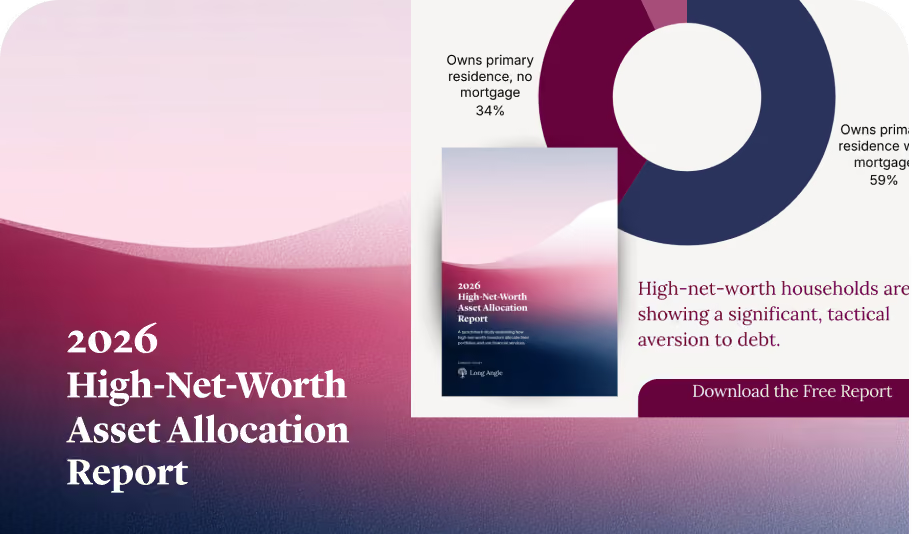
2026 High-Net-Worth Asset Allocation Report
See how high-net-worth investors with an average net worth of $17M are allocating across public equities, private markets, real estate, bonds and cash. Based on benchmark data from 230+ respondents.
The Modern FIRE Landscape
The concept of FIRE (Financial Independence, Retire Early) began as a minimalist movement. Early adopters used frugality, index investing, and low-cost living to exit traditional careers decades before the standard retirement age.
About two decades later, that same idea has evolved into something much broader, and more nuanced, for high-net-worth households. Within the Long Angle community, the conversation is less about escaping work altogether and more about reaching optionality, or the point where money no longer dictates decisions.
At Long Angle, members typically approach FIRE through the lens of stewardship, not scarcity. Their goal is to have enough to live with autonomy while continuing to pursue meaningful projects, entrepreneurship, or philanthropy. For some, that threshold might be $5–10 million in liquid net worth. For others, it’s $25–50 million, depending on lifestyle and intergenerational goals.
But the thread running through nearly every comment is consistent: the closer one gets to “enough,” the blurrier it becomes.
How Close Are Members to Their Number?
A recent Long Angle benchmark poll asked members how close they were to their FIRE target. Nearly half (45%) said they’ve already reached their number, while about one-third said they needed roughly 1–2× their current wealth to feel secure. Another 16% said they needed 2–3×.
That pattern of wanting “twice what I have now” appears across income levels. A Harvard study on wealth satisfaction found that even households with $10 million or more believed they would feel completely secure with about double their current assets.
Inside Long Angle, members described a similar mindset. “My number used to be $3M, then $7M,” one investor noted. “Now I’m around $15M and still don’t feel done because life keeps expanding.” Another added, “I’m financially independent on paper, but I don’t feel independent emotionally.”
For many wealthy individuals, financial independence is a spectrum, not a switch. The math can be precise; the feeling rarely is.
Why the Goalposts Keep Moving
Few topics generate as much introspection as the question of “enough.” The FIRE number tends to inflate quietly, not only because of lifestyle upgrades, but because of the subtle human instinct to insure against uncertainty.
Several members pointed to hedonic adaptation, the psychological process that normalizes comfort. A $5M net worth that once seemed life-changing becomes a baseline once achieved. Larger homes, private schools, travel expectations, or health considerations all accumulate over time.
Others cited longevity and inflation risk as drivers of moving targets. With longer lifespans and unpredictable healthcare costs, many investors build buffers not out of greed, but prudence. “It’s not about the number,” one member said. “It’s about how many unknowns it can absorb.”
There’s also a social dimension. Comparing notes with other high-achieving peers can shift what feels “normal.” When everyone around you is still in motion — scaling companies, buying second homes, funding startups — contentment takes intentional effort.
As one investor summarized: Enough stops being a number and starts being a mindset.
From Spreadsheet to Sufficiency
Traditional FIRE math relies on a few well-known frameworks: the 4% rule (spend 4% of your portfolio annually), or the more conservative 3% rule used for longer retirements. But among Long Angle members, few treat the spreadsheet as gospel. Instead, they approach sufficiency from multiple angles:
- Cash-flow independence: focusing on recurring income from real estate, business interests, or private credit.
- Permanent capital mindset: living off yield while preserving principal indefinitely.
- Tax-aware sequencing: managing withdrawal timing, Roth conversions, and deferred gains to extend portfolio life.
Still, the underlying theme is less about perfect optimization and more about confidence. Many noted that the psychological leap from “work optional” to “fully independent” happens later than the math suggests.
“I could stop working now,” one member admitted, “but it feels safer to wait until the markets are less volatile.” Another added, “It’s easier to keep playing the game than declare it won.”
That tension between financial freedom and emotional readiness runs through nearly every FIRE discussion, not only at Long Angle, but across wealth psychology research.

Redefining Risk and Lifestyle
As portfolios grow, so does the challenge of defining “risk.” The traditional notion — volatility of returns — gives way to risk of regret. Many Long Angle members discussed rebalancing their lifestyle portfolios, not just their asset allocations. They questioned whether new expenses truly enhanced happiness, or whether they were hedging against discomfort.
Some began experimenting with geographic arbitrage: moving part-time to lower-cost regions such as Portugal, Costa Rica, or the U.S. mountain west. The goal being to stretch lifestyle value without expanding budgets. Others emphasized purpose-driven spending: investing in health, travel, and experiences that produce satisfaction rather than fleeting luxury.
This redefinition of risk ties back to sufficiency: security isn’t only about protecting assets, but about aligning spending with what matters. As one member noted, “I don’t need more money — I need more time spent well.”
Life After FIRE
Reaching the number doesn’t mean the journey ends. Many members described the post-FIRE stage as a psychological recalibration. The first realization is typically that structure, challenge, and contribution don’t disappear just because employment does. One member shared that they thought they wanted to retire at 45. Instead, they started a nonprofit because they didn’t need the paycheck. They said they needed the purpose of getting up every day to help others and work toward something meaningful.
Another described how time abundance can feel as disorienting as financial scarcity: “Without a reason to get up, I lost momentum. So I built one.” These reflections align with broader studies on post-career satisfaction: purpose is the new dividend. The happiest early retirees tend to channel their energy into mentorship, philanthropy, and creative work.
For Long Angle members, that has meant shifting from accumulation to contribution, leveraging their resources to support causes, fund startups, or teach the next generation.
The Prevailing Perspective
Across hundreds of community replies, one throughline emerged: “Enough” is more emotional than numerical.
Many members acknowledged that their FIRE numbers have doubled or tripled since they began tracking them. But the maturity of the conversation has shifted from chasing net worth to calibrating purpose. Success, in this context, looks less like early retirement and more like financial alignment, where the portfolio supports values, relationships, and curiosity rather than endless accumulation.
As one member summarized: FIRE isn’t about never working again. It’s about never being forced to do something just for money.
When “Enough” Stops Being a Number
The FIRE number isn’t just about personal consumption. It’s also about what remains after them.
As wealth compounds, the definition of “enough” can expand to include intergenerational goals: funding children’s education, supporting aging parents, creating charitable vehicles, or building durable family capital that extends beyond one lifetime. Several members noted that once basic independence was secured, legacy planning quietly became the dominant variable in their FIRE math.
This introduces a different kind of flexibility. Instead of optimizing for the earliest possible exit from work, some members deliberately slow down accumulation in favor of de-risking, simplifying structures, or designing trusts and gifting strategies that reduce future friction. Others described FIRE not as a destination, but as a platform, a base level of security that allows thoughtful decisions over decades rather than quarters.
In that sense, “enough” becomes less about stopping and more about sustaining. Sustaining autonomy, relationships, health, curiosity, and impact across a long time horizon. The portfolio becomes a stabilizer for life’s uncertainty and an enabler of intentional choices.

Final Thoughts
Numbers matter. Withdrawal rates matter. Asset allocation matters. But none of them fully capture what members are really chasing. What they’re after is resilience, optionality, and the ability to say no, to wait, to pivot, and to choose meaning over momentum.
For some, that happens at $5 million. For others, it doesn’t arrive until $25 million or more. And for many, it never locks into a single figure at all. Instead, “enough” becomes a relationship with risk, time, and self-knowledge.
Frequently Asked Questions
What is the average FIRE number among high-net-worth investors?
The median target shared within the Long Angle community is roughly $20 million-plus, though answers vary widely depending on family size, spending habits, and location.
Why do FIRE goals rise over time?
Inflation, lifestyle expansion, and shifting definitions of safety push the target upward. Even those with eight-figure portfolios admit they’d feel fully secure with “about twice what I have.”
How do members calculate their FIRE numbers?
Most start with annual spending and apply a conservative 3–4% withdrawal rate, adjusting for taxes, healthcare, and legacy goals. Others focus on achieving recurring income streams equal to or greater than their expenses.
Can FIRE be achieved below $10 million?
Yes, especially for those practicing lean or “chubby” FIRE with modest spending, geographic flexibility, or income-producing assets. Some Long Angle members described successful independence in the $3–8 million range.
What happens after reaching the number?
Many re-enter work by choice, typically through entrepreneurship, investing, or philanthropy. The emphasis shifts from earning returns to creating meaning.
Ready to connect with like-minded peers navigating similar wealth decisions?
Join Long Angle, a private community where successful entrepreneurs, executives, and professionals collaborate on wealth strategies, investment opportunities, and life's next chapter.
More From Long Angle
Beyond Wealth Newsletter
Navigating Wealth Podcast
Research & Studies
Alternative Investment Education
Blog