Written by Scott Nixon


Hampton Membership: Cost, Requirements and Is It Worth It?
Hampton Membership: Cost, Requirements and Is It Worth It?
Hampton costs $15,000 a year plus a $2,500 initiation fee. Who qualifies, who it fits, and what exited founders and full-time investors use instead.
Scott Nixon
Hampton membership costs $15,000 a year plus a $2,500 initiation fee, or $17,500 in the first year, and it is for actively operating founders, CEOs and owners of digital or tech-enabled companies in one of its 18 chapter cities. Applicants also need $3 million in revenue, $3 million raised or a prior exit above $10 million. It is worth it for a founder building now who wants a monthly in-person board. Founders who have sold and stepped back, and full-time investors, fall outside it; TIGER 21, Post Exit Founders and Long Angle are built for them.
Key Takeaways
- Hampton publishes $15,000 a year plus a non-refundable $2,500 initiation fee. Annual dues are refundable within 45 days if you attend your Commitment Call.
- The role test comes first: Hampton is for actively operating founders, CEOs and owners of digital or tech-enabled companies. A prior exit above $10 million meets the financial test but does not replace the operating requirement.
- Core groups of about 8 to 10 meet in person for about three hours a month, ten months a year, with a professional moderator. Core is never virtual.
- Exited founders who have stepped back, full-time investors and operators outside tech are better served elsewhere: Post Exit Founders, TIGER 21, Long Angle, EO, YPO or Vistage.
- Long Angle tests what you hold rather than what you run. It is free to join above $3 million in household assets; optional Trusted Circles cost $4,500 a year.
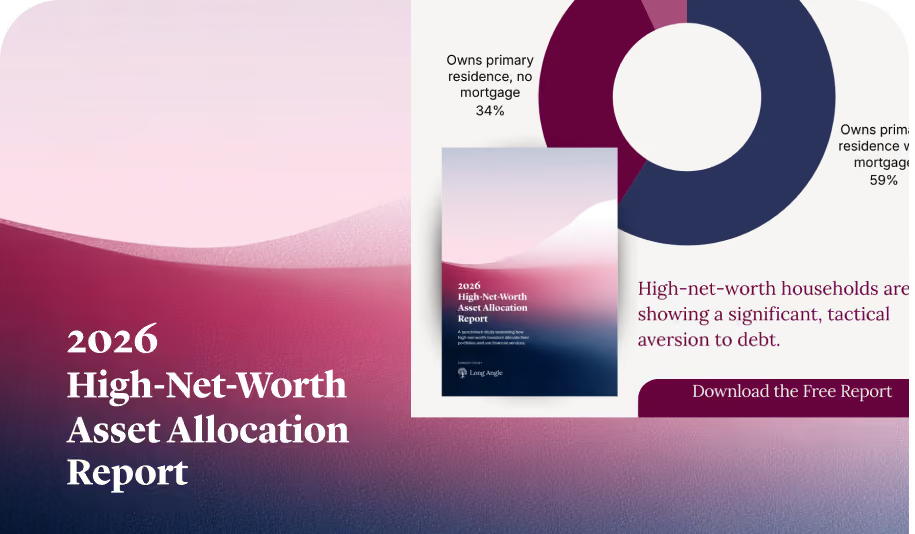
2026 High-Net-Worth Asset Allocation Report
See how high-net-worth investors with an average net worth of $17M are allocating across public equities, private markets, real estate, bonds and cash. Based on benchmark data from 230+ respondents.
Hampton at a Glance: Cost, Eligibility, Format and Commitment
Hampton is a private community for founders and CEOs of high-growth, tech-enabled companies, built around a monthly in-person Core group. Every figure below is Hampton's own, from its own site.
| What Hampton publishes | |
|---|---|
| Annual dues | $15,000 a year, billed annually |
| Initiation fee | $2,500, non-refundable |
| First-year cost | $17,500, before any paid retreats or overnight events |
| Refund | Annual dues 100% refundable within 45 days of the membership start date, if you attend your Commitment Call |
| Who qualifies | Actively operating founders, CEOs or owners of digital or tech-enabled companies |
| Financial test (one of three) | More than $3M in revenue, more than $3M raised in venture capital, or a previous exit above $10M |
| Location | Must live in one of 18 chapter cities in the US, Canada and London; elsewhere, wait for a launch |
| Vetting | Screen, interview, member veto, final approval by the founders; about 2% accepted (Hampton's figure) |
| Format | Core group of about 8 to 10 founders with a professional moderator, in person in your city |
| Commitment | About three hours a month, skipping August and December; chapter events, retreats and Slack optional |
| Placement | Core group placement within about 90 days of joining |
Source: joinhampton.com FAQ, home page, Explore Membership, Hampton vs. YPO, refund policy and post-download pages, checked October 6, 2026. The $15,000 price appears on Hampton's comparison pages and the $2,500 fee on its post-download page; the FAQ itself gives no amount. Hampton describes group size as about 10 on some pages and about 8 plus a moderator on others.
Two rows decide most applications before cost comes up: who qualifies and where you live. The rest of this page works through both.
What Hampton Costs in the First Year
Hampton costs $17,500 in the first year: $15,000 in annual dues and a $2,500 initiation fee that covers onboarding, Core group matching and setup. From the second year, the dues alone apply.
Three details are worth knowing before you pay. The dues are refundable in full within 45 days of your membership start date, as long as you attended your Commitment Call; the initiation fee is not refundable. Some retreats and overnight events cost extra, which Hampton says it runs at break-even. And once invited, you have ten days to accept and pay.
Hampton says many members deduct the dues as a business expense. Whether that works for you depends on how you hold the company and what the membership is for, so it is a question for your CPA, not an assumption to price in.
Hampton's Requirements, Read Closely
Hampton's requirements have four parts, and the first one is the one most people skim past: you must be an actively operating founder, CEO or owner of a business.
The second is the company. Hampton's first screen checks that the business is in tech, internet or a related space, and every Core member runs a tech, internet or digital-first company. The third is a financial test, any one of three: more than $3 million in revenue, more than $3 million raised in venture capital, or a previous exit above $10 million. The fourth is location: you must live in one of its 18 chapter cities, which include New York, San Francisco, Los Angeles, Chicago, Austin, Toronto and London.
The exit test is the one most often misread. A founder who sold for more than $10 million meets the financial threshold, but still has to be operating a business now. It is a route in for someone who has exited and started again, not for someone who has exited and stopped.
Clearing all four gets you an interview, not a seat. Hampton's membership team screens the application, interviews the candidate, gives current members a chance to veto, and leaves the final call to its two founders. Hampton says about 2% of applicants are accepted.
Who Hampton Fits
Hampton fits a founder or CEO who is building a tech-enabled company now, lives in a chapter city, and wants the same small group of operators across the table every month.
Core groups are matched on what Hampton calls a Mirror, Mentor, Mentee model, mixing company stage, age, family, wealth and experience rather than industry. A typical session runs about three hours. Hampton lists portfolio reviews of members' own net worth among its Core exercises, so personal wealth is in scope as well as the company. Across the year that is ten meetings, roughly 30 hours, plus whatever chapter dinners, retreats and Slack you choose to add.
Hampton reports more than 1,000 members, and says its members' companies average $23 million in revenue. If you are in that range, operating, and in one of its cities, the format is built around you.
Who Hampton Does Not Fit, and What They Use Instead
Hampton does not fit people whose main work is no longer running a company, people running companies outside tech, or people who cannot meet in person in one of its cities. Each has a closer match.
| If you are | Why Hampton does not fit | Where to look instead |
|---|---|---|
| A founder who sold and stepped back | Hampton is for actively operating founders; the $10M exit test does not replace that | Post Exit Founders (exited founders; price not published); TIGER 21 at $20M+ in investable assets ($34,000 a year plus $5,000); Long Angle, free above $3M, with a $4,500-a-year Post-Exit Trusted Circle |
| A full-time investor or executive who does not own the company | Hampton admits founders, CEOs and owners | TIGER 21; Long Angle; YPO if you are the top operational leader of a qualifying company and under 45 |
| Running a company outside tech | Hampton admits digital and tech-enabled companies only | EO (founders and owners from $1M revenue); YPO; Vistage |
| Outside Hampton's 18 cities, or wanting to meet online | Core groups are in person only | Long Angle Trusted Circles over Zoom; TIGER 21 Global Groups online; Post Exit Founders, in person and remote; EO's virtual chapters |
| Below $3M in revenue and $3M raised | Below each of Hampton's financial tests | EO, from $1M in annual revenue |
Source: each group's own published eligibility, price and format pages, checked October 6, 2026: joinhampton.com, pef.co, tiger21.com, ypo.org, eonetwork.org, vistage.com, and longangle.com /apply and /trusted-circles. TIGER 21 figures are North American dues from April 1, 2026. Meeting a test does not guarantee admission; every group here vets applicants.
The first two rows are the ones Hampton's own criteria rule out most often, and they are the people who most often ask about it.
The founder who has sold. Once the company is gone, the question usually changes from how to grow it to what to do with what it produced. Post Exit Founders admits only founders who have exited. TIGER 21 and Long Angle test what you hold rather than what you run, so check the after-tax figure, not the sale price, against each threshold. Peer groups after selling a business works through that check group by group.
The investor or executive. A full-time investor, or a senior executive who is not the founder, CEO or owner, does not meet Hampton's role test at any level of wealth. TIGER 21 admits entrepreneurs, investors and executives from $20 million in investable assets; Long Angle admits them from $3 million in household assets. For how the wider field compares, see TIGER 21 alternatives and YPO alternatives for former CEOs.
The Money Questions an Operating Founder Brings to Peers
Hampton is built around the company. An operating founder's own balance sheet raises a second set of questions, and among Long Angle members they come up long before any sale.
The first is concentration. In Long Angle's 2026 asset allocation research, respondents whose primary source of wealth is entrepreneurship held 27% of their investment portfolio in private company equity, against 11% for other respondents, and 35% in public equities, against 61%. Founders and owners held 61% of their private and alternative investments in their own company. Most members would not choose that exposure in a public stock: in a December 2025 member poll, 60% of respondents said the most they would hold in any single stock and still sleep at night is under 15%.
The second is liquidity while still running the company. Member threads since 2024 return to the same decisions: whether to sell now or keep building, a private equity buyer or a strategic one, how much to take off the table through a secondary sale or a recapitalization while staying in the CEO seat, and how to structure the company years ahead of an exit, including qualified small business stock (QSBS) planning. When an operator asks whether to sell, the replies often come from members who already have.
After the sale, the questions turn to who manages the proceeds.
Sources: Long Angle, 2026 High-Net-Worth Asset Allocation Report, survey of 233 members, December 2025 to January 2026; portfolio shares exclude home equity, and the 61% is a share of the private and alternatives portfolio. Long Angle member poll: single-stock comfort, 286 respondents, posted December 3, 2025, read October 6, 2026 and still open. Respondents are Long Angle members who chose to answer and are not a representative sample of high-net-worth households.
Hampton and Long Angle Answer Different Questions
Hampton tests the company you run; Long Angle tests what you hold. Long Angle is a free, vetted community of entrepreneurs, executives and investors with more than $3 million in household assets, including illiquid assets such as rollover equity but not a primary residence. Every applicant agrees to a no-solicitation policy.
Most of what members do happens in the community itself: comparing notes on concentration, allocation, private investments, advisors and their fees, tax, estate planning and family decisions. For a fixed group, Trusted Circles put six to eight members, matched by life stage and net worth, with a professional moderator for three hours a month over Zoom. Circles cost $4,500 a year with a twelve-month minimum, and include Entrepreneurs and Post-Exit circles.
Some founders use both: Hampton for the company, Long Angle for the decisions the company's success creates. For what households at different wealth levels hold, see Long Angle's 2026 High-Net-Worth Asset Allocation Report.
Long Angle is the wrong fit if what you want is an in-person room of tech founders working on their companies every month. Hampton is built for that.
Is Hampton Worth It?
The answer: Hampton is worth $17,500 in the first year to a founder who passes three checks, and hard to justify for anyone who fails one.
First, you are operating a tech-enabled company now, not planning the next one or managing the proceeds of the last. Second, you live in a chapter city and can give ten in-person sessions a year. Third, the peers you need most are other operators working through hiring, fundraising, acquisitions and growth. If all three hold, the format, the price and the 45-day refund window are clear enough to test it.
If one fails, compare on the reason. Before you apply, ask Hampton for the full first-year figure in writing, including the initiation fee and any events you expect to attend, and how long Core placement is running in your city. For nine groups side by side, see high-net-worth peer advisory groups.
Final Thoughts
Start with Hampton's first requirement, not its price. If you are operating a tech-enabled company in one of its cities and want a monthly room of founders doing the same, Hampton is built for you, and its refund window lets you test it. If you have sold and stepped back, invest full time, or run a company outside tech, the better match is elsewhere: Post Exit Founders or TIGER 21 for life after the exit, EO, YPO or Vistage for other operators, and Long Angle, free from $3 million, for the wealth decisions that follow.
Frequently Asked Questions
How much does Hampton cost?
Hampton publishes $15,000 a year in dues plus a $2,500 initiation fee, so $17,500 in the first year. Annual dues are refundable within 45 days if you attend your Commitment Call; the initiation fee is not. Some retreats and overnight events cost extra.
What are the requirements to join Hampton?
You must be an actively operating founder, CEO or owner of a digital or tech-enabled company, live in one of Hampton's 18 chapter cities, and meet one financial test: more than $3 million in revenue, more than $3 million raised, or a previous exit above $10 million. Applicants are then interviewed and can be vetoed by members.
Can I join Hampton after selling my company?
Only if you are running a business again. A previous exit above $10 million meets one of Hampton's financial tests, but Hampton is for actively operating founders, CEOs and owners. Founders who have stepped back look at Post Exit Founders, TIGER 21 or Long Angle.
Does Hampton have a virtual option?
No. Hampton places members only in in-person Core groups in its chapter cities, and if it is not in your city yet you wait for a launch. Long Angle's Trusted Circles meet over Zoom, and TIGER 21's Global Groups meet online.
What is the difference between Hampton and Long Angle?
Hampton tests the company you run: tech-enabled founders and CEOs, $17,500 in the first year, in-person Core groups. Long Angle tests what you hold: free to join with more than $3 million in household assets, excluding a primary residence, with optional $4,500-a-year Trusted Circles over Zoom.
Hampton is built for the company. The wealth decisions need peers too.
Long Angle is a free, vetted community of entrepreneurs, executives and investors with more than $3 million in household assets, comparing notes on allocation, advisors, tax and family decisions.
More From Long Angle
Beyond Wealth Newsletter
Navigating Wealth Podcast
Research & Studies
Alternative Investment Education
Blog