Written by Scott Nixon


Peer Groups After Selling a Business: Founder-Only Groups vs. Peers From Every Path
Peer Groups After Selling a Business: Founder-Only Groups vs. Peers From Every Path
Founder-only groups (Post Exit Founders, Hampton) vs. peers from every path (TIGER 21, Long Angle): cost, eligibility and who each suits after an exit.
Scott Nixon
Peer groups for people after a liquidity event come in two kinds: groups made only of founders, and groups of peers at a similar level of wealth who got there different ways. Post Exit Founders admits founders who have exited, and Hampton is for founders and CEOs still running a company. TIGER 21, at $20 million in investable assets, and Long Angle, free to join with more than $3 million in household assets, admit entrepreneurs, executives and investors alike. Long Angle's optional Trusted Circles, at $4,500 a year, include founder-specific groups such as Post-Exit as well as mixed groups.
Key Takeaways
- Post Exit Founders and Hampton admit only founders: Post Exit Founders those who have exited, Hampton those actively running a business now.
- TIGER 21 and Long Angle admit entrepreneurs, executives and investors, so a founder who has sold sits with peers who built wealth other ways.
- TIGER 21 requires $20 million in investable assets and costs $34,000 a year plus $5,000 to join in North America. Hampton costs $15,000 a year plus $2,500.
- Long Angle is free to join with more than $3 million in household assets. Its optional Trusted Circles cost $4,500 a year and include founder groups and mixed groups.
- After a sale or an IPO, founders and employees with equity face the same problem: too much of their wealth in one company.
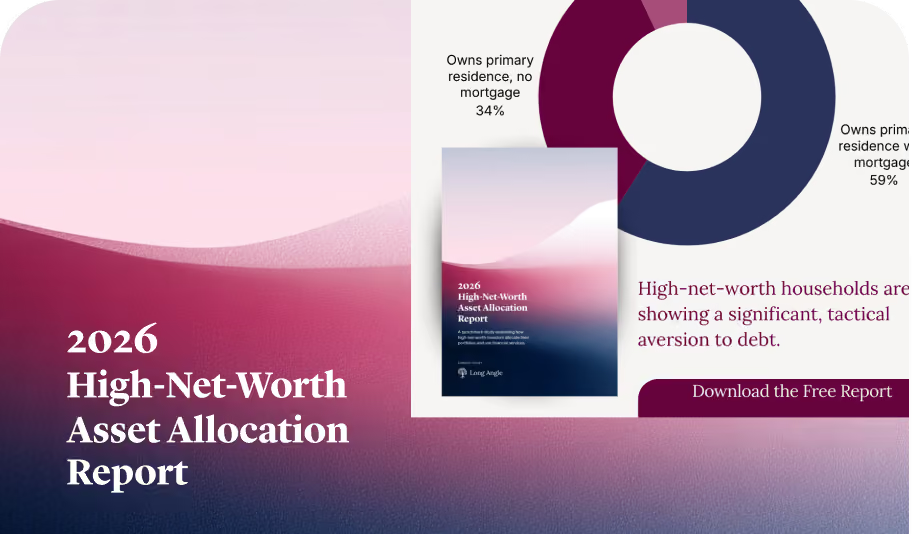
2026 High-Net-Worth Asset Allocation Report
See how high-net-worth investors with an average net worth of $17M are allocating across public equities, private markets, real estate, bonds and cash. Based on benchmark data from 230+ respondents.
Post-Exit Peer Groups Compared
The four groups differ most on who they admit and how much of your calendar they expect. Three of the four run small, moderated groups that meet monthly.
Source: each group's own published pages, checked October 6, 2026: pef.co and its terms of service; tiger21.com home page, membership FAQ, membership qualifications, Global Groups and code of conduct; joinhampton.com home page, FAQ, Hampton vs. YPO page and membership guarantee page; longangle.com /apply, /faq and /trusted-circles. TIGER 21 raises dues each April by at least CPI.
Two Kinds of Room: Founders Only, or Peers From Every Path
The first decision after a liquidity event is which kind of room you want. Post Exit Founders and Hampton admit founders only. TIGER 21 and Long Angle admit people at a similar level of wealth whatever path got them there.
A founder-only room offers a shared identity: everyone has built something, and at Post Exit Founders everyone has also handed it over. That matters when the open question is who you are without the company. A room built around wealth offers a wider set of answers to the decisions an exit creates, such as how to allocate the proceeds, which advisors to trust, what to do about tax and how to talk to family. A founder who has sold faces those decisions alongside executives, investors and professionals who have faced them too.
Source: published eligibility and circle types, checked October 6, 2026. Meeting a test does not guarantee admission; every group here vets applicants.
Check What You Hold After Tax, Not the Sale Price
Asset-based tests count what you hold, not what the company sold for. A $20 million sale clears TIGER 21's $20 million bar only if that much reaches you after taxes, transaction costs, debt, other shareholders, and any escrow or earnout still outstanding. Those can take a large share of a headline price, so work out the after-tax figure with your CPA before you apply. Long Angle counts household assets, including illiquid ones such as rollover equity, but not your home. Hampton's exit test is a financial threshold, not a route in for someone who has stopped operating.
For what households at different wealth levels hold once the money is liquid, see Long Angle's 2026 High-Net-Worth Asset Allocation Report. The financial sequence after a sale, from tax to advisors, is covered in what to do after selling your business.
After a Sale or an IPO, the Shared Problem Is Concentration
Founders are not the only people a liquidity event leaves concentrated. In Long Angle's 2026 asset allocation research, founders and owners held 61% of their private and alternative investments in their own company, and employees with equity held 67% in employee shares.
That is why a room organized by wealth rather than job title is useful after an exit. An executive working down a position in employer stock faces many of the same decisions as a founder working down the proceeds of a sale: what to diversify into, how fast, and who to ask.
Source: Long Angle, 2026 High-Net-Worth Asset Allocation Report, survey of 233 members, December 2025 to January 2026. Respondents are Long Angle members and are not a representative sample of high-net-worth households. Shares are of the private and alternatives portfolio.
Post Exit Founders
Post Exit Founders is built only for people who have already sold. Every member has financially exited a company they founded, and the group describes itself as the largest vetted community for that situation, with more than 6,000 founders across 30+ chapters.
Its forums put about ten founders together each month with a professional facilitator, in person or remote. It does not publish a price, a minimum exit size or an attendance rule; its terms describe a 30-day free trial before a paid subscription begins. Ask for all three before you commit. It fits a founder whose main question is what to do next, and who wants to work through it with people who have handed over the keys too.
TIGER 21
TIGER 21 is a peer group for entrepreneurs, investors and executives whose main job is now stewarding wealth, and it began with a liquidity event: it was founded in 1999 by an entrepreneur seeking objective advice after a major liquidity event. Members need $20 million in investable assets or qualifying net worth, excluding personal-use assets, and the group runs a post-liquidity event program.
The format is the most demanding of the four: groups of up to 15 meeting eleven times a year for a full day, attendance at eight or more of those meetings, and a Portfolio Defense in the first year, where each member presents their investment portfolio for the group to challenge; later presentations cover topics the member and Chair choose. Members who don't live near a chapter can join a virtual Global Group, which meets online twelve times a year. Dues are $34,000 a year plus a $5,000 initiation in North America. For someone well above $20 million after tax who wants a standing personal board, that structure is the point. A fuller comparison is in TIGER 21 vs. YPO.
Hampton
Hampton describes itself as being for "actively operating founders, CEOs, or owners of businesses," specifically of digital or tech-enabled companies. Applicants meet one of three financial tests ($3 million of revenue, $3 million raised, or a prior exit above $10 million) and must live in a chapter city. The exit test does not replace the operating requirement, so Hampton suits a founder who has started or is running another company, not one who has stepped back.
Its Core groups meet in person for about three hours a month, skipping August and December, with a professional facilitator; placement in a group takes about 90 days. Hampton publishes a price of $15,000 a year, and a $2,500 initiation fee on its membership guarantee page. Hampton reports that its members' companies average $23 million in revenue. EO vs. Hampton covers the operating side in more depth.
Long Angle
Long Angle is a free, vetted community for entrepreneurs, executives, investors and professionals with more than $3 million in household assets, including illiquid assets and excluding a primary residence. The community is deliberately mixed by professional background, so a founder who has sold sits alongside executives, high earners and real estate investors making the same allocation, tax and advisor decisions. Applicants agree to a no-solicitation policy: members don't pitch services or investments to each other.
Most of what members do happens in the community itself, comparing notes on allocating the proceeds, choosing advisors, tax, estate planning and what comes after the job. Trusted Circles are optional: six to eight members matched by life stage and net worth, meeting for three hours a month over Zoom with a professional moderator, at $4,500 a year with a twelve-month minimum. Members can choose a founder room, such as the Post-Exit or Entrepreneurs circle, or a mixed one, such as High-Earners, Real Estate Investors, FIRE with Young Families, Retired Early or UHNW+ ($25M+).
One member described what that room was useful for: "I got excellent feedback on the decision to sell my company, how to think about rollover equity, negotiating with the buyer, and thinking about reallocating the proceeds." Kwiri Yang, an eight-time founder, put it this way: "There is a power in being in such an intimate environment, a safe container where you can drop in with peers who relate to your life experiences, all guided by a facilitator."
If you want a full-day, in-person meeting every month with a ritual like the Portfolio Defense, TIGER 21 is built for that and Long Angle is not.
Why CEO Groups Fit Less Well After a Sale
YPO and EO are built around the company you run, so their tests stop fitting when you no longer run one. YPO requires applicants under 45 who are the top operational leader of a company meeting its revenue and employee thresholds. EO requires a founder or owner of a business with at least $1 million in annual revenue.
EO does keep members who sell: once a sale is verified, its procedures treat the member as qualified for future renewals. A founder who was never a member cannot join on an exit alone. Vistage, the third group usually named, is built around a paid Chair who coaches business leaders monthly, which suits a founder going back into an operating role. See is Vistage worth it and YPO requirements.
Other Groups You Will See Named
Lists and AI answers on this question also name Founders Lodge, Beyond The Finish Line and INSEAD's Post-Exit Entrepreneurs Retreat. We have not compared their terms here. Treat any figure you see for them, or for the four above, as worth checking on the group's own site; several third-party lists still carry older prices.
Final Thoughts
Decide which room you want before you compare brands. If you want founders only, Post Exit Founders is built for life after the exit and Hampton for founders who are building again. If you want peers at your level of wealth from any path, TIGER 21 offers a formal board above $20 million, and Long Angle is free to join above $3 million, with founder and mixed small groups for members who want the same faces every month.
Frequently Asked Questions
Do I qualify for TIGER 21 if I sold my company for $20 million?
Not automatically. TIGER 21 requires $20 million in investable assets or qualifying net worth, excluding personal-use assets. It counts what you hold, so taxes, transaction costs and any proceeds still in escrow or earnout come off the sale price first.
Can I join Hampton after selling my company?
Only if you are running a business again. Hampton is for actively operating founders, CEOs and owners. A prior exit above $10 million meets one of its financial tests, but not on its own.
Can I join YPO or EO after selling my company?
Existing EO members who sell can stay members once the sale is verified. A new applicant to either needs to run a qualifying company: YPO asks for the top operational leader under 45, and EO for a founder or owner with $1 million or more in revenue.
Is Long Angle only for founders?
No. Long Angle is for entrepreneurs, executives, investors and professionals with more than $3 million in household assets, excluding a primary residence. Membership is free. Optional Trusted Circles cost $4,500 a year and include founder groups such as Post-Exit and mixed groups.
How much does Post Exit Founders cost?
Post Exit Founders does not publish a price on its site. Its terms describe a 30-day free trial, then a paid subscription that renews automatically.
Most of what follows an exit is a decision someone here has made.
Long Angle is a free, vetted community of entrepreneurs, executives, investors and professionals with more than $3 million in household assets, comparing notes on allocation, advisors, tax and what comes next.
More From Long Angle
Beyond Wealth Newsletter
Navigating Wealth Podcast
Research & Studies
Alternative Investment Education
Blog