Written by Scott Nixon


How High Earners Reduce Taxable Income: What Members Report
How High Earners Reduce Taxable Income: What Members Report
How high earners reduce taxable income: what 351 Long Angle poll respondents use, which accounts lower this year's tax, and who is moving for tax reasons.
Scott Nixon
High earners mostly reduce taxable income through workplace and health accounts, and much of what they report doing shifts tax to later rather than cutting this year's bill. In a June 2026 Long Angle poll of 351 respondents on FIRE tax strategies (select all that apply; self-selected, not a representative sample), 80% maxed pre-tax 401(k) or 403(b) contributions and 57% maxed an HSA, the two that lower current-year taxable income. The next three, backdoor Roth (54%), 529 plans (40%) and mega backdoor Roth (37%), do not lower federal taxable income this year.
Key Takeaways
- Pre-tax 401(k) or 403(b) contributions lead: 80% of 351 respondents to a June 2026 Long Angle poll max them, and 57% max an HSA.
- Only two of the six most-used vehicles lower this year's federal taxable income. Roth routes and 529 plans change how later growth is taxed, and an ESPP is a purchase discount, not a deduction.
- 59% of respondents pair a current-year deduction with a Roth route, a hedge between paying tax now and later.
- 39% of 207 respondents to a May 2026 poll are considering a move in the next five years with tax in mind, mostly state to state.
- The polls are self-selected and FIRE-framed. Long Angle's 2026 benchmark survey (233 respondents) asked a different question and found 31% hold an HSA.
- This is general information, not tax advice. Confirm any strategy with a tax professional against current rules.
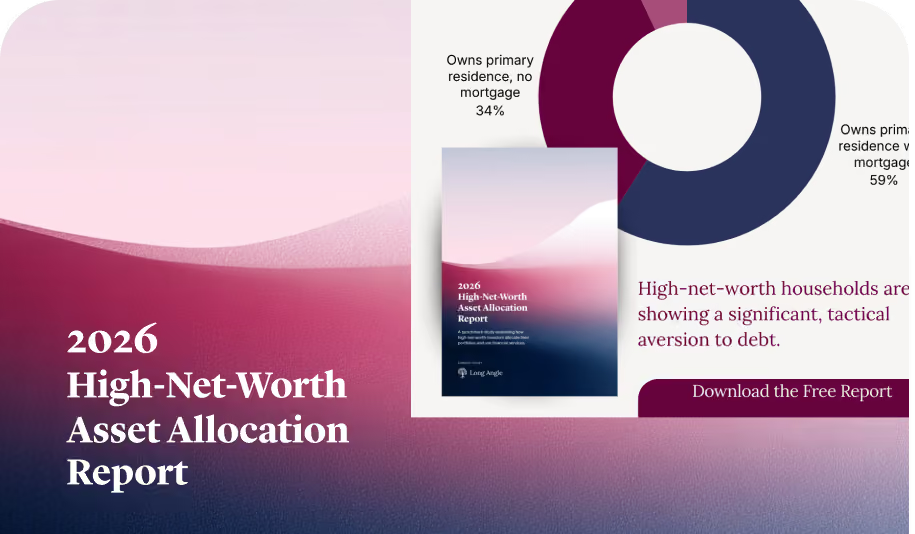
2026 High-Net-Worth Asset Allocation Report
See how high-net-worth investors with an average net worth of $17M are allocating across public equities, private markets, real estate, bonds and cash. Based on benchmark data from 230+ respondents.

What High Earners Report Using Most
High earners lean on the same short list of workplace and health accounts, and they use them thoroughly. In June 2026 Long Angle asked members which tax strategies they take advantage of, in a poll framed around FIRE (financial independence, retire early) planning. 351 answered, selecting all that applied.
| Vehicle (select all that apply) | % of respondents selecting | Respondents | Lowers this year's federal taxable income? |
|---|---|---|---|
| Pre-tax 401(k) or 403(b), maxed | 79.8% | 280 | Yes |
| HSA, maxed | 57.0% | 200 | Yes, for those eligible |
| Backdoor Roth IRA | 54.1% | 190 | No. Growth can come out tax-free later |
| 529 plan, maxed | 39.9% | 140 | Not federally. Some states allow a deduction |
| Mega backdoor Roth | 37.3% | 131 | No. Growth can come out tax-free later |
| ESPP discount capture | 17.9% | 63 | No |
| Other | 6.8% | 24 | Varies |
| None of these | 4.6% | 16 | Not applicable |
Source: Source: Long Angle member poll, "What FIRE tax optimization strategies do you take advantage of?", posted June 30, 2026, 351 respondents and 1,044 selections, latest vote August 6, 2026, read October 2026. Select all that apply, so shares are of respondents and sum past 100%. Self-selected: respondents are Long Angle members who chose to answer, not a representative sample of high earners; net worth and income are not linked to answers. The right-hand column is general information about how each vehicle works, not part of the poll.
Two things stand out. Almost everyone uses something: 96% of respondents chose at least one of the six named vehicles, and fewer than 5% chose none. And the list is not exotic. The most common answers are the accounts an employer or a health plan already offers, filled to the limit year after year.
The question was framed for people planning financial independence, so it was posed to, and answered by, members who think about this. Read the shares as what engaged high earners do, not as what every high earner does. The section on how to read these numbers covers the gap.
Only Two of the Top Six Lower This Year's Taxable Income
Most of what high earners report doing does not reduce this year's taxable income. It changes when, or whether, future growth is taxed. Of the six named vehicles, only pre-tax workplace retirement contributions and HSA contributions lower federal taxable income in the year you make them.
Backdoor Roth and mega backdoor Roth contributions go in after tax. Their value is that qualified withdrawals later, growth included, can come out tax-free. A 529 plan works the same way federally, with tax-free withdrawals for qualified education costs, although many states give a deduction or credit for contributions. An employee stock purchase plan buys company stock at a discount, but it is not a deduction.
Cut the poll that way and the pattern is clear.
| Combination | % of respondents | Respondents |
|---|---|---|
| At least one of the six named vehicles | 96% | 336 |
| Pre-tax 401(k) or 403(b), or an HSA, or both | 88.0% | 309 |
| Backdoor or mega backdoor Roth, or both | 65.0% | 228 |
| Both a current-year deduction and a Roth route | 59.0% | 207 |
| Three or more of the six named vehicles | 58.1% | 204 |
Source: Source: Long Angle analysis of the same poll (351 respondents, posted June 30, 2026, read October 2026). The six named vehicles exclude "Other" and "None of these". Self-selected: respondents are Long Angle members who chose to answer, not a representative sample of high earners; net worth and income are not linked to answers.
88% of respondents use at least one vehicle that lowers this year's taxable income, and 59% pair it with a Roth route. That pairing works as a hedge: some income is taxed now at a known rate, some is deferred, and the mix leaves room to choose later. The question for a high earner is rarely whether to use these accounts. It is how to split contributions between pre-tax and Roth, which our guide to Roth 401(k) vs. 401(k) for high-income earners walks through.
The HSA Is the Most-Used Account After the 401(k)
Among members who can open one, most treat the HSA as a long-term investment account rather than a spending account. Eligibility depends on being covered by a high-deductible health plan, which is why it is not universal. A separate Long Angle poll asked members directly.
| Are you growing an HSA? | Share of respondents | Respondents |
|---|---|---|
| Yes, invest the maximum every year and spend very little of it | 62.1% | 177 |
| Yes, but only whatever is left over each year | 6.7% | 19 |
| No, not eligible | 14.4% | 41 |
| No, not worth the hassle | 14.7% | 42 |
| Other | 2.1% | 6 |
Source: Source: Long Angle member poll, posted November 17, 2025, 285 respondents, single answer, latest vote September 6, 2026, read October 2026. Self-selected: respondents are Long Angle members who chose to answer, not a representative sample of high earners; net worth and income are not linked to answers.
Of the 244 respondents who did not report being ineligible, 72.5% invest the maximum each year and spend little of it, leaving the balance to grow for later medical costs. Contributions lower taxable income, and through payroll they generally avoid payroll taxes as well. The members who skip it mostly say it is not worth the hassle, which is a fair call for anyone whose health plan makes a high deductible a poor fit.
Roth Routes Trade a Deduction Now for Tax-Free Growth Later
High earners use Roth routes because their income is too high for a direct Roth IRA contribution and because they expect large pre-tax balances later. A backdoor Roth is a nondeductible traditional IRA contribution converted to a Roth IRA. A mega backdoor Roth uses after-tax contributions to a workplace plan, converted to Roth, and only works if the plan allows both steps.
Neither lowers this year's bill. Two details decide whether they work as intended. Existing pre-tax IRA balances can make part of a backdoor conversion taxable, and plan rules decide whether a mega backdoor is available at all. Both are worth confirming with whoever prepares your return before the first contribution.
The reason members bother is the other side of the 401(k) habit. Years of maximum pre-tax contributions can leave a traditional balance large enough that required distributions become their own tax problem, covered in are you contributing too much to your 401(k)?
Moving for Tax Reasons Is a Minority Plan
Changing where you live is the largest single lever on a high earner's income tax, and most members are not planning to pull it. A May 2026 Long Angle poll asked whether members are considering a move in the next five years with tax optimization in mind.
| Considering a move in the next five years with tax optimization in mind? | Share of respondents | Respondents |
|---|---|---|
| Yes, state to state | 25.6% | 53 |
| Yes, relocating abroad | 13.0% | 27 |
| Not considering | 61.4% | 127 |
Source: Source: Long Angle member poll, posted May 19, 2026, 207 respondents, single answer, latest vote July 28, 2026, read October 2026. Self-selected: respondents are Long Angle members who chose to answer, not a representative sample of high earners; net worth and income are not linked to answers.
39% are considering some move, mostly from one state to another. A move changes the state tax on future income, not on income already earned, and high-tax states can review a departure closely. Where your domicile sits, where you spend your time and where income is sourced all count. A move made for tax alone also trades against family, work and community, which is part of why most respondents say they are not considering one.
What Members Discuss Once the Accounts Are Full
Once the capped accounts are full, the conversations move to levers that depend on how income is earned. In Long Angle member discussions, a few themes recur.
Business income. Members with consulting, board or side-business income discuss entity choice and self-employed retirement plans, which can add pre-tax room beyond a single employer plan.
Real estate. Depreciation from rental property, and the strict rules that decide whether those losses can offset wages, come up often. Members treat the qualifying tests as the hard part, not the arithmetic.
Charitable giving. Giving appreciated stock instead of cash, and grouping several years of gifts into one through a donor-advised fund, are the common approaches. See our guide to charitable giving strategies.
Timing. Deferring compensation where a plan allows it, and planning around a one-time spike in income such as a vesting event or a fund distribution.
Members are also skeptical of arrangements sold mainly for the deduction. Promoter-organized charitable schemes and investments whose main appeal is a tax write-off draw the most pushback, and the usual advice in replies is that the tax benefit should not be the only reason to own something. For the levers that matter more as assets grow, such as concentrated positions and tax-loss harvesting, see high-net-worth tax strategies.
How to Read These Numbers
These are polls of Long Angle members who chose to answer, and that choice shapes the results. A tax-strategy poll framed around FIRE attracts members who use tax strategies.
Long Angle's 2026 High-Net-Worth Asset Allocation Report, a survey of 233 respondents fielded December 2025 to January 2026, asked a different question: which account types respondents hold. In that report, 31% of respondents held an HSA, 47% of parents held a 529 plan and 17% held a donor-advised fund. It is a different question and a different group of respondents, so the figures are not directly comparable with the polls above, but the gap is a useful caution. The polls show what engaged members do. The report, which also relies on members who chose to take part, points to lower adoption when the question is simply which accounts people hold. Full account and allocation results are in the 2026 High-Net-Worth Asset Allocation Report.
None of the polls records income or net worth beside the answer, so they cannot say how behavior changes with income. Contribution limits, income thresholds and state rules change every year, and nothing here is tax advice.
Final Thoughts
High earners cut taxable income mainly by filling the accounts they already have, and they use Roth routes to decide when the rest is taxed. The polls show that habit is close to universal among members who answer, and that the larger levers, where you live and how your income is earned, are pulled far less often.
If the capped accounts are full, the next step depends on your income, not on a list. This is general information, not tax advice; confirm any strategy with a tax professional against current rules and your own facts.
Frequently Asked Questions
What do high earners do to reduce taxable income?
Most max pre-tax workplace retirement contributions and an HSA. In a June 2026 Long Angle poll of 351 respondents, 80% maxed a pre-tax 401(k) or 403(b) and 57% an HSA. Beyond those, members discuss business income, real estate depreciation, charitable giving and timing.
Does a backdoor Roth reduce taxable income?
No. A backdoor Roth is funded with after-tax money, so it does not lower this year's taxable income. Its value is that qualified withdrawals later, including growth, can be tax-free. Existing pre-tax IRA balances can make part of the conversion taxable.
Is an HSA worth it for high earners?
For those eligible, most Long Angle members treat it as an investment account. In a November 2025 poll of 285 respondents, 62% invest the maximum each year and spend little of it. Eligibility requires a high-deductible health plan.
Do 529 contributions reduce taxable income?
Not for federal income tax. Many states offer a deduction or credit for contributions to a 529 plan, often only for that state's plan. Withdrawals for qualified education costs are tax-free.
How many high earners move states to cut taxes?
In a May 2026 Long Angle poll of 207 respondents, 25.6% were considering a state-to-state move in the next five years with tax in mind and 13.0% a move abroad. 61.4% were not considering one.
Are these poll results representative?
No. They are voluntary polls of Long Angle members who chose to answer, and a tax-strategy poll attracts people who use tax strategies. A broader 2026 Long Angle benchmark survey of 233 respondents found lower adoption, such as 31% holding an HSA.
How do you pressure-test a tax decision before you make it?
Long Angle is a vetted community of high-net-worth founders, executives and investors who share what they did, what it cost and whether it was worth the complexity.
More From Long Angle
Beyond Wealth Newsletter
Navigating Wealth Podcast
Research & Studies
Alternative Investment Education
Blog