Written by Ryan Morrison



Selling to Private Equity: What Founders Should Expect
Based on a Navigating Wealth conversation with Eric Wiklendt.
Selling to Private Equity: What Founders Should Expect
Founders often assume private equity means disruption and a strategic buyer means stability. After fifteen years buying middle-market manufacturing businesses at Speyside Equity, Eric Wiklendt explains why that assumption is frequently backwards — and what founders should understand about PE buyers, continuation vehicles, and exit structure before they are in the room.
Ryan Morrison
Most founders approaching an exit assume the same thing: private equity means disruption, headcount cuts, and a buyer who cares about nothing except the multiple. A strategic acquirer, by contrast, means stability, cultural fit, and a home where the business can keep growing. That framing is understandable. It is also frequently wrong. Eric Wiklendt has spent fifteen years buying and transforming middle-market manufacturing businesses at Speyside Equity, after selling one himself in 2011, and his view of what founders consistently misread about the PE acquisition process is worth understanding before you are across the table from one.
Key Takeaways
- PE firms use a leveraged buyout structure and plan to exit in five to seven years, not hold the business in perpetuity
- Strategics often pay more but typically make deeper operational changes post-close, including cutting teams and consolidating functions
- PE is frequently the better choice for founders who want their business and team to have a more stable post-close home
- The right buyer type depends on whether you want a full exit, a transition period, or an ongoing role in the business
- Continuation vehicles allow PE firms to extend ownership into a new fund structure while giving existing investors liquidity
- Specialist PE carries less risk than generalist PE because deep sector expertise enables better identification and mitigation of downside
2026 High-Net-Worth Asset Allocation Report
See how high-net-worth investors with an average net worth of $17M are allocating across public equities, private markets, real estate, bonds and cash. Based on benchmark data from 230+ respondents.

The Three Types of Exits Founders Should Know
Before choosing between a PE firm and a strategic acquirer, a founder needs to be honest about which exit type they are looking for. Eric identifies three:
A full exit means you are done. No ongoing role, no equity rolled into the new structure. You hand over the keys and move on. A transition exit means you stay involved for roughly six to twelve months to transfer institutional knowledge and relationships, then step away. A continuation vehicle orientation means the equity structure of the business changes but you remain primarily in charge of running it.
Which of these three you want shapes everything about which buyer is the right fit. A founder who wants a clean break may find a strategic the simplest path. A founder who wants to stay involved, or who cares what happens to the team they built, should understand how PE firms work before assuming they are the wrong choice.
Watch the Full Conversation
This article draws on a Navigating Wealth conversation with Eric Wiklendt, where we discuss what founders should expect from a PE acquisition, how to choose between a strategic and a financial buyer, and how continuation vehicles work from the inside. Watch the full episode for the broader discussion.
Subscribe on YouTube · Get weekly episode updates
Eric Wiklendt is Managing Director and Partner at Speyside Equity, a lower middle-market PE firm focused on manufacturing businesses. He started his career in consulting, worked in operations and at C-level roles at manufacturing companies, then sold one of them in 2011 before joining Speyside. He approaches private equity from an operator background, not investment banking, and that shapes how his firm thinks about acquisition and value creation.
Strategic Buyer vs. Financial Buyer: What the Difference Means for Founders
A strategic buyer acquires a business with the assumption of owning it in perpetuity; a financial buyer acquires it with a defined exit timeline and a debt-plus-equity structure. That difference in time horizon drives most of what follows.
Strategics model acquisitions using discounted cash flow and synergy assumptions. In theory, those synergies justify a higher purchase price. In practice, roughly six of seven corporate acquisitions fail to create value on a cash-on-cash basis. The two most common reasons: the acquirer overpays, and the synergies projected in the model prove harder to achieve in the first two years than the team expected.
The way most strategics realize their synergies is also worth understanding. They reduce SG&A headcount. They consolidate facilities. They replace the acquired company's suppliers with their own. They hand off the acquired sales force to their existing team. These are rational moves from an operating leverage standpoint. They are also the moves most likely to dismantle what the founder spent years building.
PE firms operate on a different logic. The leveraged buyout structure means they are using debt alongside equity to fund the acquisition, which creates a specific mandate: improve EBITDA margins to service the debt and build the equity value they will exit on, typically in five to seven years. They are not in the business of consolidating your operations into theirs. They are in the business of making the business more valuable as a standalone entity.
When Selling to a Strategic Makes More Sense
There are situations where a strategic is the right buyer, and a good PE firm will tell you so.
If you want a full exit and do not want to be involved after close, strategics are generally the cleaner path. They tend to pay a modest premium over what a PE firm will offer, because they can model synergies that a financial buyer cannot. If your primary goal is maximum liquidity and a clean break, that premium matters.
Strategics also tend to have rationally exuberant management teams who believe they can extract more value through integration than the math supports. That exuberance often shows up in the purchase price, which is good for the seller.
The honest tradeoff: your team, your culture, and the operating model you spent years building are at higher risk under a strategic. The integration playbook that generates the synergies is the same playbook that eliminates your sales team, your R&D function, and the processes that made the business work. A founder who sells to a strategic and expects the business to remain recognizable two years later is often surprised.
What to Expect From a PE Acquisition
PE firms are not uniform, and the background of the investment team matters more than founders often realize.
Most PE professionals enter the industry from investment banking. That shapes how they approach acquisition: the investment team closes the deal, the operating team takes over afterward, and the two operate with some degree of separation. This is not a criticism; it reflects where those professionals learned their craft. What it means for a founder is that the people who diligenced your business and negotiated the purchase agreement may not be the same people running the value creation process post-close.
Operator-background firms work differently. At Speyside, every partner has spent time inside manufacturing businesses, at the C-level or below. The investment and operating teams are the same people throughout the process. The diligence is more operationally detailed, the transition is more integrated, and the post-close value creation plan is built collaboratively before the deal closes.
For any PE buyer, the value creation arc typically runs in two phases. Phase one is operational improvement: process discipline, efficiency gains, EBITDA margin expansion. Phase two is commercial growth: organic top-line growth and, often, acquisitions. Understanding which phase the firm is focused on at entry, and how they plan to move from one to the other, is one of the most useful questions a founder can ask in diligence.
One structural feature worth understanding: LP accountability creates genuine walk-away discipline. PE firms cannot afford many losing investments. A bad deal is harder to explain at an annual LP meeting than a missed deal is. That accountability creates an incentive to walk away from transactions that feel uncomfortable, even after months of diligence and significant deal costs. For founders, this means that a PE firm that is still engaged late in the process generally has real conviction.
For founders who want to understand how private market allocations for high-net-worth investors typically change following a liquidity event, including how post-exit capital is typically redeployed, Long Angle's research covers the patterns in detail.
The Continuation Vehicle, Explained
A continuation vehicle is a structure where a PE firm sells an asset out of one fund into a new special-purpose vehicle, effectively selling the business to itself while recapitalizing the equity table.
Here is how it works. The original fund has held the business for several years. Value has been created, but there is more runway ahead. The existing investors (limited partners) have been in the fund for a long time and want liquidity. A continuation vehicle lets the GP sell the asset out of the old fund into a new one, giving existing LPs the choice to take their money off the table or roll their proceeds into the new structure.
The most important distinction is between a well-used continuation vehicle and a poorly used one. A well-used continuation vehicle reflects genuine remaining value creation opportunity: the business is performing well, the management team wants to continue, and the firm needs a recapitalized balance sheet to pursue the next phase of growth, often a series of acquisitions that the original cap structure cannot support. One Speyside portfolio company tripled its EBITDA organically in three years, then used a continuation vehicle to fund seven acquisitions in eighteen months and open five new manufacturing facilities.
A poorly used continuation vehicle is a liquidity management tool. It appears when a fund has not generated cash returns to investors and is using the vehicle to create the appearance of realized performance rather than a genuine ongoing value creation thesis.
For management teams, a continuation vehicle is typically a positive outcome. It triggers a change of control event, which pays out their existing long-term incentive plan equity. They then receive a new equity grant tied to the next value creation phase. The team that built the platform gets to participate in the upside of deploying it.
Pricing is set through two mechanisms. Internal valuation applies the original entry multiple (plus a premium based on the company's improved position) to the current EBITDA to establish a net asset value. A third-party fairness opinion from a large accounting firm provides external validation. If the existing LPs are receiving above-industry-average returns on the deal, the valuation discussion is usually straightforward.
For a broader view of how private equity secondaries work for investors, including the LP-side mechanics of buying and selling fund positions, Long Angle's alternatives education guide covers the market in detail.
Specialist PE vs. Generalist PE: Where Returns Differ
Not all private equity returns are the same, and the generalist vs. specialist distinction matters more than most people realize, whether you are choosing a buyer for your business or allocating capital to PE funds.
Recent data puts S&P average returns at roughly 12 to 13 percent annually over the past ten to fifteen years. Specialist private equity has averaged closer to 19 percent over comparable periods. Generalist PE has averaged closer to 14 percent.
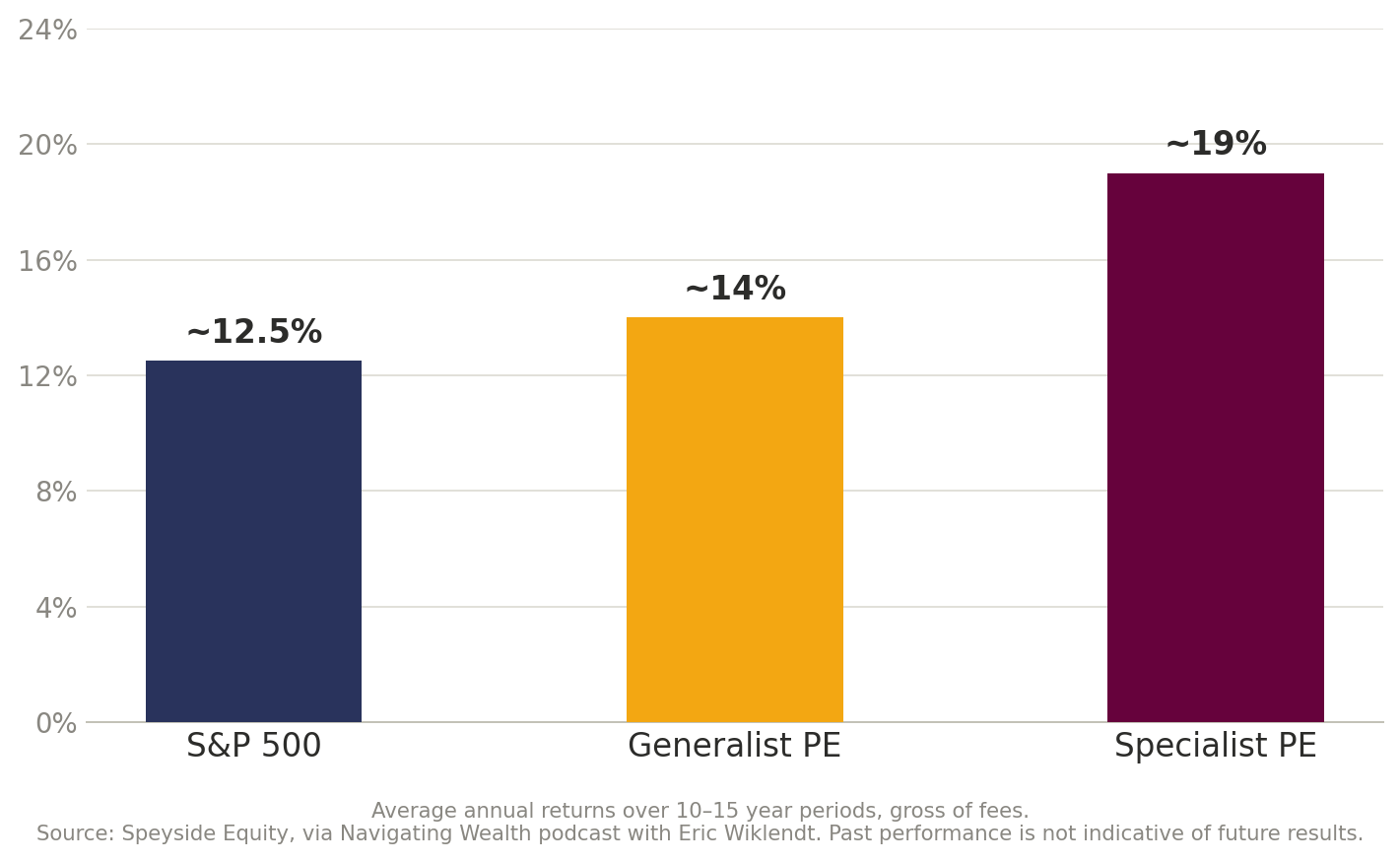
Once you account for the standard two-and-twenty fee structure, a generalist PE fund returning 14 percent gross is delivering something close to the S&P 500 on a net basis, with significantly less liquidity and a longer hold period. The illiquidity premium essentially disappears.
Specialist PE justifies its premium because deep sector expertise changes the risk calculus. A firm that has operated inside manufacturing businesses for decades sees the same failure modes repeatedly and knows how to mitigate them. They know which operational levers move margins, which market dynamics create acquisition opportunities, and which risks are genuinely structural versus which ones are solvable. That is a materially different proposition than a generalist firm underwriting an unfamiliar industry using pattern recognition from adjacent sectors.
For founders evaluating PE buyers, the implication is direct: a specialist firm with operator backgrounds in your industry is unlikely to be surprised by what they find. They have seen versions of your business before. They know what good looks like and what the path to it requires. That shared context is the basis for a more productive post-close relationship.
For a broader look at how high-net-worth investors allocate after a liquidity event, including how private market allocations shift at different net worth tiers, Long Angle's 2026 Asset Allocation Report covers the patterns across 230+ respondents. Long Angle also maintains a curated set of private market investment offerings for members who want access to institutional-quality alternatives alongside peer diligence.
What to Tell Your PE Buyer Before You Close
The single most useful piece of advice from this conversation is also the simplest: do not surprise a PE firm.
PE firms can structure around almost any founder intention if they know about it in advance. The CEO who wants to retire at sixty, the co-founder who wants to exit cleanly at close while the operating partner stays on, the management team that wants liquidity now but will roll equity into the next vehicle. All of these are solvable with lead time. None of them are easy to solve when they surface at close.
The recommended window is six to eighteen months. That is enough time for the firm to plan the transition, identify a successor if needed, structure a new incentive plan, and build the post-close org without the disruption that a late-stage surprise creates. Firms that have built long relationships with founders before acquiring them tend to have a clearer picture of these intentions early. That is part of why the pipeline for owner-operated businesses is longer on the PE side.
The dynamic runs in both directions. A founder who communicates their intentions clearly also earns more flexibility. The Speyside example: a CEO who had always planned to retire at sixty communicated that timeline well before close. By the time the exit arrived, the firm had already been thinking about succession. The CEO, freed from the obligation of the operating role, ultimately chose to roll some of his LTIP proceeds into the next vehicle anyway because the relationship had the room for it.

Frequently Asked Questions
What is the difference between a strategic buyer and a financial buyer?
A strategic buyer acquires a business to hold it indefinitely and integrate it into their existing operations, often extracting value through cost synergies. A financial buyer, such as a private equity firm, acquires a business using debt and equity, plans to exit in five to seven years, and focuses on improving the business as a standalone entity to generate returns on sale.
How long does private equity hold a company before selling?
The typical PE hold period is five to seven years. Some firms extend this through continuation vehicles when the asset has remaining value creation runway and the fund structure allows it. The hold period is determined by the fund's life, LP expectations, and the state of the exit market at the time of the anticipated sale.
What happens to the founder and management team after a PE acquisition?
It depends on which of the three exit types the founder negotiated at close. A full exit means the founder steps away. A transition exit means the founder stays for six to twelve months. A continuation vehicle orientation means the founder remains in an operating role under the new fund structure. Management teams at businesses that go through a continuation vehicle typically receive a payout of their existing equity incentive plan and a new grant tied to the next phase.
What is a continuation vehicle in private equity?
A continuation vehicle is a structure where a PE firm transfers an asset from an existing fund into a new special-purpose vehicle. Existing investors can take liquidity or roll their proceeds into the new fund. The GP continues to control the asset under the new structure with a recapitalized balance sheet. Well-used continuation vehicles reflect genuine remaining value creation opportunity. They are sometimes misused as a way to generate the appearance of returns when a fund has not generated sufficient cash distributions.
Does private equity or a strategic buyer pay more for a business?
Strategics typically pay a modest premium over financial buyers, because they can model revenue and cost synergies that a PE firm cannot. That premium comes with a tradeoff: strategics tend to make deeper post-close operational changes. The acquisition playbook that generates synergies often involves cutting headcount, consolidating facilities, and replacing the acquired sales team. PE firms tend to pay a lower headline price but preserve more of the business's operating infrastructure.
What size business does private equity typically buy?
It varies by firm strategy. Speyside focuses on $100M to $500M revenue manufacturing businesses and will not go below $50M revenue for a platform investment, because businesses below that threshold often lack the processes and systems required for repeatable operational improvement. Larger generalist firms focus on different segments. There are PE buyers at virtually every revenue size, including micro PE funds targeting businesses well below $50M.
What is specialist private equity and why does it matter?
Specialist PE firms focus on a specific industry or sector and build their investment and operating teams from people with deep operating experience in that sector. Generalist PE firms invest across industries. The distinction matters because specialist firms carry better risk-adjusted returns. Sector expertise allows them to identify risks that a generalist would miss and to execute on value creation more reliably. For founders, a specialist buyer in your industry is likely to have more realistic diligence assumptions and more useful post-close support.
Final Thoughts
Whether the right buyer is a PE firm or a strategic depends less on which type sounds better and more on what the founder wants from the situation. A full exit with maximum liquidity points in one direction. A transition that protects the team and preserves what was built points in another. A continuation role with a firm that treats the acquisition as a partnership points somewhere else entirely.
The PE buyers who create the best post-close outcomes for founders tend to share a few traits: they come from operating backgrounds, they communicate the value creation plan before close, they ask what the founder wants from the situation, and they can be honest about which situations are better served by a strategic. That conversation is worth having early, while there is still time to use the information.
A business exit compresses years of decisions into a short window.
Long Angle's Trusted Circles are small, confidential peer advisory groups of 6 to 8 members matched by life stage and wealth complexity, meeting monthly with a facilitator who is also a financial professional. For founders navigating a business sale, preparing for a PE partnership, or working through what comes after the exit, the High-Intensity Builders with Young Families Circle and the Post-Exit / Next Chapter Circle are designed for exactly this stage.
More From Long Angle
Beyond Wealth Newsletter
Navigating Wealth Podcast
Research & Studies
Alternative Investment Education
Blog