Written by Tess Nakaishi


Short-Term Investment Options for High-Net-Worth Individuals
Short-Term Investment Options for High-Net-Worth Individuals
From money market funds to crypto, these short-term investment options help high-net-worth investors diversify their portfolios.
Tess Nakaishi

Investing in short-term assets—such as money market funds or short-term bonds—is a popular strategy for those seeking to balance liquidity with potential gains. While many traditional options remain popular, recent market conditions have led investors to explore newer, higher-yield opportunities.
[Note: Financial markets are dynamic, and yields on investment products can change frequently. The specific yields mentioned in this article are for illustrative purposes only. Readers should always verify current rates and terms with financial institutions or investment providers before making any investment decisions.]
Here are some of the best short-term investment options for high-net-worth investors looking to strike a good balance between risk and return.
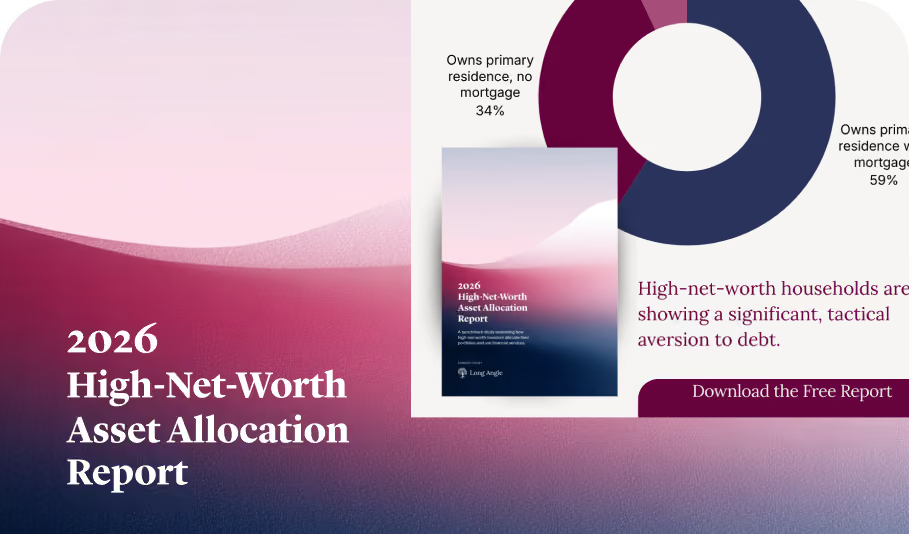
2026 High-Net-Worth Asset Allocation Report
See how high-net-worth investors with an average net worth of $17M are allocating across public equities, private markets, real estate, bonds and cash. Based on benchmark data from 230+ respondents.

Money Market Funds
Money market funds are common short-term investment options. These funds invest in low-risk, short-duration securities such as U.S. Treasury bills and commercial paper, offering investors an easily accessible and relatively stable route.
Given the current rate environment, money market funds provide a strong return compared to other short-term instruments. For instance, the Vanguard Money Market Fund (VMFXX) has recently yielded around 5.3%.
While yields can fluctuate, they offer a high degree of safety. If safety is a primary concern, options like Vanguard's Cash Plus account—which yields 4.7% and is FDIC insured—provide an even more secure alternative.
It is worth noting that while money market funds offer high liquidity, their yields can fluctuate with market conditions. Regular monitoring of investments is advisable to ensure they continue to meet your financial goals.
Certificates of Deposit (CDs)
For investors looking to lock in a guaranteed return, certificates of deposit (CDs) offer a straightforward solution. Unlike money market funds, which fluctuate, CDs provide a fixed interest rate over the investment period. While money market funds can be more flexible, a CD can guarantee a current rate—often exceeding 5%—which is valuable in an uncertain interest rate environment.
A possible trade-off to consider is the opportunity cost if rates rise after locking into a CD. However, for many risk-averse investors, this may be a small price to pay for guaranteed returns.
Treasury Bills
Treasury bills (T-bills), particularly those with short durations, are another strong candidate for short-term investments. These government-backed securities offer both liquidity and security, along with the added benefit of being exempt from state income taxes.
Some prefer 3-month T-bills, which can have yields of 5.39%. For investors looking to avoid fluctuations while maintaining tax efficiency, T-bills remain a good option.
There are also automated solutions like Jiko, a fintech platform that automatically invests deposits into 1-month T-bills. Jiko’s personal product offers a 5.52% return, with no state income taxes, providing a seamless way to take advantage of T-bill yields without manual intervention.
T-bills offer an additional advantage for high-net-worth individuals: they are exempt from state and local taxes. This can significantly boost their after-tax returns, especially for those living in high-tax states. When comparing yields across different investment types, consider the tax implications to get a true picture of potential returns.
Municipal Bonds
For those seeking tax efficiency, particularly in higher tax brackets, short-term municipal bond funds can offer yields free from both federal and state taxes, depending on where the investor resides.
For example, the Vanguard Short-Term Tax-Exempt Fund (VWSTX) has a yield of around 3.3% but is exempt from federal taxes. While the yield may seem lower compared to T-bills or CDs, the tax advantages can make this option more lucrative for high-net-worth individuals in states with high income taxes.
In addition, platforms like Fund Yields can help investors compare yields across various tax-free options, which can simplify the process of selecting the most tax-efficient investment for their situation.
While municipal bonds offer tax advantages, they typically yield lower returns than other fixed-income securities. However, for high-net-worth individuals in high tax brackets, the tax savings can more than make up for the lower yield.
Floating Rate Notes and ETFs
Those worried about interest rate fluctuations should consider floating rate notes or floating rate ETFs. These instruments adjust their interest payments periodically, making them less sensitive to rate changes.
For example, the U.S. Treasury Floating Rate ETF (USFR) was yielding 5.47% as of recent reports. These instruments carry a 0.0 duration, meaning that they are not subject to the same price fluctuations as fixed-rate bonds, making them a low-risk option in a rising rate environment.
Ultra-Short Bond Funds
For investors willing to explore bond markets, ultra-short bond funds offer slightly higher yields than money market funds while keeping volatility low. These funds invest in very short-term bonds, often maturing in less than a year, and provide a good mix of yield and security.
The Alpha Architect 1-3 Month Box ETF (BOXX) can be especially good for taxable accounts where the investment horizon exceeds 12 months. This fund focuses on ultra-short-duration fixed-income securities and provides a stable, liquid option for short-term needs.
However, it is crucial to hold such investments for over 12 months to maximize tax efficiency, particularly in states with income tax.
Crypto and DeFi
While traditional options like T-bills, CDs, and money market funds are generally safe, some investors have turned to cryptocurrency and decentralized finance (DeFi) markets in search of higher yields. These opportunities often come with significantly more risk but can offer enticing returns.
For instance, it is possible to earn over 11.25% APY on stablecoins through Crypto.com, although these funds aren’t insured, and the platform itself carries inherent risks. 2022 saw the collapse of many prominent crypto firms, including Celsius and FTX, causing significant losses for investors. Exercise caution with cryptocurrency; if a return sounds too good to be true, it often is.
More experienced crypto investors often recommend decentralized finance (DeFi) platforms like Aave or Compound, which operate on-chain and may provide greater transparency and control over assets. These platforms can offer yields ranging from 3% to 13% or even higher on stablecoin deposits. However, even these platforms carry significant risks, including smart contract vulnerabilities, regulatory uncertainties, and market volatility.
Those considering exploring this space should do thorough research, start with small amounts, and be prepared for the possibility of loss. For most high-net-worth individuals, crypto investments should represent only a small, speculative portion of a well-diversified portfolio.
| Investment Type | Features |
|---|---|
| Money Market Funds | Safe, liquid, currently offering competitive yields |
| Treasury Bills | Secure, liquid, tax-efficient |
| CDs | Guaranteed fixed returns, but may involve opportunity cost if rates rise |
| Municipal Bonds | Tax-free income, especially beneficial in high-tax states |
| Floating Rate ETFs | Help hedge against interest rate risk |
| Crypto/DeFi | High-risk, high-reward |
Tiered Approach to Short-Term Investing
Many high-net-worth investors find success in using a tiered approach to manage their short-term funds. This strategy allows for balancing liquidity needs with potential returns:
1. Immediate Needs (0-3 months): Keep funds in high-yield savings accounts or money market funds for quick access.
2. Near-Term Needs (3-12 months): Invest in T-bills or short-term bond ETFs for a balance of yield and flexibility.
3. Longer-Term Short Investments (1-2 years): Consider CDs or bond funds for potentially higher yields.
This approach ensures there is cash available when needed while maximizing returns on funds not needed immediately. Remember to regularly reassess tiers based on changing financial situations and market conditions.
Monitoring and Adjusting a Short-Term Investment Strategy
The short-term investment landscape can change rapidly with shifting economic conditions and interest rates, making it crucial to regularly review an investment strategy and make adjustments as needed. It is wise to set a schedule to reassess short-term investments quarterly or semi-annually, considering factors such as:
- Changes in personal financial situation or goals
- Shifts in interest rates or economic outlook
- Performance of current investments
- New investment products or opportunities in the market

Finding the Right Short-Term Investment Options
Short-term investment strategies need to be tailored to individual goals, risk tolerance, and tax situations. Options like money market funds and T-bills remain staples due to their liquidity and relative safety, while products like municipal bonds offer tax advantages that can boost after-tax returns. For those with higher risk appetites, floating rate notes or cryptocurrency have the potential for high returns.
Diversification is key, even in short-term investing. Spreading funds across different types of short-term investments balances risk and can potentially enhance overall returns. For example, an investor might combine the safety of money market funds with the tax advantages of municipal bonds and the potential higher yields of ultra-short bond funds.
Here is an example of what a diversified short-term investment portfolio might look:
- 40% in money market funds for safety and liquidity
- 30% in Treasury bills for tax-efficient returns
- 20% in municipal bonds for tax-free income
- 10% in ultra-short bond funds or floating rate ETFs for potentially higher yields
Adjust these percentages based on your risk tolerance, tax situation, and liquidity needs.
Whether an investor is prioritizing safety, tax efficiency, or higher yields, it is always a good idea to diversify and consult with a financial advisor or wealth management group.
At Long Angle, our community of high-net-worth individuals regularly shares insights on investment strategies, including short-term options. Members have reported success with various approaches, from maximizing yields with T-bill ladders to using municipal bonds for tax efficiency.
Join Long Angle today to access valuable discussions, ranging from investing and estate planning to travel and parenting. Learn from peers' experiences and discover curated investment opportunities tailored for high-net-worth individuals.
Cash management is easier with providers someone has already vetted.
Long Angle vets providers across financial products, professional services, health, lifestyle and travel so members do not have to. Partners do not pay to be listed, and any referral fee is disclosed on the partner page.
More From Long Angle
Beyond Wealth Newsletter
Navigating Wealth Podcast
Research & Studies
Alternative Investment Education
Blog