Published


Stop Paying the Sleep Tax: How High Performers Reclaim Energy, Focus, and Longevity
Stop Paying the Sleep Tax: How High Performers Reclaim Energy, Focus, and Longevity
High performers can operate at a discount without realizing it. Dr. Natun Verma explores the “sleep tax” draining cognitive sharpness, emotional regulation, and long-term health, and the structural changes leaders can make to reclaim energy, focus, and longevity.
Important Disclosures:
This analysis is based on a private webinar hosted for Long Angle members and reflects a summary of diverse viewpoints. This blog is intended for educational and informational purposes only and should not be considered legal, financial, investment or relationship advice.

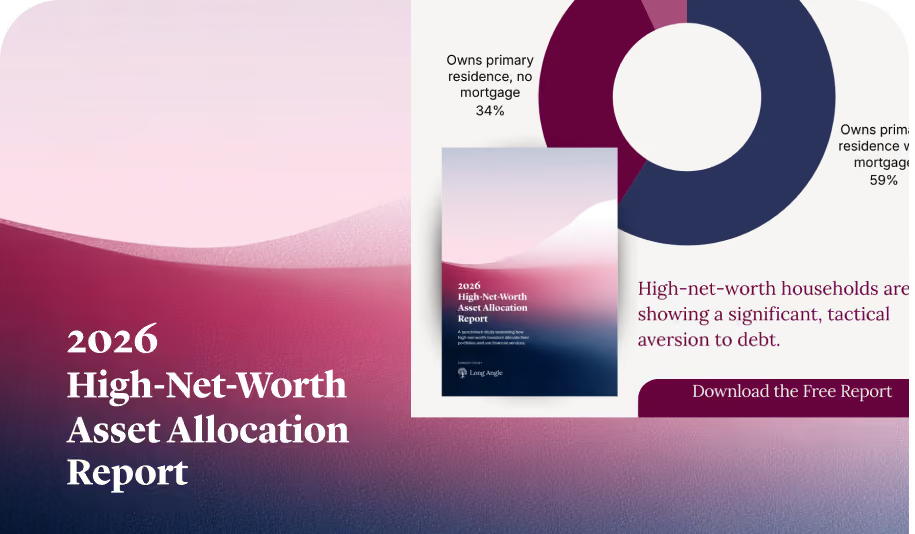
2026 High-Net-Worth Asset Allocation Report
See how high-net-worth investors with an average net worth of $17M are allocating across public equities, private markets, real estate, bonds and cash. Based on benchmark data from 230+ respondents.

Introduction: The Cost of the Sleep Tax
High performers rarely view themselves as undisciplined. They build companies, manage capital, travel across time zones, and operate at sustained intensity. Yet many function at a discount.
Dr. Natun Verma, a Stanford-trained sleep physician who later designed sleep programs for global employees at Meta and Apple, calls this discount the sleep tax. It’s the cumulative effect of insufficient or misaligned sleep that quietly drains cognitive sharpness, emotional control, and long-term health.
The tax is rarely obvious. Many executives believe they have adapted to six hours of sleep. Founders wake at 2:00 a.m. replaying decisions. Parents feel a subtle fog separating them from family moments. Over time, the performance cost compounds.
People don’t build meaningful careers and wealth to experience them through fatigue. The goal is not more hours asleep, but rather it’s about making waking hours count for more.
Dr. Natun Verma’s Background and High-Performance Focus
Dr. Verma began in conventional sleep medicine, diagnosing sleep apnea and interpreting sleep studies. Over time, his practice shifted toward a different population:
- Highly stressed founders and executives
- Frequent travelers
- Women navigating perimenopause
- Parents managing intense academic environments
Traditional advice often failed this cohort. Generic recommendations such as turning off all devices three hours before bed rarely align with global meetings, investor calls, and family obligations.
The insight: sleep challenges among high performers are not rooted in laziness. They stem from structural mismatches between modern life and biological design.
The Three Domains of the Sleep Tax: Cognitive, Emotional, Physical
The sleep tax affects three critical performance domains.
Cognitive Performance
Attention narrows. Working memory declines. Creativity and complex problem-solving suffer. Multitasking becomes slower and less fluid.
In leadership roles where marginal gains in judgment compound over years, this erosion matters.
Emotional Regulation
After poor sleep, individuals experience a shorter fuse. The ability to read social cues weakens. Self-monitoring and emotional modulation decline.
For leaders responsible for teams and negotiations, this subtle shift can alter culture and outcomes.
Physical Health and Longevity
Chronic short sleep correlates with elevated cardiovascular risk and shorter lifespan, particularly below five to six hours nightly. The sleep tax is not a single dramatic failure. It is accumulated friction.
Why Generic Sleep Advice Fails Executives and Founders
Traditional sleep advice assumes stable schedules, limited travel, and low evening stimulation. High performers live differently. Your calendar is not designed for circadian rhythm optimization. It is designed for opportunity. Back-to-back meetings compress recovery time. Late international calls spike cortisol when your body should be winding down. Cognitively demanding work keeps the prefrontal cortex lit up long after the laptop closes.
Most people respond the same way. They try harder at night. They lie in bed earlier. They download a meditation app. They negotiate with themselves. None of this addresses the real issue. Sleep is not a switch you flip at 10:30 p.m. It is the outcome of dozens of inputs that began 12 to 16 hours earlier.
The nervous system does not care that you have an early flight. It tracks light exposure, caffeine timing, emotional stress, and mental load. If you have been in artificial light all day, consumed caffeine at 3 p.m., trained intensely at 7 p.m., and answered a tense email at 9:45 p.m., your body is doing exactly what it was designed to do: stay alert.
Effort at night is rarely the solution. The leverage point lies earlier.
Morning light anchors the circadian clock. Midday movement regulates stress hormones. Strategic caffeine cutoffs protect sleep pressure. Intentional wind-down routines reduce cognitive spillover. When you get those upstream variables right, sleep becomes less of a performance and more of a byproduct.
High performers do not need perfect schedules. They need intelligent constraints, because the goal is a day structured in a way that makes sleep the natural ending, not a nightly battle.
The Day–Night Performance Loop
Dr. Verma frames sleep challenges as a loop: Rough nights create rough days, rough days create elevated stress, and elevated stress fuels the next rough night.
Many attempt to intervene only at bedtime. Counting sheep or closing eyes tighter rarely works. The most successful patients addressed the daytime component, and elite athletes invest as much in recovery as training. High performers must do the same.
The objective is not necessarily fewer waking hours, but rather higher-quality waking hours.
Restructuring the Evening Arc for Better Sleep
Rather than rigid device elimination, Dr. Verma recommends redesigning the evening arc.
Stressful tasks and emotionally charged conversations should occur earlier. Later hours should feature more consuming, calming activities. Digital platforms often operate on a slot-machine model. The brain scrolls through low-value content until encountering stimulation, which elevates arousal.
Analog activities provide cleaner transitions:
- Large puzzles
- Non-timed crosswords
- Reading a novel that is not emotionally intense
The brain responds to sequencing. Evenings should feel like a gradual landing, not an abrupt shutdown.
Transitions, Stress Compounding, and the Mr. Rogers Effect
High performers frequently stack meetings without breaks. Stress compounds invisibly.
Short transitions interrupt this compounding effect: four to five minutes between demanding events can dissipate accumulated tension. A brief walk. Stepping outside. A quiet reset before the next call.
If stress accumulates unchecked all day, nighttime becomes a steep climb. If managed incrementally, the evening is manageable.
The Third Space: Environmental Design for Recovery
Dr. Verma advocates creating a third space within the home. Most homes contain a workspace and a sleep space. The third space is reserved exclusively for relaxation.
It may be a dedicated room or a specific chair with a lamp and audio device. Nothing stressful occurs there. The psychological benefit begins before sitting down. The environment becomes an automated cue for calm. Structural design reduces reliance on willpower, which is typically depleted by evening.
If unable to fall asleep after approximately 20–30 minutes, or unable to return to sleep after waking for 15–20 minutes, the recommendation is counterintuitive.
Get out of bed,mMove to the third space. Engage in a calm activity. Return only when sleepy. Remaining in bed awake trains the brain to associate the bed with frustration. Avoid checking the clock. Avoid calculating remaining sleep. Reserve the bed as a place of sleep.
Circadian Rhythm, Night Owls, and Catch-Up Sleep
After a poor night, the default recommendation is to wake at the usual time. This anchors circadian rhythm and builds sleep drive for the following evening.
Night owls are not inherently unhealthy. Problems arise when social schedules conflict with biological timing.
Shifting earlier may involve morning light exposure and very small doses of melatonin timed hours before usual bedtime. Shifting later may require bright light at night and dim mornings. Consistency builds resilience.

Alcohol, Caffeine, Exercise, Supplements, and Sleep Architecture
Alcohol
Alcohol may speed sleep onset by engaging GABA pathways. However, as it metabolizes, arousal systems rebound, fragmenting the second half of the night. Shifting alcohol earlier and moderating intake reduces disruption.
Caffeine
Caffeine’s half-life averages six and a half hours. A noon coffee can leave residual stimulation at 1:00 a.m. Switching to decaf preserves ritual without nocturnal cost. Avoiding caffeine also creates the opportunity for strategic performance boosts on critical days.
Magnesium Glycinate
Data appears promising but remains insufficient for broad recommendation. Excessive doses may cause gastrointestinal discomfort.
Melatonin
Melatonin is most effective for shifting circadian rhythm. Very small doses taken hours before usual bedtime can adjust timing. Large doses at bedtime for sedation are less understood.
Z-Drugs and Orexin Antagonists
Medications such as Ambien were designed to reduce addiction risk compared to benzodiazepines. However, tolerance can develop if underlying stress persists.
Newer orexin antagonists aim to reduce wakefulness rather than induce sedation and may present safer long-term profiles.
Short-term pharmacologic support may be reasonable during acute stress. Structural changes remain foundational.
Exercise
Exercise is almost always beneficial for sleep, but timing matters.
Intense exercise elevates metabolism, creating a furnace effect. The brain requires a slight drop in core temperature to initiate sleep.
Strenuous workouts should allow sufficient cooling time before bedtime. A practical measure is observing when sweating stops and body temperature normalizes.
Final Thoughts
The sleep tax is incremental. So are its solutions.
High performers do not build opportunity to experience it through fog. Recovery is not retreat. It is preparation.
When sleep improves, waking hours expand in value. Creativity sharpens. Patience strengthens. Decisions clarify.
The goal is not perfection. It is reducing leakage, because sleep is performance infrastructure.
For leaders managing capital, teams, and complex decisions, the sleep tax influences:
- Judgment quality
- Emotional steadiness
- Strategic creativity
- Health trajectory
Structural solutions outperform willpower. Environmental design, sequencing, transitions, and circadian alignment generate compounding returns.
Small, consistent improvements in recovery mirror disciplined capital allocation. Over years, they produce durable advantage.
Frequently Asked Questions
What is the “sleep tax” for high performers?
The sleep tax refers to the cumulative performance cost of insufficient or misaligned sleep. It reduces cognitive sharpness, emotional regulation, and long-term health, often without obvious symptoms.
Should I wake up at the same time after a bad night?
In most cases, yes. Waking at the usual time anchors circadian rhythm and builds sleep drive for the next evening. Exceptions may apply for unusually critical events.
What should I do if I wake up at 3:00 a.m. and cannot fall back asleep?
After 15–20 minutes, get out of bed. Move to a calm environment and return only when sleepy. Avoid checking the clock.
Is melatonin safe and effective?
Melatonin is most effective for shifting circadian timing in small doses. Large bedtime doses for sedation have less supporting data. Timing and dosage matter.
Does alcohol help or hurt sleep?
Alcohol may help initiate sleep but fragments the second half of the night as it metabolizes. Earlier timing and moderation reduce disruption.
How does aging affect sleep quality?
Slow-wave sleep declines with age, and sleep becomes lighter and more fragmented. Strategies such as exercise, circadian alignment, and sleep efficiency optimization can mitigate these changes.
Health optimization is easier when someone has already vetted the providers.
Long Angle vets health and longevity providers, along with financial and professional services, so members do not have to. Partners do not pay to be listed, and any referral fee is disclosed on the partner page.
More From Long Angle
Beyond Wealth Newsletter
Navigating Wealth Podcast
Research & Studies
Alternative Investment Education
Blog