Written by Scott Nixon

SPV Fees: What You Pay, and How to Tell Whether the Terms Are Fair
SPV Fees: What You Pay, and How to Tell Whether the Terms Are Fair
An SPV investor can pay across three fee levels. What the market charges, what the numbers mean, and how to judge terms you have been offered.
Scott Nixon
A special purpose vehicle is a single-purpose entity that pools capital from several investors into one private investment, holds that one position, and dissolves when it exits. An SPV investor can pay across three separate levels: the sponsor's carried interest and any management fee, the vehicle's formation and ongoing administration cost, and, where a firm assembles and diligences the opportunity, that firm's own fee. Because those layers are charged on different bases, a single headline percentage cannot be compared across offerings. The layer most often understated is formation cost, which is charged against committed capital before any return is earned.
Key Takeaways
- Carried interest has moved off the 20% convention. Across roughly 1,800 SPVs formed on Sydecar between October 2024 and October 2025, median carry was 15% and only 25% charged 20%.
- Just over half, 53%, charged a management fee, most commonly 2%. Of those, 80% charged it for one year only rather than annually for the life of the vehicle.
- Formation cost is one-time and material: $4,500 to $14,500 at Sydecar, $10,000 for a standard AngelList vehicle, charged against the raise.
- Carry is the line most often left out of a comparison and usually the largest. Long Angle typically charges a 0.55% to 1.00% management fee on syndicated offerings and takes none.
- Placement fees a sponsor pays to whoever introduced the opportunity never appear in the schedule an investor sees. Ask whether they exist.
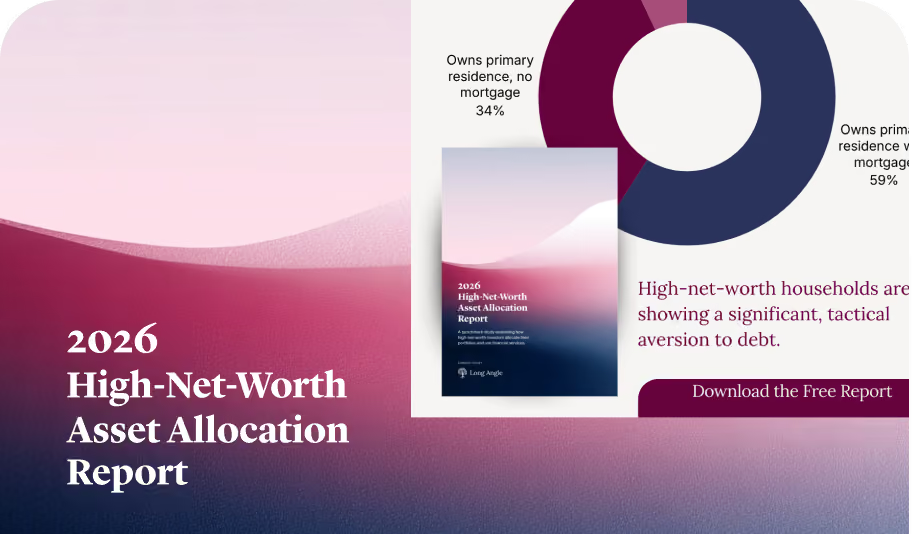
2026 High-Net-Worth Asset Allocation Report
See how high-net-worth investors with an average net worth of $17M are allocating across public equities, private markets, real estate, bonds and cash. Based on benchmark data from 230+ respondents.

What an SPV is, and what it is not
A special purpose vehicle is a limited liability entity formed to hold a single investment. Investors subscribe to the vehicle, the vehicle takes one position in one company or asset, and it winds up when that position is realized.
The structure exists because the underlying opportunity will not accept forty individual subscriptions. A late-stage company allocating secondary shares wants one line on its capitalization table, not forty. The SPV supplies that line, and the investors hold their interest in the vehicle rather than in the company.
That is the whole mechanism, and it is worth being precise about what it does not do. An SPV is not a fund. A fund raises blind-pool capital and invests it across many positions over a defined period, and its fees compensate a manager for selecting those positions over years. An SPV holds one position that has already been selected. An investor evaluating SPV terms against fund terms is comparing a single-position vehicle to a portfolio mandate, and the fee conventions carried over from funds often do not fit.
The five charges an SPV investor can pay
Most confusion about SPV economics comes from treating several separate charges as one number. They are levied by different parties, on different bases, at different times, and only some of them appear in a summary.
| Charge | Who levies it | Charged on | Typical range |
|---|---|---|---|
| Carried interest | The syndicate lead or sponsor | Profits, at exit | Median 15%, average 12% |
| Management fee | The syndicate lead or sponsor | Committed capital | 2% where charged, usually for one year |
| Formation and administration | The SPV administrator | The amount raised, once | $4,500 to $14,500 |
| Underlying expenses | The vehicle itself, over its life | The vehicle's assets | Rarely disclosed as a capped figure |
| Intermediary fee | A firm that sources and diligences the opportunity | Varies by firm | Rarely quoted as a percentage |
Not every SPV carries every line. An investor in a vehicle raised by a syndicate lead from their own contacts typically faces the first three. An investor accessing opportunities through a firm that sources and underwrites them may face all five.
The number that matters is the all-in cost, and it is almost never the one quoted. An offering described as "no management fee" may still carry 20% of profits, a $12,500 formation cost against a small raise, and undisclosed ongoing expenses. The two lines least likely to appear in a summary are the last two: underlying expenses, because they are charged against the vehicle rather than billed to the investor, and any intermediary fee, because it is often paid by the sponsor rather than by the investor, which changes whose interests it serves.
What the market charges
Published market pricing is uneven, because the parties that publish are the ones whose pricing is a product feature.
Sponsor economics. Carried interest is conventionally 20%, and that convention no longer describes the market. The largest published dataset on realized SPV terms covers approximately 1,800 SPVs formed on Sydecar between October 2024 and October 2025.
| Term | Finding |
|---|---|
| Average carry | 12% |
| Median carry | 15% |
| SPVs charging the traditional 20% carry | 25% |
| SPVs charging any management fee | 53% |
| Most common management fee | 2% |
| Of those charging a fee, share charging it for one year only | 80% |
| Average fee where the sponsor takes a fee and no carry | 5.3% |
| Correlation between management fee and carry | 0.08 |
Source: Sydecar SPV fee and carry data, approximately 1,800 SPVs formed on its own service, October 2024 to October 2025. One administrator's book, weighted toward emerging managers and venture-stage opportunities.
Three things in that table matter more than the headline averages.
The one-year point is the most consequential. A "2% management fee" sounds like an annual charge and usually is not. In 80% of cases where a fee was charged at all, it ran for a single year. An investor comparing that to any ongoing annual fee is comparing a one-time charge to a recurring one.
Average and median diverge. Mean carry of 12% against a median of 15% means a substantial group of sponsors take no carry or very little, pulling the average down. The typical offering an investor sees is closer to 15%.
Fee and carry are uncorrelated at 0.08. Sponsors are not trading one against the other in any systematic way, so a low fee does not predict high carry, and an investor cannot infer the rest of the terms from the part they were quoted.
Stage matters as well: over 50% of pre-seed and seed vehicles used "2 and 20", against roughly 40% at Series A and 28% of secondary SPVs.
Sample limitation. This is one administrator's book, weighted toward emerging managers and venture-stage opportunities. It is the best public dataset on realized SPV terms, and it is not the whole market. Institutional and real-asset SPVs are not represented in it.
Formation and administration. This is the most transparent layer, because administrators compete on it publicly.
| Administrator | Published cost | Structure |
|---|---|---|
| Sydecar | $4,500 to $14,500 | 2% of capital raised, $2,500 to $12,500, plus a $2,000 regulatory fee. No annual administration fee. |
| AngelList | $10,000 standard, $7,000 follow-on | $8,000 setup plus $2,000 blue sky. Fee capped at 10% of the amount raised. |
| Carta | Not published | Custom quote. |
Source: Administrator pricing pages, read September 2026. Sydecar lists add-ons including $3,000 for non-US investments, $3,000 for US pass-through entities, $3,000 for additional closes and $1,000 for a first distribution. Pricing as published and subject to change.
Because most of that cost is fixed, it falls sharply as a share of the raise. A $10,000 formation cost is 0.5% of a $2 million vehicle and 4% of a $250,000 one. Small vehicles carry it hardest, and it is the number most often absent from the summary an investor is shown.
What Long Angle Management fees are
There are no membership fees and no obligation to participate in any offering. Long Angle Management fees on syndicated offerings run 0.55% to 1.00%, with the rate set at the time of each commitment, reduced from the base rate to reflect prior active commitments. There is no carried interest, and no placement or referral fees are accepted from sponsors. Long Angle negotiates fee reductions on members' behalf and passes concessions through to investors.
| Syndicate-led SPV | Long Angle | |
|---|---|---|
| Carried interest | Median 15%, average 12%; 25% charge the traditional 20% | None |
| Management fee | 2% where charged, and 80% of those for one year only | 0.55% to 1.00% |
| Formation and administration | $4,500 to $14,500, once, charged against the raise | Not charged separately to the investor |
| Placement or referral fees from sponsors | Varies, rarely disclosed to investors | None accepted |
Source: Syndicate SPV figures: Sydecar, approximately 1,800 SPVs formed October 2024 to October 2025. Not a like-for-like price comparison: a syndicate lead's management fee, where charged, usually runs for a single year rather than for the life of the vehicle.
Carried interest is the line that matters most here, and it is the one most often missing from a comparison. A management fee is charged on capital; carry is charged on success. On a position that doubles, 15% of the gain is a far larger number than one percent a year, and it is taken precisely when the investment has worked. Two offerings quoting similar management fees can differ enormously once carry is included.
The second is duration. The most common sponsor management fee in the Sydecar data is 2%, and in 80% of cases it runs for one year only. A reader setting 2% against 1.00% and concluding the second is cheaper has compared a one-year charge to a recurring one.
And the third is who else is paid. A firm that accepts placement fees from sponsors earns more when its members invest, which is an incentive to present opportunities rather than to decline them. A firm that takes no sponsor compensation earns the same whether a member subscribes or passes.
How to evaluate terms you were offered
An investor shown an SPV can work through the charges in order.
Establish what the sponsor's economics are. Carry percentage, whether a management fee is charged, on what basis, and for how long. A 20% carry is the convention but no longer the median, so it is a question rather than a given.
Ask for the formation cost as a dollar figure and as a percentage of the raise. Both matter. A percentage alone hides a small vehicle; a dollar figure alone hides a large one.
Ask who else is being paid, and by whom. Placement and referral fees paid by the sponsor do not appear in an investor's fee schedule and do not reduce an investor's return directly, but they tell you whether the party recommending the opportunity is compensated for the recommendation.
Check whether the fee is charged per opportunity or across the relationship. The two produce very different totals for an investor making several commitments over several years, and comparing one against the other on headline percentage alone will mislead in both directions.
Establish what happens after the close. Annual administration, tax preparation, distribution handling and additional closes are frequently priced separately. The cost of the vehicle over its life is not the cost at formation.
None of this is a judgment about whether a given set of terms is good. Terms that are expensive against the market may still be reasonable for access to an opportunity an investor could not otherwise reach, and terms that are cheap say nothing about the quality of the underlying position.
Final Thoughts
A fee is only assessable against what it buys, and the two questions are separate. The first is arithmetic: what is the all-in cost across every layer, over the life of the vehicle, not the headline percentage in the summary. The second is judgment, and no table answers it: whether the position is one an investor could otherwise reach, and whether the party presenting it is paid the same whether they subscribe or pass. Terms that look expensive against the market may still be worth it. Terms that look cheap say nothing about what is inside the vehicle.
Frequently Asked Questions
What is a typical SPV fee?
There is no single figure, because an SPV investor can pay across three levels. Across roughly 1,800 SPVs formed on Sydecar between October 2024 and October 2025, median carry was 15% and average carry 12%, against a 20% convention. Formation cost is separate and one-time, published between $4,500 and $14,500 at Sydecar and $10,000 for a standard AngelList vehicle.
Do SPVs charge management fees?
Just over half do. In the Sydecar data, 53% of SPVs charged a management fee, most commonly 2%. The important detail is duration: of those that charged one, 80% charged it for a single year rather than annually for the life of the vehicle, so a fee that sounds recurring usually is not.
Is 20% carry standard on an SPV?
No. Only 25% of the SPVs in that dataset charged 20%. It is the inherited convention from fund structures rather than the current norm. An SPV holds one already-selected position rather than a portfolio assembled over years, and pricing has moved accordingly. Early-stage vehicles hold to the convention more closely than secondaries, where 28% used "2 and 20".
What is a placement fee, and why does it matter?
A payment from a sponsor to whoever introduced the investor. It does not appear in the fee schedule an investor is shown, and it means the party recommending the opportunity is compensated for the recommendation. Long Angle accepts no placement or referral fees from sponsors.
A member was pitched an SPV and asked here whether the terms were fair
Twelve replies came back, including from people who had been in earlier rounds of the same company. Compare notes with peers who have seen the structure before.
Alternative investments