Written by Scott Nixon

What Is an Insurance Dedicated Fund? How the IDF Structure Works
What Is an Insurance Dedicated Fund? How the IDF Structure Works
How an insurance dedicated fund is built, why only insurance separate accounts are allowed to own one, and why no policy can promise a specific manager.
Scott Nixon
An insurance dedicated fund is a pooled fund that only insurance company separate accounts may own, held inside a private placement life insurance or annuity policy so the policy can reach institutional strategies and still qualify as insurance. No individual can buy one directly: Treasury rules allow the look-through the structure depends on only where every interest is held through an insurance account. The fund's manager chooses the holdings, never the policyholder, and no single investment may exceed 55% of the fund's assets. Directing the investments, or failing that test, ends the tax treatment.
Key Takeaways
- An IDF is defined by who may own it, not what it holds: look-through treatment applies only where every beneficial interest sits in an insurance separate account.
- The diversification test is mechanical: no one investment above 55% of assets, no two above 70%, no three above 80%, no four above 90%, tested quarterly.
- No policy can commit to a named manager. A policyholder who directs the investments is taxed as the owner of them, as the Tax Court held in Webber v. Commissioner (2015).
- Fees stack at the fund and the policy level. The Wall Street Journal reported in August 2026 that advisers put the cost as high as 2% to 4% annually in the early years.
- LISG's 2026 U.S. PPLI Market Report counted $44 billion under administration across the largest carriers it surveyed at end-2025, so a preferred strategy may not exist in this form.
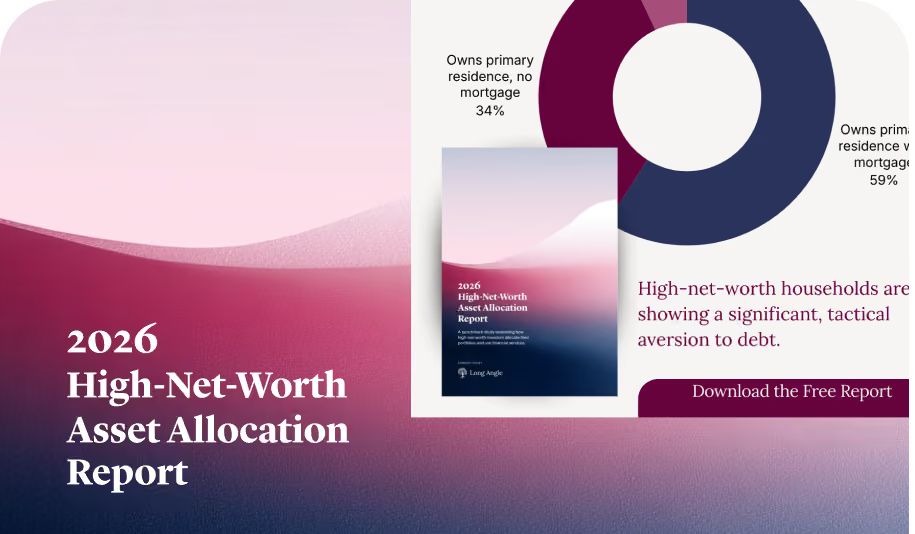
2026 High-Net-Worth Asset Allocation Report
See how high-net-worth investors with an average net worth of $17M are allocating across public equities, private markets, real estate, bonds and cash. Based on benchmark data from 230+ respondents.

What Makes a Fund Insurance Dedicated
An insurance dedicated fund is defined by who is allowed to own it, not by what it invests in. Almost any strategy could in principle be offered in this form. What makes a fund insurance dedicated is a restriction written into the Treasury regulations, and it is narrower than most descriptions of the structure suggest.
A life insurance policy has to satisfy a diversification test to be treated as insurance for tax purposes. If a policy's separate account simply bought an interest in a fund, that interest would count as a single investment, and the account would breach the test the moment it held one fund. The regulations solve this with a look-through: the account is treated as owning a pro rata share of each asset inside the fund rather than the fund interest itself. That treatment is available only where all the beneficial interests in the fund are held by insurance company separate accounts, and public access runs exclusively through the purchase of a variable contract. The regulation is 26 CFR 1.817-5(f).
So the defining restriction is not a marketing choice. It is the condition on which the whole structure depends, and it produces most of what investors find unusual about these funds. An individual cannot subscribe to one. They are not offered for sale outside the insurance channel, they carry no public track record in the ordinary sense, and an adviser cannot line them up against retail funds and compare.
Why No One Can Promise You a Manager
Any honest guide to this structure runs into the same constraint early, and it is better stated than worked around. No policyholder can be promised a specific investment manager inside a policy, and nobody selling one can credibly commit to a lineup in advance.
The reason is the investor control doctrine. The IRS position, which the Tax Court applied in Webber v. Commissioner in 2015, is that a policyholder who exercises enough influence over what the separate account buys is the owner of those assets for tax purposes, and is taxed on their income directly. In that case the taxpayer had steered the account's investments through recommendations, and the policies failed. Revenue Ruling 2003-91 describes the other side of the line: a policyholder may allocate premiums among the options offered and move between them, and may not select or direct a particular investment.
A commitment made to a prospective policyholder that a named manager will be in the fund is close to the arrangement the doctrine exists to catch. That is why this guide names no managers, and it is why a page that does name them is describing something no reader can be promised.
The practical consequence is that the thing being evaluated is not a lineup. It is the mandate, the process that selects and replaces managers within it, and the party doing the selecting.
The Diversification Test the Fund Has to Pass
Source: 26 CFR 1.817-5(b)(1) and 1.817-5(c)(1), implementing Internal Revenue Code section 817(h). A new account has a start-up period running to its first anniversary. Variable life contracts may apply increased limits where the account holds Treasury securities.
Two details in that table do more work than they look like they do. Treating all securities of the same issuer as one investment means concentration cannot be disguised by holding several instruments from the same borrower. And the test runs quarterly rather than continuously, which is what makes a portfolio of private, infrequently traded positions administrable inside a policy at all.
Failing the test is not a fee or a penalty. Under 26 CFR 1.817-5(a)(1) the contract is not treated as life insurance for any quarter in which the account is not adequately diversified, and the income on the contract is taxed to the policyholder as ordinary income under section 7702(g). The regulation goes further than most summaries admit: a contract that loses the treatment for one period is not treated as insurance for later periods either, even after diversification is restored.
There is a cure, and it is narrow. Where the failure was inadvertent, the holder or issuer can ask the Commissioner to disregard it, provided the account is brought back into compliance within a reasonable time and they agree to pay whatever the Commissioner requires for the period of the failure. That is a discretionary remedy applied for after the fact, not a safe harbor to rely on.
How a Policy Can Hold Investments
Source: 26 CFR 1.817-5(f), which sets the conditions for look-through treatment. Look-through applies only where all beneficial interests are held by insurance company separate accounts, subject to the limited exceptions in 1.817-5(f)(3).
The first route works and is common, but it rarely justifies the wrapper. Registered funds available on a carrier's menu are mostly tax-efficient already, so there is not much annual tax for the policy to defer, and the policy's own charges sit on top of a small benefit. That is the same reasoning that decides which assets belong in which account outside an insurance policy.
The third route puts the diversification test on the account position by position, and it raises the control question directly, because someone has to be choosing those positions and it cannot be the policyholder. The second route is the one built for the problem: a single subscription, diversification handled inside the fund, and a manager already accustomed to insurance money.
Which Strategies Appear in Insurance Dedicated Form
The strategies offered in this form are not a cross-section of the private markets. They are the ones the tax code treats worst.
Fit follows from a single question: how much tax would this strategy generate each year if it were held in a taxable account? Approaches that distribute interest, or that turn their portfolios over quickly, produce ordinary income and short-term gains, and those are the ones where deferring the annual bill is worth paying for. In practice that means private credit and specialty finance, multi-strategy and relative-value hedge funds, systematic and managed futures strategies, and litigation finance.
Strategies that are already efficient rarely appear, because there would be little point. A buyout fund that holds a company for six years and exits into long-term capital gain generates very little annual tax to defer, and a low-turnover index fund generates less still.
Supply narrows the field again. Building a fund that only insurance accounts may own means a separate vehicle, separate administration and a separate audit, serving capital that can be reached only through policies. The managers who take that on are the ones with enough demand from the insurance channel to justify a dedicated vehicle, and that is a smaller group than the set of managers an investor might want. LISG's 2026 U.S. PPLI Market Report counted $44 billion in assets under administration across the largest carriers it surveyed at the end of 2025. Measured against the private markets as a whole, that is a narrow channel, and the practical consequence is that a preferred strategy may simply not exist in this form.
Where the Fees Sit
An insurance dedicated fund carries its own fees, and the policy wrapped around it carries more. Reading one layer and not the other is the most common way the cost of this structure gets understated.
At the fund level the charges look like any private fund: a management fee, fund administration, audit and custody, plus the incremental cost of running a vehicle restricted to insurance investors. At the policy level sit the cost of insurance, the carrier and broker charges, and one-time costs including the federal deferred acquisition cost tax and state premium tax. Those are set out in our guide to every PPLI charge, one-time and recurring.
Advisers told the Wall Street Journal in August 2026 that fees "can run as much as 2% to 4% annually in the early years," and reported that the tax savings generally need at least $5 million of premium to outweigh the complexity and cost. The qualifiers matter. The range is an upper bound rather than a typical figure, and it is described as an early-years cost, because several of the charges are fixed and amortize as the policy grows.
That is also why the quoted floor is a market convention rather than a rule. Nothing in the tax code sets a minimum premium. The figure exists because fixed costs have to be spread across something, and PPLI economics improve materially with scale and negotiated access.
When an IDF Is the Wrong Structure
The failures here are structural rather than matters of preference, and every one of them can be tested before anyone runs an illustration.
It is close to pointless for a portfolio held mainly in index funds, because there is little recurring tax to remove. It does not survive a short horizon, because the one-time costs need decades to amortize. It is the wrong answer for an investor who wants to choose managers, and that is permanent rather than negotiable. It does nothing for someone who is not a US taxpayer. And it is unreachable in practice for an investor who cannot fund a policy at the scale the economics require, whatever the strategy inside the fund looks like.
Whether the question is worth asking at all turns on how much of a portfolio already sits in strategies like these. In Long Angle's 2026 High-Net-Worth Asset Allocation Report, 233 respondents reported holding roughly 28% of net worth in private and alternative investments, including home equity. Those are voluntary participants in one community rather than a representative sample of wealthy households, and the figure describes what they reported holding rather than what anyone should hold. But a portfolio already weighted that way toward private strategies is the one where the question of where those assets sit starts to be worth the work. The full fit test is in our guide to the downsides of PPLI, and the structure the fund sits inside is covered in our guide to how PPLI works.
Final Thoughts
Judge this structure on two things the reader can check before anyone runs an illustration. The first is what would go inside it, because the wrapper is worth roughly what the annual tax on those assets is worth, and an efficient portfolio has little to defer. The second is who selects the managers and how, because the one thing a policyholder cannot do is make that choice themselves. A page that answers the first question and skips the second is describing half the decision.
Long Angle does not provide legal or tax advice. The treatment described here depends on a policy satisfying tests that turn on individual circumstances. Confirm anything here with your own attorney, CPA or tax professional before acting on it.
Frequently Asked Questions
What is an insurance dedicated fund?
An insurance dedicated fund is a private fund that only the separate accounts of insurance companies may own. It is held inside a private placement life insurance or annuity policy, and it exists so the policy can hold a pooled institutional strategy while still satisfying the diversification rules that keep it taxed as insurance.
Can an individual invest in an insurance dedicated fund?
No. The look-through treatment the structure depends on is available only where all beneficial interests are held by insurance company separate accounts and public access runs exclusively through the purchase of a variable contract. An investor reaches the fund by buying a policy, and holds the policy rather than the fund.
Who chooses the investments in an insurance dedicated fund?
The fund's manager does, and the policyholder cannot. Under the investor control doctrine a policyholder who directs what the separate account buys is treated as the owner of those assets and taxed on their income directly. Revenue Ruling 2003-91 permits a policyholder to allocate among the options offered while barring them from selecting or directing a particular investment.
What is the 817(h) diversification requirement?
Section 817(h) of the Internal Revenue Code, implemented by 26 CFR 1.817-5, requires that no single investment exceed 55% of the account's total assets, no two exceed 70%, no three exceed 80% and no four exceed 90%. All securities of the same issuer count as one investment. The test is applied on the last day of each calendar quarter, or within 30 days after it.
What happens if an insurance dedicated fund fails the diversification test?
The contract stops being treated as life insurance for that quarter and the income on it is taxed to the policyholder as ordinary income. The regulation also denies the treatment for subsequent periods even after diversification is restored. Where the failure was inadvertent, the holder or issuer can ask the Commissioner to disregard it, on condition that it is corrected within a reasonable time and they pay what the Commissioner requires.
Is the tax treatment of an insurance dedicated fund safe?
The treatment is codified rather than discretionary. It rests on the rules Congress wrote for life insurance in sections 7702 and 101 of the Internal Revenue Code and on the diversification requirement in section 817(h), and it holds for as long as the policy meets those tests. The burden sits on the policy and the fund satisfying the requirements, not on the structure being permitted.
The fund is the part of PPLI an individual buyer cannot reach alone.
Long Angle negotiates as one community and brings members a PPLI offering built on that collective scale. Members review the full materials with peers, with no expectation to participate.
Alternative investments