Written by Scott Nixon


What to Do Before a Liquidity Event: A Pre-IPO Planning Guide for High-Net-Worth Investors
What to Do Before a Liquidity Event: A Pre-IPO Planning Guide for High-Net-Worth Investors
The 2026 IPO wave (SpaceX, OpenAI, Anthropic, and others) is producing the largest cohort of pre-IPO equity holders in a generation. The most expensive mistakes are sequencing mistakes, not tax mistakes.
Scott Nixon
Pre-liquidity planning is most effective in the window before a sale or IPO is announced, because the highest-value moves close off once a transaction becomes public or a lockup begins. The decisions that matter most are equity exercise timing, state residency, entity structure and estate transfers, and each carries a deadline tied to the event rather than to the tax year. Long Angle members holding concentrated private-company equity consistently report that the planning they regret is the planning they started after terms were already signed.
Key Takeaways
- The most consequential after-tax decisions usually happen 12 to 24 months before liquidity, not after, since most tax strategies, entity restructurings, and estate transfers close when the deal does.
- Pre-IPO equity exposure typically spans three layers: vested shares, unvested grants, and career capital tied to the same company.
- Exercising incentive stock options (ISOs) before an IPO can create a tax bill on paper gains the employee cannot yet sell, triggered by the alternative minimum tax. Modeling how many shares can be exercised each year before tax kicks in, then spreading exercises across multiple years, is a common pre-IPO planning move worth running with a qualified tax advisor.
- Long Angle's 2026 Asset Allocation Report shows high-net-worth investors hold 51% in public equities and 28% in private and alternative assets on average. Allocations to private and alts rise from 24% at the $2M-$10M tier to 34% at the $25M+ tier.
- Decide how you want to be served before liquidity, not after. Long Angle's 2026 Asset Allocation Report shows 57% of respondents self-manage their portfolios. One likely reason is that many $10M-$50M households with concentrated pre-IPO equity do not fit neatly into standard wealth management models.
- Five foundational areas need to be addressed regardless of whether you sell or hold: taxes, estate, insurance, asset allocation, and borrowing and investing.
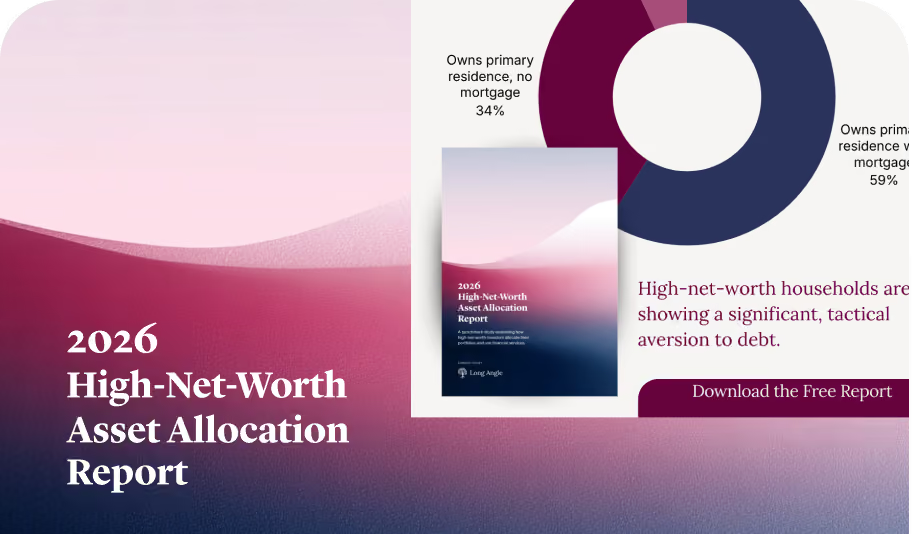
2026 High-Net-Worth Asset Allocation Report
See how high-net-worth investors with an average net worth of $17M are allocating across public equities, private markets, real estate, bonds and cash. Based on benchmark data from 230+ respondents.

Why the Months Before Liquidity Matter More Than the Months After
The pre-liquidity window matters because many of the highest-leverage decisions close before the event does. Most tax strategies, entity restructurings, residency moves, estate transfers, and exercise sequences close when the deal does. After the lockup releases or the deal signs, the menu shortens. What looked like a wide field of options collapses to a much smaller list, and most of the remaining options are reactive rather than strategic.
The structural reality is that most advisor relationships form after liquidity, when the assets are visible and the work is straightforward to scope. That timing creates a practical mismatch: many of the highest-leverage planning decisions need to happen before the assets are liquid, when the advisor relationship usually does not yet exist.
The leverage runs the other way. A founder who restructures ownership 24 months before a sale can shift more pre-appreciation value than a founder who tries to do the same work the week the letter of intent (LOI) arrives. An employee holding incentive stock options (ISOs) who staggers exercises across three or four years can convert more shares at long-term capital gains rates than someone who exercises in a single year after the IPO is announced. A member who establishes Texas or Florida residency 18 months before pricing can capture a state-tax differential measured in hundreds of thousands of dollars, while a member who tries to move the week before pricing usually cannot. The pattern repeats across every category of pre-event work. Time creates options. Time runs out fast.
Inventory Your Full Pre-IPO Equity Exposure
Pre-IPO company exposure typically spans three layers most employees underestimate: vested shares, unvested grants and career capital tied to the same company. The first layer is the only one most people track. The second and third are usually invisible until something goes wrong.
Vested shares are the visible portion. Already-vested options, exercised shares sitting in a brokerage account, restricted stock units (RSUs) that have already settled. This is the layer most members can name from memory. It is also, for many late-stage tech employees, the smallest of the three.
Unvested grants are the larger and less visible layer. Stock options scheduled to vest over the next several years, RSUs tied to time or performance milestones, refresh grants linked to continued employment. Unvested equity is economically real even if it cannot yet be sold. A common pre-IPO mistake is treating unvested grants as future income rather than as current exposure. The exposure is current. The unvested grants are tied to the same company stock, the same management team, the same operational risk, and the same valuation that the vested shares are tied to. If the underlying business deteriorates, the vested shares and the unvested grants take the hit together.
Career capital is the third layer, and usually the most overlooked. For an early-stage tech employee, the salary and future earnings potential at the company are themselves a concentrated bet on the same company. If the company underperforms, the equity falls and the income source weakens at the same time. The same risk that hits the brokerage account hits the household paycheck. For founders, the same logic applies even more sharply: the company is the income, the equity, and the operational time commitment.
Long Angle's 2026 High-Net-Worth Asset Allocation Report shows the dimension of this concentration in plain numbers. Among founders and owners, company equity represents 61% of their private and alternative asset allocation on average. Among employees with significant company equity, that figure rises to 67%. This is not theoretical concentration. It is the actual portfolio shape for the cohort heading into the 2026 liquidity wave. Members who run the three-layer inventory before the lockup typically end up with a different post-lockup plan than members who only count what is already vested.
The Three Windows and the Most Common Mistake in Each
IPO planning often breaks down when the event is treated as a single decision rather than three sequenced windows, each with a different highest-leverage move and a different recurring mistake.
The pre-lockup window is where the structural decisions live: residency, entity, exercise sequencing, estate transfers, charitable structures. The recurring mistake is waiting for IPO certainty before starting. The IPO date slips. The planning gets deferred. By the time pricing is real, half the options are already gone. Members who treat the pre-lockup window as live planning time, regardless of whether the IPO ultimately prices on schedule, end up with more options than members who wait for certainty.
The lockup window is the discipline window. Most IPO lockup agreements prevent insiders from selling their shares for 180 days after the IPO, though some structures use staggered releases or early-release provisions tied to share price or earnings windows. Lockup periods are not mandated by the SEC; they are private contracts between the company, its insiders, and the underwriters. The recurring mistake during lockup is letting the price action change the post-lockup plan. The same employee who held a written hold thesis at IPO sometimes finds themselves drafting a sell order three months after the lockup releases, with no clear framework for what changed beyond the price. The lockup window is where pre-written rules and pre-modeled scenarios matter most, since the decision environment is exactly the one that tempts the wrong call.
The post-lockup window is the execution window. The recurring mistake is treating it as the start of the planning rather than the end. Members who arrive at the post-lockup window with no entity restructuring, no residency planning, and no charitable structures already in place work with a much smaller decision set than members who used the prior two windows deliberately. The post-lockup work is mostly execution of decisions already made.
The AMT Crossover Point and Pre-Lockup Exercise Strategy
The alternative minimum tax (AMT) is a parallel federal tax system that requires high earners to calculate their tax liability two ways and pay the higher of the two. For employees exercising incentive stock options (ISOs) before an IPO, AMT is often the biggest tax variable, because the difference between the strike price and the fair market value at exercise (the bargain element) is treated as income for AMT purposes even though no shares have been sold.
The AMT crossover point is the maximum bargain element an employee can realize in a given year before AMT exceeds regular tax. Modeling it annually can help some ISO holders identify how many shares they may be able to exercise before AMT kicks in. The result depends on the full household tax picture and should be modeled with a qualified tax advisor.
The mechanics are worth getting right. When ISOs are exercised and the underlying shares are held past year-end, the bargain element becomes a preference item for AMT purposes. The exercise itself is not a taxable event under the regular tax system, but it can trigger a meaningful AMT bill in the exercise year, calculated on IRS Form 6251. The result is "phantom" income: tax owed on paper gains the employee cannot yet sell.
At pre-IPO companies, this problem compounds. Most employees cannot fund the AMT bill by selling shares, since the shares are not yet tradable. Cashless exercise programs that are common at public companies are often unavailable or more limited at the pre-IPO stage. The result is that an ISO-heavy employee planning to exercise pre-IPO may need both the strike price cash and the AMT cash on hand, usually from outside savings. Many members report being surprised by this when they first run the math.
The crossover strategy reframes the decision. Rather than asking "should I exercise?", the better question is "how much can I exercise each year and stay below the AMT crossover line?" The answer depends on the rest of the employee's tax picture, but for many ISO holders the math works cleanly across two to four years of staggered exercises. Modeling the crossover annually and staggering exercises across multiple years is a common input in pre-IPO exercise planning for ISO-heavy employees.
The other variable worth modeling is Section 1202. Qualified Small Business Stock under Section 1202 can allow eligible non-corporate taxpayers to exclude a percentage of gain on the sale of qualifying stock held for the required period. The rules around what qualifies, holding periods, issuer eligibility, and per-issuer caps are nuanced and have shifted with recent legislation. The practical implication is that QSBS analysis may need to happen alongside exercise and sale planning, because eligibility depends on facts that may include issuance date, holder type, holding period, issuer qualification, and transaction structure. Members evaluating QSBS for the first time may want to begin that analysis well before any sale, since retroactive structuring is usually limited. For a broader review of related considerations, see Long Angle's coverage of common tax planning mistakes high earners make.

State Residency, Entity Structure, and Estate Transfers Before the Deal Closes
State residency at the moment of sale can shift the after-tax outcome by hundreds of thousands of dollars on a meaningful liquidity event, and the time to act is months or years before liquidity, not the week of pricing. California’s top marginal income tax rate can exceed 13% for high earners, while Texas and Florida have no state income tax.
The catch is that residency changes do not happen on paper. State tax authorities (California's Franchise Tax Board in particular) are aggressive about audit when a high-income individual moves out of state in the year of a major liquidity event. A "paper move" without a real change in domicile, daily life, family location, and operational ties usually fails audit. The members who execute residency moves successfully typically begin the process 12 to 24 months before the liquidity event, establish bona fide domicile in the new state with the standard markers (driver's license, voter registration, primary residence, professional and personal ties), and document the transition carefully. A residency move is a real-life decision before it is a tax decision.
Entity structure is the second pre-lockup variable. For founders and early holders, the question of whether equity sits in an individual name, an LLC, a revocable trust, or one of several irrevocable structures may have tax and estate implications that compound across decades. Restructurings are usually easier to execute before the valuation has hardened. Once the IPO price is set or the acquisition is signed, valuation discounts compress and the leverage of pre-appreciation transfers disappears.
Estate transfers compound the same logic. Tools like grantor retained annuity trusts, spousal lifetime access trusts, and intentionally defective grantor trusts can be used to shift pre-appreciation value to heirs while consuming relatively little of the lifetime gift tax exemption, depending on the structure and the timing. The technical details are state-specific and attorney-specific, and the rules around these tools have shifted with recent tax legislation. The general principle is durable: the earlier the transfer, the more value moves to the next generation outside the taxable estate. Estate transfers attempted in the final weeks before pricing usually capture far less value than transfers executed 12 to 24 months earlier. For members starting the conversation now, Long Angle's guide to high-net-worth estate planning covers the foundational structures.
How High-Net-Worth Peers Actually Allocate at Your Wealth Stage
The average high-net-worth investor holds 51% of net worth in public equities and 28% in private and alternative assets, with the breakdown shifting materially by wealth tier. The standard 60/40 portfolio is largely absent from this cohort. The traditional bond and cash allocation combined is less than 10% of net worth for most respondents, outweighed by holdings in private companies, alternative investments, and investment real estate.
The wealth-tier breakdown matters most for liquidity event planning. In the $2M to $10M tier, private and alternative assets represent approximately 24% of net worth. At the $10M to $25M tier, the figure rises into the high 20s as members shift exposure toward private equity, venture capital, and angel investments. At $25M and above, private and alternative assets reach approximately 34% of net worth, with private company equity alone representing roughly three times the proportional share seen in the lowest wealth tier. The shift is not accidental. It reflects the fact that founders, owners, and operators in the $25M+ group typically built their wealth through concentrated private equity in the first place, and the post-liquidity portfolio reshape often expands rather than contracts the alternative allocation.
The implication for someone planning for a 2026 liquidity event is that the post-event portfolio target is unlikely to look like the public 60/40 most pre-event employees imagine. The 60-10-30 framing is closer to reality for this cohort: roughly 60% in stocks, 10% in bonds and cash, 30% in private and alternative assets. The exact split depends on the household's primary objective (growth, income, or preservation), but the general shape is consistent across the survey.
The FIRE subset (Financial Independence, Retire Early) within the Long Angle membership skews more aggressively toward public equities, often above 60%, with correspondingly lower allocations to investment real estate. The legacy and family-office subset skews the other direction, with higher private and alternative allocations and a longer planning horizon. Both are valid. The point is that "what should I do after the IPO?" usually has a different answer depending on which objective the household is solving for. Members who name the objective before the lockup releases typically end up with a cleaner post-lockup allocation than members who try to figure it out under time pressure. For the full data set, see Long Angle's 2026 High-Net-Worth Asset Allocation Report.
The Wealth Management Industry Is Fragmented for a Reason
A16z Perennial CIO Michel del Buono describes the structural gap this way: traditional wealth managers optimize for service and asset gathering, not investment performance, while institutional asset managers are built for non-taxable capital and don't optimize for after-tax outcomes. The result is a fragmented landscape with no obvious default, which is why so many high-net-worth households end up managing the problem themselves.
The 2026 Long Angle benchmark numbers reinforce the pattern. In Long Angle's respondent base, no single wealth manager held dominant share. 57% of respondents self-manage their portfolios. 50% have no interest in using a financial advisor at all. The remaining respondents who do use advisors are spread thinly across many firms, with Morgan Stanley leading at 9% share and no other provider above single digits. One likely reason is structural mismatch: many $10M-$50M households need tax-aware, concentrated-equity, estate and alternative-investment planning that does not fit neatly into standard retail wealth management or institutional asset management models. The largest advisor categories were built for retail households or tax-exempt institutions, and the planning needs of a household with concentrated pre-IPO equity sit in between the two.
Fee structures reinforce the mismatch. Average advisor AUM fees step down linearly as net worth rises, from roughly 0.79% at $2M-$10M, to 0.67% at $10M-$25M, to 0.58% at $25M+. The implication is that wealth managers are competing on price for larger accounts because they have to, not because the underlying service is differentiated. A growing minority of advised members are moving to flat-fee or hourly engagements rather than AUM-based arrangements, on the view that the work involved in advising a $20M household is not three times the work involved in advising a $7M household. For members evaluating advisor options, Long Angle's coverage of how to choose a high-net-worth financial advisor covers the practical screening criteria, and the companion piece on average wealth management fees by tier covers the fee data in more detail.
What Long Angle Members Are Discussing About the 2026 Liquidity Wave
Across Long Angle discussions about SpaceX and adjacent late-stage private-company exposure, four patterns have emerged. The value is not that members reach the same answer. It is that the discussion surfaces the different ways sophisticated households are approaching the same planning window.
The first pattern is the multi-round holder considering a staged post-lockup sale. Some members invested or were granted equity across several rounds, often with different cost bases and holding periods. The discussion in this group focuses on which lots to consider selling first, how to sequence sales across the lockup release, and how to model the QSBS holding period across multiple grant dates. The mechanical question is which lots to dispose of in what order. The strategic question is how much to keep after diversification.
The second pattern is the valuation skeptic. Some members weighing how much SpaceX exposure to keep through the lockup have calibrated the reported valuation range against publicly traded comparables, sometimes arriving at meaningfully different hold-versus-sell decisions than members who anchor on the implied IPO valuation alone. The comparison is not a prediction. It is a calibration exercise. For members weighing how much exposure to keep through the lockup, calibrating against publicly traded comparables is one input among several.
The third pattern is the intentional holder. A subset of members plan to hold a significant portion of their pre-IPO position past the lockup, sometimes for years. This group typically writes the hold thesis down, defines the conditions under which they would sell, and pre-commits to a downside scenario. The framework is covered in the next section. The point worth surfacing here is that intentional holders behave differently from default holders, and the difference compounds over time.
The fourth pattern is the political and operational risk assessor. Some members have flagged CEO-specific and operational risk as variables that, while difficult to model, are real and worth weighting. Discussions on this topic are typically the most heterogeneous in the community, with members at very different points on the spectrum. The discussion itself is the value. No single member's view is the answer, but the breadth of considered perspectives is hard to replicate elsewhere.
How to Hold a Concentrated Stock Position Without Drifting Into Hope
This is a planning framework, not a recommendation to buy, hold, or sell any specific security.
For members who decide to hold a concentrated position through the lockup and beyond, the discipline that separates intentional holders from passive holders is a written thesis, pre-defined exit rules, and a downside scenario modeled to the bottom.
The written thesis is the foundation. Three questions, answered in writing before the lockup releases, usually surface most of the work: why is this position worth more than the diversified alternative, what would have to change to update that view, and how long am I willing to wait. The discipline of writing the answers down does most of the work. Members who can articulate the thesis clearly often have clearer exit rules. Members who cannot articulate the thesis are usually holding by default rather than by intention.
Exit rules are the second piece. The strongest frameworks combine three triggers: price-based rules (deciding in advance whether a portion would be diversified if the position reaches a certain value), thesis-based rules (revisiting the position if the original thesis changes materially), and time-based rules (deciding in advance to diversify on a fixed schedule regardless of price, to enforce diversification over a defined horizon). The combination matters. Price-only rules tend to anchor to recent highs and create regret cycles. Thesis-only rules are vulnerable to motivated reasoning during drawdowns. Time-only rules can leave value on the table if the underlying business is compounding faster than expected. Members who write rules in all three categories often end up with cleaner execution.
The downside scenario is the test that catches the rest. The question is simple: if this stock were cut in half tomorrow and stayed there for 24 months, would the household still hit its essential life goals? If the answer is no, the position may be too large relative to the household's essential goals. The "cut in half" framing is not pessimism. It is calibration. Heavily concentrated positions in high-growth single names experience 50% drawdowns with some regularity, even in companies that ultimately compound to extraordinary outcomes over a decade. Members who have run this scenario in advance often hold through drawdowns more calmly. Members who have not sometimes find themselves selling at the bottom for reasons unrelated to the original thesis. For the broader framework around concentrated stock divestment, Long Angle's coverage of divesting large stock holdings walks through the recurring patterns members apply.
Five Foundational Decisions Every High-Net-Worth Investor Needs to Address
Regardless of whether you sell at lockup or hold for a decade, five foundational areas need to be addressed in the months leading up to liquidity: taxes, estate planning, insurance, asset allocation, and borrowing and investing. The strategic argument above is the framework. The five foundations are the tactical version.
Taxes. A standard CPA files returns. A high-net-worth tax advisor builds a proactive strategy around the entire financial picture: capital gains management, equity compensation planning, business entity structuring, multi-state and international exposure, and the year-round timing decisions that compound over decades. For households heading into a liquidity event, the tax advisor relationship is usually the most consequential professional relationship outside the household's own decision-making.
Estate planning. Basic documents (will, durable power of attorney, medical power of attorney, healthcare directive) are the floor. A revocable living trust is typically the next layer, providing probate avoidance, privacy, and clean transfer to heirs. Irrevocable structures such as spousal lifetime access trusts (SLATs), grantor retained annuity trusts (GRATs), intentionally defective grantor trusts (IDGTs), domestic asset protection trusts (DAPTs), and charitable remainder unitrusts (CRUTs) come into play for asset protection and estate tax reduction at higher wealth levels and during pre-event windows. The technical work is attorney-specific. The principle is that the documents need to exist before the event, not after.
Insurance. Umbrella coverage is the highest-leverage and lowest-cost piece. Many high-net-worth households evaluate umbrella coverage in the $5M to $10M range, often at a relatively low annual cost compared with the size of the liability protection. The carrier matters: high-net-worth specialists may offer agreed-value coverage on homes, higher liability limits, and more hands-on claims service, depending on the policy. An independent broker (rather than a captive agent for a single carrier) is usually the right entry point.
Asset allocation. As wealth grows, access to asset classes expands. The portfolio shape that worked at $2M usually does not match the household's goals at $20M. The right time to set an intentional target allocation is before the liquidity event, when the conversation is theoretical, rather than after, when every percentage point represents real dollars on a real balance sheet.
Borrowing and investing. Portfolio-based lending at competitive rates, tax-aware public equity implementation (such as direct indexing for tax-loss harvesting), and, for employees whose 401(k) plans allow it, after-tax 401(k) contributions converted to Roth during the pre-event window. Charitable planning and concentrated stock monetization structures also sit in this category. The common feature is that the structures take time to set up and longer to optimize. The pre-event window is usually the right time to begin the work.
The full version of this framework lives in the New to Wealth Checklist, a free resource covering recommended next steps across each pillar. Long Angle members also get access to the vetted partners the community has selected through peer-driven diligence for each foundation. The checklist is the operational complement to the strategic framework in this post.
Final Thoughts
The most expensive liquidity event mistakes are rarely tax mistakes. They are sequencing mistakes. A founder restructures ownership after the LOI arrives, when most of the leverage is already gone. An ISO holder exercises in a single year after the IPO is announced, when staggered exercises across the prior three years would have converted more shares at lower tax cost. A household tries to establish state residency the week before pricing, when an 18-month bona fide move would have held up under audit. The pattern repeats across every category of pre-event work. Time creates options. Time runs out.
The 2026 liquidity wave is unusual mostly because of scale. SpaceX, OpenAI, Anthropic, Cerebras, Databricks, Waymo, Stripe, Canva, and other late-stage private companies represent one of the most visible concentrations of potential private-company liquidity in recent memory. The decisions facing each member holding that equity, though, are the same decisions members have always faced before a major financial event. Inventory the full exposure. Use the pre-lockup window for the structural work. Stagger ISO exercises against the AMT crossover. Decide on state residency, entity structure, and estate transfers before the deal closes. Benchmark against peers at the relevant wealth tier rather than against retail allocation defaults. Decide if and how to be served by an advisor before the post-event pitches arrive. Write the hold thesis down. Address the five foundations.
Frequently Asked Questions
How early should I start planning for a liquidity event?
Most of the highest-leverage decisions need to be made 12 to 24 months before the event closes, not after. Residency changes, entity restructurings, ISO exercise sequencing, estate transfers, and charitable structures usually close when the deal does. Members who start the work while the IPO date is still uncertain often have more planning options than members who wait for the date to be confirmed. The most expensive mistakes are sequencing mistakes, not tax mistakes.
How long is the post-IPO lockup period?
Most IPO lockup agreements prevent insiders from selling their shares for 180 days after the IPO. Some IPOs use staggered releases or early-release provisions tied to share price or earnings windows. Lockup periods are not mandated by the SEC; they are private contracts between the company, its insiders, and the underwriters.
Should I exercise my stock options before the IPO?
It depends on cash on hand, AMT exposure, and conviction in the company. Exercising early starts the long-term capital gains holding period and can convert future appreciation to long-term capital gains treatment rather than ordinary income. The trade-off is that ISO exercises at pre-IPO companies often require both the strike price cash and the AMT cash up front, with no cashless exercise mechanism available. Modeling the AMT crossover point each year and staggering exercises across two to four years is a common input in pre-IPO exercise planning, and should be done with a qualified tax advisor.
How much of my net worth should be in a single stock?
A common planning guideline is to limit single-stock exposure to roughly 10% to 15% of investable assets, though founders and pre-IPO employees often begin far above that level. The more useful question is whether the household could absorb a 50% to 70% drawdown in that position without affecting essential life goals. If the answer is no, the position may be too large relative to the household's essential goals, regardless of the upside view.
What is the AMT crossover point for ISOs?
The AMT crossover point is the maximum number of incentive stock options (ISOs) an employee can exercise in a given year before triggering an additional tax bill under the alternative minimum tax (AMT). In technical terms, it is the maximum ISO bargain element (the difference between the strike price and fair market value at exercise) that can be realized in a single year before AMT exceeds regular tax. Exercising up to this line may allow some ISO holders to avoid incremental AMT in that year. The calculation depends on the full household tax picture and should be modeled with a qualified tax advisor. Modeling the crossover annually and staggering exercises across multiple years is the foundation of staggered ISO exercise planning.
Can I sell shares before the IPO?
Some pre-IPO companies offer structured tender offers that allow employees and early investors to sell a portion of their vested shares before the IPO. Independent secondary platforms also facilitate private-market transactions, though these typically require company approval and may carry transfer restrictions in the employee's grant agreement. Tender offers and secondaries usually price at a discount to the implied IPO valuation, and the tax treatment depends on holding period, lot identification, and the structure of the transaction. For employees considering whether to sell into a pre-IPO tender, the decision is usually less about price and more about household liquidity needs, concentration risk tolerance, and tax planning across multiple years.
A liquidity event compresses years of decisions into a short window.
Trusted Circles are small, confidential peer advisory groups of 6 to 8 members matched by life stage and wealth complexity, meeting monthly with a facilitator who is also a financial professional. For members holding pre-IPO equity in the 2026 wave, Long Angle’s High-Intensity Builders Circle is designed for members actively navigating concentrated equity, liquidity events, business ownership and major wealth decisions.
More From Long Angle
Beyond Wealth Newsletter
Navigating Wealth Podcast
Research & Studies
Alternative Investment Education
Blog