Written by Ryan Morrison


Five Mistakes Wealthy Parents Make Raising Their Kids (and the Framework That Fixes Them)
Based on a Navigating Wealth conversation with Kristen Keffeler.
Five Mistakes Wealthy Parents Make Raising Their Kids (and the Framework That Fixes Them)
Family wealth researcher Kristin Keffeler names the five mistakes wealthy parents make raising their kids: sharing money details too early, waiting too long, false scarcity, overly permissive access, and overly controlling from fear. She offers a framework grounded in self-determination theory, staged trust design, and the letter of wishes.
Ryan Morrison
The five most common mistakes wealthy parents make are (1) sharing specific financial information too early without context, (2) waiting too long to share anything at all, (3) practicing false scarcity, (4) being overly permissive with access to money, and (5) being overly controlling out of fear. Every one of them either removes the experiences that build competence and autonomy, or creates shame and confusion around money. The fix is not a single rule but a developmental framework built on self-determination theory, staged trust design, and a letter of wishes that turns a legal document into a relationship.
The goal of raising financially capable children is the same regardless of how much money a family has: competence, autonomy, grit, relationships, and the ability to contribute something meaningful. The challenge in affluent families is not that these goals are different. It is that wealth creates a buffer that quietly removes the developmental experiences that build them. Kristin Keffeler has spent 20 years working with wealthy families on exactly this problem, first as a second-generation member of her own wealth-creating family, and for two decades as a Rising Gen coach, Chief Learning Officer at JFG Family Office, and co-author of Wealth 3.0. Her diagnosis is specific: most parents are not making mistakes out of indifference, but out of love. And the most loving interventions are sometimes the most developmentally costly.
Key Takeaways
- The goals are the same in any family: competence, autonomy, relationships, contribution. Wealth removes the friction that builds them, since every problem solved for a child is a developmental rep they never get
- Five mistakes (numbers too early, waiting too long, false scarcity, permissive access, controlling from fear) each strip away an experience the child needed or attach shame to money
- Self-determination theory (autonomy, competence, relatedness) is the diagnostic frame; a restrictive trust can undermine all three at once, and a parent acting as trustee compromises the relationship that matters most
- Developmental readiness, not age, governs disclosure: values and stories of failure first, trust vocabulary in the late teens, specific numbers only when the child won't turn the figure into a measuring stick
- The apprenticeship model stages trust design as a sequence: beneficiary and student in the early 20s, co-trustee with a mentor around 30 to 35, then co-trustee selection power with a trust protector as backstop
- A letter of wishes is the relational layer on a legal instrument: name the heir's specific strengths, state the money is a gift of love, describe what it should support and what it should not replace
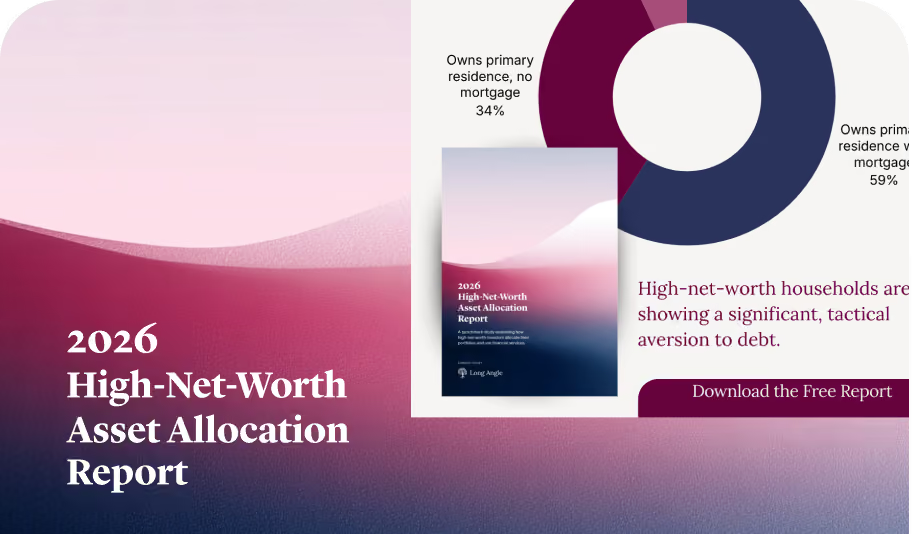
2026 High-Net-Worth Asset Allocation Report
See how high-net-worth investors with an average net worth of $17M are allocating across public equities, private markets, real estate, bonds and cash. Based on benchmark data from 230+ respondents.

What Success Looks Like for the Rising Generation
Success for a child in an affluent family is defined no differently than for any other family: genuine competence in something, meaningful relationships, a way to contribute, and a self-authored vision for their own life. Wealth does not change the destination. It changes the terrain.
The specific way wealth changes the terrain is by functioning as a buffer. A family with significant resources can solve problems before their children encounter them. The attorney gets called. The credit card handles it. The difficult conversation gets avoided. Each solved problem is, at the same time, a missed developmental experience. Kristin Keffeler draws a direct analogy to physical health: if you stop using a muscle, it atrophies. The capacity to navigate difficulty, make decisions under uncertainty, and recover from failure is built through practice. Removing the practice removes the development.
The most damaging psychological pattern Keffeler sees is what she calls comparing insides to outsides. A child growing up in a family where one parent built something significant has watched that parent achieve something they do not yet understand fully. What they see is the external result: the house, the resources, the recognition. What they cannot see is the full interior of that journey: the failures, the bad bets, the periods of genuine uncertainty. By the time the child is old enough to be aware of the comparison, they are already measuring their own uncertain interior against a curated external image of their parent's success.
Keffeler knows this dynamic personally. When her father sold his company, she was 23 and working toward a master's in public health, planning a career in public service. She remembers thinking, with clarity she still carries: I will never make as much money as my dad, and is that good enough? That question, lodged in a 23-year-old who genuinely wanted to do something different with her life, is the direct product of measuring her inside against her father's outside. The antidote is not to hide the success. It is to make the full story visible, including the parts that did not go as planned.
Watch the Full Conversation
This article draws on a Navigating Wealth conversation with Kristin Keffeler, where we discuss the developmental framework for raising children in affluent families, the five most common mistakes, how to structure trusts that build independence, and how to write a letter of wishes that turns a legal document into a relationship. Watch the full episode for the broader discussion.
Subscribe on YouTube · Get weekly episode updates
Kristin Keffeler is Chief Learning Officer at JFG Family Office and co-author of Wealth 3.0, a book on the evolution of family wealth advising. She is a second-generation member of a wealth-creating family and has spent 20 years as a Rising Gen coach working with heirs and parents across the full arc of family wealth transitions. She specializes in human motivation, behavioral change, family governance, and the developmental psychology of growing up in affluent families.
The Framework: Self-Determination Theory Applied to Wealth
Self-determination theory, developed by psychologists Edward Deci and Richard Ryan, holds that a self-directed life requires three things: autonomy (the ability to direct your own life), competence (effectiveness in domains that matter to you), and relatedness (the capacity for genuine, productive relationships). Raising a capable heir means building all three. Poorly designed trusts can undermine all three at once.
The three components are interdependent. A person who has autonomy and competence but no meaningful relationships has a different kind of problem from someone who has relationships and competence but whose major life decisions are made for them by someone else. The goal of raising children in affluent families is to produce adults who have all three.
The reason trust design matters so much in this framework is that a poorly structured trust can work against every component simultaneously. A trust that requires a beneficiary to seek approval for every significant expenditure removes autonomy. A trust that withholds financial education from the beneficiary prevents them from building competence as a future wealth owner. A trust administered by a parent creates a relationship dynamic where the child does not know whether they are talking to their parent or their trustee, which corrupts the most important relationship in the developmental picture.
Understanding this is what turns the five mistakes below from a list of dos and don'ts into a coherent diagnosis. Each mistake is a failure of at least one of the three legs: autonomy, competence, or relatedness. For a deeper look at the practical tools that build financial agency in children before they reach the trust-design stage, the post on the invisible allowance and practice money covers the earlier developmental work that sets the foundation for everything Keffeler describes here.
The Five Mistakes Wealthy Parents Make
The five mistakes share one root cause: each either strips away a developmental experience the child needed, or attaches shame and confusion to money. Most come from love, not indifference, which is exactly what makes them hard to see from inside the family.
Mistake 1: Sharing specific financial information too early, without the context framework in place.
Before a child has a developed sense of their own identity and values, specific numbers create stories that are extremely difficult to undo. Keffeler's own experience is instructive: when she learned what her father's company sold for, she immediately began calculating how it might be divided among her siblings. That calculation was not relevant to anything happening in her life at 23. But the number lodged in her mind and became a measuring stick she carried for years. The problem is not that the child learns about wealth. It is that they learn the number before they have the internal framework to understand what it means, what it does not mean, and what their own relationship to it should be.
Mistake 2: Waiting too long.
The mirror image of the first mistake, and equally common. When parents defer financial conversations until children are in their 40s or 50s, or until a major wealth event occurs, they leave their heirs with no framework for integrating the information. The people who could have helped them learn (the parents who built the wealth) are aged or gone by the time the money arrives. Keffeler finds this genuinely heartbreaking: a 60-year-old receiving a significant distribution with no one left who can help them understand what their family stood for when they created it.
Mistake 3: False scarcity.
Pretending the family has less than it does, or living as if wealth does not exist, creates shame and confusion rather than values. Children are observant. They can look up the house on a real estate website. They know whether their family's lifestyle differs from their neighbors'. When the message at home contradicts what they can see with their own eyes, the result is not that they internalize healthy values around money. It is that they develop shame and confusion about why their family does not match their reality. Keffeler describes a third-generation family member whose mother deliberately dressed him in secondhand clothes and lived in a small house to create the appearance of normalcy, while his grandfather arrived on a private jet to take him on vacation with cousins who lived very differently. The inconsistency did not produce a values-aligned adult. It produced someone with unresolved shame about his own identity.
Mistake 4: Overly permissive access.
Handing a 21-year-old a multimillion-dollar trust without the developmental preparation to manage it is not generosity. Keffeler describes it as handing someone the keys to a sports car before they know how to drive. The damage is not necessarily dramatic. It is quieter: the heir who never had to develop competence, because they never had to, and who reaches middle age having never needed to build the skills that a meaningful life requires.
Mistake 5: Overly controlling from fear.
This is the most common mistake Keffeler sees, and the one that most directly contradicts what the parents intended. Parents who are deeply worried about wealth's potential to harm their children sometimes structure trusts so restrictively, withhold information so completely, and restrict access so thoroughly that the heir reaches adulthood without autonomy, without competence, and without a healthy relationship with the family's financial situation. The fear is understandable. The outcome is the one the parents were most trying to prevent. A child whose financial life has been managed for them by others does not become independent at 40 just because the trust structure eventually releases funds. They have not had the practice.
When to Tell Your Kids the Numbers
There is no single right age to tell children how much the family is worth. Developmental readiness matters more than a birthday. Share the family's values, identity, and stories of failure and recovery first; disclose specific numbers only once that framework is in place and the child is ready to hear them without turning the figure into a measuring stick.
The question that comes up most often in Keffeler's work is the simplest-sounding one: at what age do you tell your children how much the family is worth? Her answer is that the age is the wrong question. The right question is whether the context framework is in place first. Before specific numbers are shared, children need to understand who the family is: what they stand for, what they believe in, and what success and fulfillment look like to them, in terms that have nothing to do with a balance sheet. They need to know the stories of failure and recovery along the path to whatever the family built. They need a developed enough sense of their own identity that a large number does not automatically become the measuring stick against which they evaluate themselves.
In practical terms, Keffeler describes a rough staging that families can adapt to their own situation and their specific children:
- Birth to school age: ordinary parenting. Model character, perseverance, and the kind of person you want your child to become.
- Early school years: begin family conversations about who we are and what we stand for. Not formal meetings, but dinner-table conversations that seed a sense of family identity.
- Teens: more structured conversations about family values and expectations. Keffeler's daughter is a horse rider; Keffeler invests in that passion and expects her daughter to show up fully for it. The investment is conditional on engagement. That is a values conversation, not a financial one.
- Late teens to early 20s: introduce the vocabulary of trusts and estates, not as a revelation but as education. What is a grantor? What is a trustee? What is a trust?
- When developmentally ready: share specific numbers. This varies by individual. Keffeler has seen children ready at 22 and others for whom the same conversation at 30 would have been more appropriate.
The guiding principle Keffeler offers is first, do no harm. The parents know their children better than anyone. The task is to trust that instinct, while making sure the framework is in place before the numbers arrive.
The Spending Modeling Conversation
What children learn from how their parents spend is not driven by the size of the purchases. It is driven by whether the choices are made deliberately and explained. A family that spends on what it values and can articulate why is teaching discernment. A family that spends reflexively is teaching nothing at all.
One of the questions raised in this conversation surfaces often in the Long Angle community: what does it model to children when parents use their resources to remove friction from daily life? A useful example came up in the discussion: driving a 20-year-old car not to practice false scarcity but out of genuine indifference to cars, while paying for a housekeeper and yard help because that time is worth buying back. These choices are not contradictory. They reflect an underlying value (spend on what matters to you, do not spend on what does not) and they are expressed consistently.
Keffeler's point is that the specific choices matter less than whether they are made deliberately and explained. A family that always flies business class is not automatically modeling entitlement. A family that flies business and can explain to their children why they made that choice, what it costs, and what it means to be discerning about how you use resources is doing something entirely different from a family that flies business because that is just what they do without ever thinking about it.
The question that comes up most often in this category is air travel, which has been a recurring topic in the Long Angle community: business class or economy, parents in business and children in economy, and so on. The answer, in Keffeler's framing, is that there is no universal rule. What there is: a deliberate choice, a values-based explanation, and age-appropriate conversations with children about why the family uses its resources the way it does. A rising adult who is beginning to spend their own money needs to understand the difference between a need and a want, and they learn that from watching how their parents navigate the same question.
The Apprenticeship Model of Trust Design
The apprenticeship model designs a trust as a developmental sequence rather than a one-time transfer of control. The heir moves through defined stages, beneficiary, then co-trustee, then co-trustee with the power to choose their own co-trustee, building competence and autonomy in order, with a mentor and guardrails present the whole way.
The structural question that follows all of the developmental work is: how do you design a trust that builds independence rather than dependency? Keffeler's answer mirrors the stages of self-determination theory, building competence first, then autonomy, with relationships maintained throughout.
- Early 20s, beneficiary and student. The heir learns that a trust exists and begins meeting with the family's advisors. This is education, not control. They learn what is in the trust, how portfolios are invested, and what it means to be a future wealth owner. They are not yet making decisions; they are building the knowledge that makes good decisions possible.
- Around 30 to 35, co-trustee with a mentor. The heir becomes a co-trustee alongside the existing trustee, building active skill and autonomy with a structural check still in place. The trustee can flag concerns, ask questions, and slow down premature decisions. The relationship stays intact because it evolved rather than being handed over all at once.
- Later, co-trustee with selection power, plus a trust protector. The heir can select their own co-trustee while a trust protector remains as a final guardrail. The protector's role is narrow and rarely activated: to step in if something goes genuinely wrong. The structure has progressively transferred competence and autonomy while keeping enough relational scaffolding that a bad year does not become an unrecoverable mistake.
The failure case discussed in the conversation is the 60-year-old who still has to ask someone else for permission to buy a car. That outcome is not unusual in families where the trust was designed to protect rather than to develop. The protection was real. So was the developmental arrest. The point of the apprenticeship model is to hold both: protect the assets and build the person.
The Letter of Wishes
A letter of wishes is a non-binding document that accompanies a trust and explains the grantor's intent in plain language. Where the trust document sets the rules, the letter of wishes establishes the relationship. The most effective ones open by naming the heir's specific strengths, state explicitly that the money is a gift of love, and describe what the wealth is meant to support and what it is not meant to replace.
Keffeler believes every grantor should write one. Many do not.
The most effective letters she has seen begin with affirmation: a specific, genuine recognition of who the heir is and what the grantor sees as their particular strengths and potential. This is not generic encouragement. It is evidence that the parent saw the child clearly, and that evidence matters far more than people realize. Many adult heirs carry, for years, the uncertainty of whether their parents really knew them.
The letter should then make the intent of the trust explicit, in plain language rather than legal language. Something like: this is a gift of love. Our hope is that these resources will support you to pursue meaningful work, to build a life you author yourself, and to have the foundation to take a worthwhile risk. Our hope is that it will not replace the satisfaction of earned contribution or the sense of mattering that comes from building something yourself.
Keffeler's suggested opening ("this is a gift of love") is not a platitude. It is a reframe. A trust document is a legal instrument. A letter of wishes that opens with those words tells the heir, before anything else, that the structure around the money is an expression of care rather than an apparatus of control. That reframe changes how the beneficiary reads everything that follows. The letter also protects the trustee: when a trustee is navigating a difficult distribution decision, a well-written letter of wishes gives them context for what the grantor wanted, rather than leaving them to interpret a legal document with no guidance about the person behind it.
For parents thinking about how high-net-worth families think about wealth across generations and how to integrate these conversations into a broader financial and life planning framework, the 2026 asset allocation report captures current patterns from 230+ respondents at this stage.
Final Thoughts
The parents who navigate this well are not the ones who got every decision right. They are the ones who stayed intentional, stayed in conversation, and kept making small adjustments as they understood their children better. Keffeler's closing observation is the one worth holding: trust your instinct, pour love into your family, and know that as long as you stay in conversation with your children, you can navigate almost anything together.
The structural tools (the trust design, the letter of wishes, the staged information disclosure) exist to support that relationship, not to substitute for it. The most durable inheritance any child receives is not the assets. It is the evidence that their parents saw them clearly, loved them specifically, and wanted something real for their lives.
Frequently Asked Questions
What are the most common mistakes wealthy parents make raising their kids?
According to family wealth researcher Kristin Keffeler, the five most common mistakes are: sharing specific financial information too early without context, waiting too long to share anything, practicing false scarcity, being overly permissive with access to money, and being overly controlling out of fear. Each either removes a developmental experience the child needed or attaches shame and confusion to money. Most stem from love rather than neglect, which is what makes them so hard to recognize from inside the family.
When should you tell your children about your family's wealth?
There is no fixed right age. Developmental readiness matters more than a birthday. Before sharing specific numbers, children benefit from a clear sense of who the family is, what it stands for, and what success looks like in non-financial terms. In practical terms, the vocabulary of trusts and estates can be introduced in the late teens and early 20s, and specific numbers when the child is developmentally ready, which varies by individual. The guiding principle is first, do no harm.
What is the rising generation in the context of family wealth?
The rising generation refers to the children and grandchildren of wealth creators who are on a developmental path toward eventually becoming wealth holders. The term is used in family wealth advising to distinguish the generation that built the wealth from the generations who will inherit it, and to focus attention on the developmental needs of those heirs rather than treating them primarily as beneficiaries of a financial transfer.
What is self-determination theory and why does it matter for raising children with wealth?
Self-determination theory, developed by psychologists Edward Deci and Richard Ryan, is one of the most well-researched frameworks in motivational psychology. It identifies three components of a self-directed life: autonomy (the capacity to direct your own life), competence (effectiveness in specific domains), and relatedness (the ability to be in positive, productive relationships). It matters for raising children with wealth because poorly structured trusts and financial environments can undermine all three at once, producing adults who are financially provided for but developmentally stunted.
What is a letter of wishes in a trust and what should it include?
A letter of wishes is a non-binding document that accompanies a trust. Unlike the trust document itself, it is not legally enforceable; it is directional, giving trustees and beneficiaries context for the grantor's intent. The most effective letters begin with an affirmation of the heir's specific strengths, state explicitly that the money is a gift of love, describe what the grantor hopes the resources will support, and describe what they hope the resources will not replace. It is the relational layer on top of a legal instrument.
What is false scarcity in parenting and why is it harmful?
False scarcity is the practice of living as if the family has fewer resources than it does, usually to instill values around money and work. It tends to backfire because children can observe the reality around them: the house, the vacations, the inconsistencies. When the message at home does not match what they can see, the result is shame and confusion rather than values. Authenticity about the family's situation, communicated age-appropriately, is more protective than denial.
How do you design a trust that builds independence rather than dependency?
The apprenticeship model treats trust design as a developmental sequence. In early adulthood, the heir learns the trust exists and meets with advisors, building knowledge. In the mid-20s to 30s, they receive specific information and begin active engagement with how the assets are managed. Around 30 to 35, they become a co-trustee alongside an experienced trustee, building skill with a mentor present. Eventually they select their own co-trustee, with a trust protector remaining as a final guardrail. Each stage builds autonomy and competence in sequence rather than transferring control all at once.
How much money can ruin a child, and does the amount matter?
The amount matters less than the structure and context around it. In Keffeler's framework, harm comes not from a dollar figure but from money that arrives without developmental preparation, or that removes the experiences a child needs to build competence and autonomy. A modest inheritance handed over with no framework can do more harm than a large one delivered through staged access, financial education, and a clear statement of purpose.
Is it better to give children money during your lifetime or leave it as an inheritance?
Both approaches can work; the difference-maker is whether the transfer is used as a developmental opportunity. Giving during your lifetime lets you observe how an heir handles resources and mentor them while you still can, which addresses the "waiting too long" mistake. Leaving it entirely as an end-of-life inheritance forfeits that mentorship window. Either way, staged access, financial education, and a letter of wishes matter more than the timing itself.
Long Angle members with children at every stage navigate these decisions together
What to say, when to say it, how to structure the financial environment for kids who will inherit something significant. The conversations are candid, solicitation-free, and grounded in real experience rather than theory.
More From Long Angle
Beyond Wealth Newsletter
Navigating Wealth Podcast
Research & Studies
Alternative Investment Education
Blog