Written by Ryan Morrison


What Really Drives Inflation: One Fund Manager's Two-Variable Framework
Based on a Navigating Wealth conversation with Jay Hatfield.
What Really Drives Inflation: One Fund Manager's Two-Variable Framework
Fund manager Jay Hatfield argues that sustained inflation comes down to two variables: the money supply and the price of oil. Everything else (deficits, unemployment, "unanchored expectations") is a symptom or a distraction. Here is his contrarian monetarist framework, the mainstream case against it, and the durable investing discipline underneath.
Ryan Morrison
In Hatfield's framework, sustained inflation comes from just two sources: growth in the money supply and shocks to the price of oil. Everything else that gets blamed for inflation (government deficits, low unemployment, "unanchored expectations") is, in his view, either a symptom or a distraction. This is a monetarist position, associated with Milton Friedman, and it leads to conclusions that often run opposite to the consensus, including the call that a high headline inflation print driven by oil can be followed by rate cuts rather than hikes.
It is easy to read an inflation report the way you read a weather forecast: the headline number goes up, and the mood in the room changes with it. Jay Hatfield thinks that reaction usually gets the causation backward. A CPA with a monetary-economics background and 38 years on Wall Street, Hatfield runs Infrastructure Capital Advisors and has spent more than a decade forecasting inflation and oil prices from a framework that puts almost everything down to two variables. His view is contrarian, occasionally at odds with mainstream macroeconomics, and worth understanding precisely because it forces a clearer question than the headline number invites: what is moving the index, and is that thing durable?
Key Takeaways
- Hatfield's framework attributes sustained inflation to two variables: the money supply and the price of oil. When both are stable or falling, he argues, a high headline number is unlikely to persist.
- The distinction between headline and core inflation matters. An oil-driven spike shows up in headline CPI first, and only "bleeds through" to core prices to a limited degree.
- He argues government deficits do not drive inflation on their own, because deficit spending crowds out private investment rather than adding net stimulus, unless the central bank is expanding the money supply to fund it.
- Mainstream economists and the Federal Reserve disagree with parts of this view, particularly the dismissal of inflation expectations, which the Fed treats as central to price stability.
- The most portable takeaway is an investing discipline, not a market call: separate the durable driver of a price move from the temporary one, and be wary of acting on a view before the market is ready to reward it.
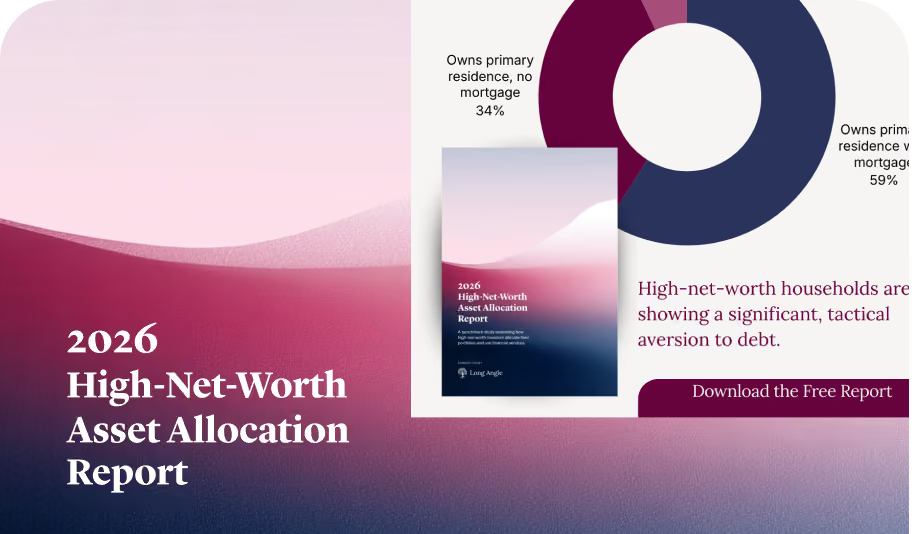
2026 High-Net-Worth Asset Allocation Report
See how high-net-worth investors with an average net worth of $17M are allocating across public equities, private markets, real estate, bonds and cash. Based on benchmark data from 230+ respondents.

The Two-Variable Framework: Money Supply and Oil
Hatfield's core claim is that sustained inflation has two causes: expansion of the money supply and shocks to the price of oil. If neither is present, he argues, a high inflation reading is likely temporary and self-correcting.
The reasoning rests on the monetarist tradition associated with the economist Milton Friedman, who held that inflation is, in the long run, a monetary phenomenon: too much money chasing the same quantity of goods. Hatfield points to the pandemic as the cleanest recent test. When the M2 money supply expanded dramatically in 2020 and 2021, a surge in inflation followed with a lag. In his reading, that sequence confirmed the monetarist model and undercut explanations built on supply chains or fiscal stimulus alone. As of the mid-June 2026 recording, he noted the money supply was running negative year over year, which in his framework removes one of the only two engines capable of producing persistent inflation.
The second engine is oil, and it operates differently. An oil price spike pushes up the cost of anything that moves, heats, or is made with petroleum inputs, so it lands in the inflation data quickly. But Hatfield draws a sharp line between headline inflation, which includes food and energy, and core inflation, which strips them out. His argument is that an oil shock shows up immediately in the headline number and only partially "bleeds through" to core prices. Once the oil move reverses or simply stops rising, the headline number falls back toward core, often faster than forecasters expect.
That distinction is what produced his most counterintuitive position at the time of the recording: that a high headline CPI print, if it was driven mostly by oil, could be followed by interest rate cuts rather than hikes. The logic is internally consistent within the framework. If the inflation is an oil artifact and the money supply is contracting, then the durable inflation signal is already below target, and raising rates would only damage interest-sensitive parts of the economy for no benefit. Whether that specific call proved right is less important than the reasoning, which is portable to any inflation report: ask how much of the number is energy, and ask what the money supply is doing underneath it.
Watch the Full Conversation
This article draws on a Navigating Wealth conversation with Jay Hatfield, where we discuss his framework for inflation and interest rates, the lessons of the 1970s, the mechanics of oil pricing, and the investing disciplines that follow from all of it. Watch the full episode for the complete discussion, including the parts where our hosts pushed back.
Subscribe on YouTube · Get weekly episode updates
Jay Hatfield is the founder, CEO, and portfolio manager at Infrastructure Capital Advisors. He began his career as a CPA after studying economics with a focus on monetary economics, earned an MBA from Wharton, and spent roughly two decades in investment banking followed by senior roles at two hedge funds focused on utilities and energy. He has managed income-oriented funds for more than a decade and publishes macroeconomic research built around the framework described in this article. The views here are his own; Long Angle presents them as one experienced practitioner's lens, not as investment advice or an endorsement.
Why This Framework Says Deficits Don't Drive Inflation
One of the framework's most contrarian implications is that federal deficits, on their own, do not cause inflation. In Hatfield's view, government spending crowds out private investment rather than adding net demand, so it slows the economy rather than overheating it, unless the central bank is simultaneously expanding the money supply to finance it.
The common intuition is straightforward: when the government spends more than it takes in, it injects money into the economy, demand rises, and prices follow. Hatfield's counter is the concept of crowding out. When the government borrows heavily, it competes for the same pool of capital that private businesses would otherwise use, which raises the cost of capital and displaces private investment. The net effect on demand, in this reading, is closer to a wash than a boost, and the drag on private investment can slow growth.
The critical qualifier is monetary. Deficits become inflationary, in this framework, when the central bank effectively finances them by expanding the money supply, which is what Hatfield argues happened during the pandemic. Absent that monetary expansion, he treats the deficit as roughly neutral for inflation and mildly negative for growth. This is why he cautions against using the deficit as an inflation forecasting tool at all.
It is worth being clear that this is a contested position. Many mainstream economists see fiscal policy as a more direct contributor to demand and inflation than the strict crowding-out view allows, particularly when the economy has slack. The point of presenting Hatfield's version is not to settle the debate but to show how internally consistent his framework is: once you accept that only two variables drive sustained inflation, deficits necessarily drop out of the primary explanation. For readers thinking through how these macro forces reach their own balance sheets, our conversation on what a weakening dollar means for a portfolio covers a related channel that the two-variable framework tends to underweight.
What the 1970s Teach About Inflation
The 1970s are usually cited as proof that inflation, once loose, spirals through self-reinforcing expectations. Hatfield reads the same history differently: the decade's inflation was primarily an enormous oil shock, amplified by wage and price controls and heavy unionization, none of which describes today's economy.
The scale of the oil move in the 1970s is easy to underestimate from a distance. Hatfield emphasizes that crude rose on the order of 1,000 percent or more over the decade, an increase without modern parallel. Layered on top of that was a policy error: the wage and price controls imposed under President Nixon, which suppressed the price signals that would normally have brought supply and demand back into balance. Domestic oil producers, paid far below the market price, cut production, which deepened the shortage. Roughly a quarter of the workforce was unionized, which gave wages more structural momentum than they carry now.
The conventional account of the era leans heavily on "inflation expectations becoming unanchored," the idea that once people expect prices to rise, they demand higher wages and set higher prices, and the expectation becomes self-fulfilling. Hatfield is blunt in rejecting this as the primary mechanism. In his telling, workers demanded higher wages because a 1,000 percent oil shock made survival impossible without them, not because of a psychological shift in expectations. Wages, in this view, responded to the goods shock rather than driving inflation on their own.
This is one of the sharper places where the framework departs from the mainstream, and it deserves a fair hearing on both sides. The Federal Reserve treats inflation expectations as central to its entire approach to price stability, and a large body of research supports the idea that anchored expectations are part of what has kept recent inflation from behaving like the 1970s. Hatfield's position is a minority one. What makes it useful even to a reader who ultimately sides with the Fed is the reminder that the 1970s were not a generic morality tale about letting inflation get loose. They were a specific combination of an extreme energy shock and specific policy choices, and pattern-matching today's environment to that decade without those ingredients can mislead.
Why Stagflation Is an Oil-Shock Phenomenon
Stagflation, the uncomfortable combination of high inflation and stagnant growth, is the one scenario where the Fed's two goals genuinely conflict. In Hatfield's framework, it has a single cause: a large oil shock, which raises prices while simultaneously acting as a tax on growth.
Normally, inflation and growth move together in a way that gives the central bank a clean tradeoff. When the Fed expands the money supply too much, interest-sensitive sectors like housing boom, growth accelerates, and inflation rises; when it tightens, the reverse happens. In that world, the Fed can lean against inflation by raising rates and slowing the economy, accepting a little less growth for a little less inflation.
An oil shock breaks that clean relationship. Higher energy prices push inflation up, but they also drain purchasing power and raise input costs, which suppresses growth. The result is the rare case where prices are rising and the economy is weakening at the same time. This is the scenario where the Fed's dual mandate, stable prices and full employment, cannot be satisfied with a single lever.
Hatfield's prescription for the oil-shock case is counterintuitive and, again, contested: he argues the central bank should not raise rates in response, because oil is a global commodity and domestic rate hikes do nothing to fix a global supply problem. They simply add a self-inflicted recession on top of the energy shock. He points to other central banks that tightened aggressively into energy shocks as cautionary examples. This framing leads him to his most heterodox historical claim, addressed in the next section: that even the Volcker rate hikes of the early 1980s, widely regarded as the decisive victory over inflation, were less necessary than the consensus believes. For investors, the durable insight is narrower and less controversial: when you see inflation and weak growth together, look at energy first, because that specific combination usually has an energy story underneath it. Our discussion of how to think about oil as an investment covers the supply-side mechanics that drive these shocks in more depth.
The Contrarian Calls, and Where the Mainstream Pushes Back
Hatfield holds several positions that sit well outside the economic consensus. Presenting them fairly means presenting the mainstream rebuttal alongside each, because the value for an investor is in understanding the disagreement, not in adopting either side wholesale.
On inflation expectations, Hatfield argues the concept is essentially a story economists told to explain the 1970s after the fact, and that it carries little real explanatory power. The mainstream view is close to the opposite: the anchoring of expectations is treated by most central banks as one of the primary achievements of modern monetary policy, and as part of why the post-pandemic inflation spike receded without a 1970s-style spiral. A reader does not have to resolve this to take something from it. Even if expectations matter more than Hatfield allows, his insistence on checking the money supply and oil first is a useful corrective to explanations that jump straight to psychology.
On Paul Volcker, Hatfield makes the striking claim that the early-1980s rate hikes to roughly 20 percent were not necessary to defeat inflation, and that inflation fell largely because the wage and price controls were removed and US oil production recovered. This is a minority reading. The prevailing view credits Volcker's willingness to tolerate a severe recession as the turning point that broke inflation and restored the Fed's credibility. Here the mainstream case is strong, and it is worth weighting accordingly.
On the interpretation of economic models more broadly, Hatfield is sharply critical of Keynesian frameworks and confident in the monetarist alternative. The honest summary is that professional economists remain genuinely divided on many of these questions, that no single framework has a monopoly on being right, and that a practitioner who has forecast within one consistent model for decades will naturally have more conviction than the underlying evidence can fully support. The reason to engage with a view this confident is not to be persuaded, but to borrow the discipline of it: a clear model, consistently applied, that forces you to ask what is driving a number.
The US Energy Advantage and the AI Buildout
One of the less controversial threads in the conversation is structural: the United States has abnormally cheap natural gas, and that advantage compounds as artificial intelligence drives up electricity demand for data centers.
The price gap is large. Hatfield notes that US natural gas often trades around a few dollars per unit, in part because so much of it is a byproduct of oil drilling that producers sometimes struggle to move it to market at all. In much of the rest of the world, natural gas is priced against oil on an energy-equivalent basis, which means gas and electricity prices there ran far higher when oil rose. That gap becomes a national competitive advantage precisely when demand for electricity is climbing, because a data center's economics are sensitive to the cost of power.
His conclusion follows directly: the US and other cheap-energy regions are positioned to capture a disproportionate share of the AI infrastructure buildout, because electricity is a meaningful and growing share of the cost of running these facilities. He is skeptical of more exotic proposals to relocate computing to avoid energy costs, on the grounds that domestic power is already cheap enough to make them uneconomic. Underneath the specific argument is a broader point about the US resource base that the two-variable framework returns to often: abundant domestic oil and gas is both a check on energy-driven inflation at home and a structural economic advantage. For investors weighing how this maps onto portfolios, our overviews of oil and gas and private credit both touch on the energy and rate dynamics at work here.
The Investing Lesson: Don't Confuse Being Right With Being Early
The most portable takeaway from the conversation is not a macro call at all. It is a discipline: being correct about a thesis and being correctly positioned for it are different, and acting too early is a way to be right and lose money at the same time.
Hatfield illustrated this against himself. He became convinced years ago that AI startups were absorbing large amounts of office space in Silicon Valley, a genuinely correct and early insight into a trend that would eventually help office real estate. The problem was timing. The market did not reward that thesis until much later, when the trend became visible to everyone at once. Being early, in his telling, felt no different from being wrong for a long stretch, and the position would have tied up capital and conviction the whole time.
The lesson generalizes into two rules he applies. The first is patience about turning points: there will eventually be too much data center capacity, too many chips, an overvalued market, but "eventually" can be years away, and positioning for it early is expensive. The second is a valuation discipline: he avoids momentum investing and prefers to buy growth at a reasonable price relative to that growth, using a price-to-growth lens as a rough proxy for whether a stock's expectations are sane. This keeps the framework from becoming an excuse to chase whatever is working.
Neither rule is exotic, and that is the point. Stripped of the specific predictions, the durable core of a good macro framework is a set of habits: identify the real driver of a move, separate the temporary from the structural, and resist acting before the evidence and the market are aligned. Those habits survive long after any particular forecast has expired. For a sense of how disciplined allocators are applying this kind of thinking right now, the 2026 High-Net-Worth Asset Allocation Study shows how a large group of investors is positioned across asset classes.
Final Thoughts
Jay Hatfield holds strong, specific, and sometimes heterodox views, and a fair reading requires holding them alongside the mainstream positions they challenge. On some points, particularly the role of inflation expectations and the necessity of the Volcker hikes, the weight of professional opinion runs against him. On others, particularly the discipline of separating an oil-driven headline spike from underlying inflation, the framework offers a genuinely clarifying way to read an economy that headline numbers obscure.
The reason to engage with a view this confident is not to adopt it wholesale. It is to borrow the habit underneath it: a clear model, applied consistently, that forces the useful question every time an alarming number crosses the screen. What is driving this, is that driver durable or temporary, and is the market ready to reward a position taken on it today? Those questions outlast any single forecast, which is exactly why they are worth more than the forecast itself.
Frequently Asked Questions
What really drives inflation, according to this framework?
In Jay Hatfield's monetarist framework, sustained inflation has two drivers: growth in the money supply and shocks to the price of oil. When both are stable or falling, he argues, a high inflation reading is likely temporary. This is a specific, contested view rooted in the tradition of economist Milton Friedman. Mainstream economics treats inflation as more multi-causal, giving weight to fiscal policy, labor markets, and inflation expectations alongside money and energy.
Does government spending cause inflation?
Hatfield argues that federal deficits do not cause inflation on their own, because government borrowing crowds out private investment rather than adding net demand. In his framework, deficits only become inflationary when the central bank expands the money supply to finance them. This is a minority position. Many economists view fiscal policy, especially when the economy has little slack, as a more direct contributor to inflation than the strict crowding-out argument allows.
What causes stagflation?
Stagflation, the combination of high inflation and stagnant growth, is caused in this framework by a large oil shock, which raises prices while simultaneously suppressing growth. That combination breaks the normal tradeoff the Fed relies on, because raising rates to fight the inflation would deepen the growth slowdown without addressing the global energy cause. This is why stagflation is rare: it requires a specific energy-driven shock rather than an ordinary overheating economy.
What caused the inflation of the 1970s?
Hatfield attributes 1970s inflation primarily to an enormous oil shock, on the order of a 1,000 percent increase in crude prices, amplified by Nixon-era wage and price controls that suppressed normal price signals and by high unionization that gave wages structural momentum. He rejects the popular explanation that "unanchored expectations" were the primary driver. The Federal Reserve and most economists give expectations far more weight than he does, and treat anchoring expectations as central to modern price stability.
What is the difference between headline and core inflation?
Headline inflation includes all prices, including food and energy. Core inflation strips out food and energy because they are volatile. The distinction is central to Hatfield's framework: an oil price spike shows up immediately in headline inflation but only partially passes through to core prices. When the oil move reverses, headline inflation tends to fall back toward core, which is why he treats an oil-driven headline spike as likely temporary rather than a sign of persistent inflation.
Does the money supply still predict inflation?
Hatfield argues it remains the single most important variable, pointing to the pandemic era, when a sharp expansion of the M2 money supply was followed by a surge in inflation. Critics note that the relationship between money supply and inflation has been unreliable across other periods, which is part of why most central banks stopped targeting the money supply directly decades ago. The honest position is that money supply is one useful input among several, and that no single variable forecasts inflation reliably on its own.
Reading the macro environment well is a lot easier alongside peers who bring different frameworks to the same data.
Long Angle members translate macro views into real portfolio decisions and pressure-test each other's thinking on inflation, rates, and positioning, in a setting with no products being sold. See how members are putting these ideas to work.
More From Long Angle
Beyond Wealth Newsletter
Navigating Wealth Podcast
Research & Studies
Alternative Investment Education
Blog