Written by Scott Nixon



Trust Fund Kids: How Much Is Too Much to Leave Your Children?
Trust Fund Kids: How Much Is Too Much to Leave Your Children?
Long Angle members navigating this at the higher end of the wealth spectrum tend to frame it less as "how much is safe" and more as "at what level does money start doing things to a person that money shouldn't do."
Scott Nixon
Warren Buffett's framing is the most-quoted answer to one of wealth's hardest questions: leave children enough to do anything, but not so much that they do nothing. It's a useful provocation. It is not a planning framework. The harder question, what number actually satisfies that standard, and how should it be structured, is the one that tends to surface when a family's net worth crosses into nine figures and the trust they set up years ago no longer reflects their reality. That is the conversation Long Angle members are navigating in real time.
Key Takeaways
- No universal number exists, but Long Angle members identify roughly $10–$15M per beneficiary as a behavioral bend point where distortion risk begins to escalate meaningfully
- Staggered distribution (limited access early, meaningful tranches in the 30s, fuller access later) is the most common structural approach
- Timing often matters more than amount: financial support in the 25–40 window tends to have more impact than a larger inheritance received in a beneficiary's 50s or 60s
- Preparation (financial literacy, real-world independence, lived experience before significant access) shapes outcomes more than trust mechanics alone
- Generational wealth decay is a documented mathematical risk, not just a cultural cliché, even with well-designed dynasty trusts
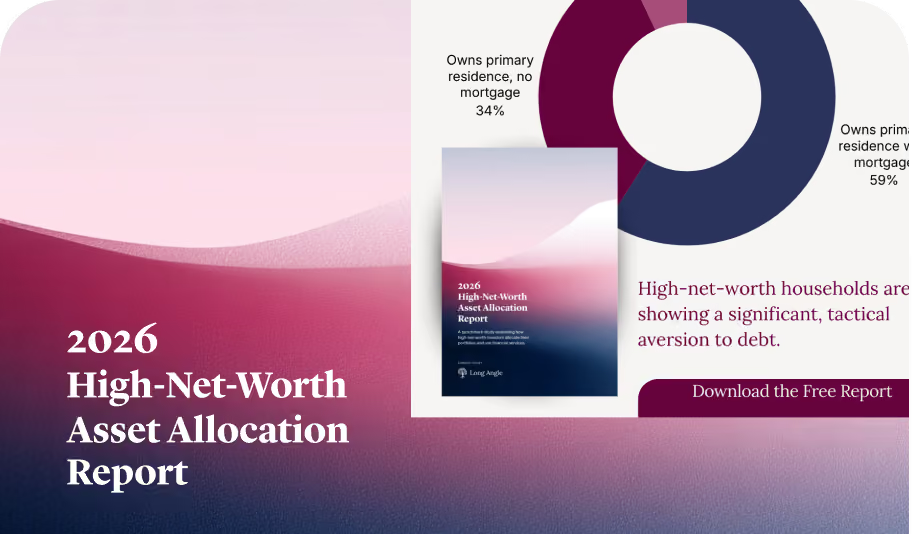
2026 High-Net-Worth Asset Allocation Report
See how high-net-worth investors with an average net worth of $17M are allocating across public equities, private markets, real estate, bonds and cash. Based on benchmark data from 230+ respondents.
The "Enough to Do Anything" Question Is Harder Than It Sounds
The Buffett line is helpful philosophy, but it leaves the hard work undone. What counts as "enough to do anything" depends entirely on the child, the city, the life they want to build, and what behaviors you are trying to protect against. A figure that enables a teacher's lifestyle in Des Moines is not the same figure that enables a startup founder in San Francisco. And the same dollar amount can land differently at 25 than at 55.
The more productive starting point is not the number itself but the underlying concern: does the inheritance change the beneficiary's relationship to work, ambition, and self-sufficiency in ways that harm them? Long Angle members navigating this at the higher end of the wealth spectrum tend to frame it less as "how much is safe" and more as "at what level does money start doing things to a person that money shouldn't do."
Two schools of thought emerge consistently in the Long Angle community. The first holds that well-raised children will handle wealth responsibly regardless of the amount, and that capping inheritance in favor of philanthropy is a failure of trust in the people you raised. The second holds that no amount of good parenting fully insulates a person from the behavioral effects of large, unconditional wealth — and that structural constraints protect children from risks they cannot yet see. Both positions have strong internal logic. The practical answer most Long Angle members land on is somewhere between them.
Where Behavioral Distortion Starts to Matter
Long Angle members report that behavioral distortion risk rises meaningfully above roughly $10–$15M per beneficiary in today's dollars — not because of any bright legal line, but because of what that figure enables.
Below $5M, wealth is largely invisible. It can pay off debt, fund a down payment, provide a financial cushion, or enable a career risk. It does not, on its own, allow a person to opt out of building a life. At $5M, someone can live modestly in most of the country without working, but the lifestyle it supports is not one that most people with ambitious parents would find satisfying for long.
The picture changes materially as the number climbs. Above $10–$15M, a beneficiary can sustain a genuinely comfortable life in virtually any city without meaningful professional engagement. The lifestyle it supports becomes harder to hide from peers, which introduces social dynamics that complicate normal relationships. The pressure to pursue something for its own sake weakens when financial failure carries no real consequence. None of these effects are inevitable — they are tendencies. But the pattern across Long Angle members who have thought carefully about this suggests that somewhere in the $10–$15M range is where those tendencies become harder to manage through parenting alone.
One member built a graduated trust framework specifically to account for this. Starting from a small annual allowance at 18, the structure increases distributions on an inflation-adjusted curve, reaching enough for comfortable retirement by the late 30s and capping total exposure at roughly $15M per beneficiary in today's dollars. The trust includes carve-outs for specific situations (early family formation, entrepreneurial ventures, medical needs) and terminates itself between ages 45 and 55. The reasoning behind the cap was not tax-driven. It was behavioral. The member noted, with some irony, that the figure landed close to the current federal estate tax exemption — not by design, but perhaps not entirely by coincidence either.
Above $75M per beneficiary, most Long Angle members see distortion risk as high regardless of structure or preparation. At that level, the wealth is difficult to conceal, lifestyle optionality becomes nearly unlimited, and the social environment around the beneficiary shifts in ways that are hard to counteract.
Staggered Distribution Is the Default — But the Design Varies Widely
Most Long Angle members favor staggered trust distributions over lump-sum inheritance, but the age milestones, amounts, and conditions vary significantly by family goals and individual circumstances.
The most common pattern involves a nominal distribution at 18, enough to cover spending money without meaningful financial independence, followed by more purposeful access in the late 20s for specific life purchases such as a home or business investment, then larger tranches at 30 and 35, with full or near-full access by the mid-40s or early 50s. Some structures include a complete trust termination date after which assets pass outright; others keep funds in trust indefinitely for asset protection purposes.
The structural debate often comes down to two competing goods: flexibility versus protection. HEMS provisions (distributions limited to Health, Education, Maintenance, and Support) give trustees wide discretion to respond to genuine need without creating an entitlement to arbitrary distributions. Fixed age-based schedules, by contrast, give beneficiaries clearer expectations and reduce the potential for trustee conflict, but they can produce outcomes the grantor never intended when circumstances change.
A middle path that Long Angle members often reach for is co-trustee access at a specified age, typically 35, where the beneficiary gains meaningful input into investment and distribution decisions without acquiring unilateral control. This approach preserves the asset protection benefits of keeping funds in trust while gradually building the beneficiary's financial judgment through direct participation.
One concern that appears consistently in Long Angle discussions is the risk of over-engineering: building a trust structure so prescriptive that it micromanages a child's life from the grave. The most thoughtful frameworks tend to pair structured distributions with explicit trustee discretion for circumstances the grantor could not anticipate, a failed business, an early family, a health crisis, rather than attempting to write rules for every contingency.
For more on the trust vehicles most commonly used in high-net-worth estate planning, including irrevocable trust structures and dynasty trust considerations, see Long Angle's estate planning guide.
Timing Often Matters More Than Amount
A member who received $1–3M at 25 in the right circumstances would have found it more life-changing than $10M at 60, when career, family, and lifestyle decisions have largely already been made.
The 25–40 window is when financial support enables the biggest irreversible decisions: where to live, whether to start a business, how many children to have, whether to take a lower-paying career path that matters more. Most of these decisions are made before peak earnings arrive, and the financial constraints that shape them (mortgage stress, childcare costs, the gap between early-career income and early-family expenses) are real and compressive. A relatively modest transfer during this window can meaningfully change the decisions a person makes. A large transfer after these decisions are settled changes far less.
This is the argument for giving during life rather than at death. Beyond the practical impact, it has one advantage that posthumous transfer does not: parents can observe the outcome. The philanthropist and author Bill Perkins has documented this reasoning extensively, arguing that the highest-value financial gift to a child is timed to when it can most change the trajectory of their choices, not when it is most convenient for estate planning.
The timing argument also intersects with longevity. Long Angle members in their 40s with 9-figure net worth and long family life expectancies may realistically be looking at a scenario where their children are in their 50s or 60s before any estate transfer occurs. At that point, children are typically past the decisions where wealth would have done the most good. The argument for structured lifetime gifts, particularly for housing, family formation, and early entrepreneurial capital, becomes stronger as life expectancies extend.
For members thinking about tax-efficient structures for transferring assets to children during life, Long Angle's guide to transferring wealth to family covers the most relevant mechanisms, including the gift tax annual exclusion, superfunding 529 plans, and intra-family loans.

Generational Wealth Rarely Survives Three Generations — Here's Why
Research on dynasty trusts shows that even a well-funded $30M trust designed to provide $50,000 per year in after-tax, inflation-adjusted income will likely fail to support all branches of a family before the second generation has died.
This finding, from Victor Haghani and James White of Elm Wealth, authors of The Missing Billionaires, is counterintuitive to most people who assume that a large enough starting pool can sustain a family indefinitely. The problem is not poor investment returns. It is uncertainty compounding across branching families, variable lifespans, and the gap between inflation-adjusted spending and real standard-of-living growth. A family that spent the average US per-capita amount in 1900 and simply kept up with CPI through 2022 would be spending $5,000 per year — a fraction of average current expenditure. Keeping pace with CPI is not the same as maintaining a standard of living.
The practical implication is not fatalism about generational wealth. It is a realistic expectation that even carefully structured trusts require active stewardship, ongoing financial education across generations, and at least one capable financial decision-maker in each generation to have a realistic chance of sustaining capital. Families that preserve wealth across multiple generations tend to share some combination of active financial engagement, realistic distribution policies, and a cultural emphasis on building rather than spending.
The "shirt sleeves to shirt sleeves in three generations" observation exists in nearly every culture because the pattern is real. The third generation typically lacks the builder's firsthand relationship with capital — not because they are worse people, but because their experience of wealth is categorically different from the experience of building it. No trust structure fully closes that gap. What it can do is buy time, provide structure, and reduce the speed of dissipation while the next generation develops its own orientation toward money. Long Angle members who are thinking about this across a generational horizon often find that the most important planning decision is not how the trust is written but how financially literate and independent their children are before they ever access meaningful wealth.
Frequently Asked Questions
How much inheritance is too much for children?
No universal threshold exists, but Long Angle members generally identify roughly $10–$15M per beneficiary in today's dollars as a behavioral bend point — enough to enable full lifestyle independence, which can reduce the incentive to build independently. Above $75M, most members see meaningful distortion risk as difficult to avoid regardless of parenting quality or trust structure.
What is a trust fund kid?
A trust fund kid is someone whose parents or grandparents placed assets in a trust that distributes to them at specified ages or upon meeting specific conditions. The term carries a cultural connotation of entitlement, but the structure itself is neutral — outcomes depend heavily on preparation, parenting, and how the trust is designed to build financial judgment over time rather than simply deliver money.
What is the best age to distribute a trust to children?
Most Long Angle members favor staged distributions beginning in the late 20s, with meaningful tranches at 30 and 35 and fuller access by the mid-40s or early 50s. Earlier access is typically limited to specific purposes (education, a home purchase, starting a business) rather than unrestricted distribution. Co-trustee access at 35 is a common middle-ground structure that builds financial agency without full control.
Should I give money to my children now or leave it as an inheritance?
Giving during life typically produces more impact than an equivalent posthumous transfer. The 25–40 window is when financial support enables the biggest life decisions — housing, family formation, entrepreneurial risk. Waiting until death means children may be in their 50s or 60s before they receive the assets, reducing the transfer's effect on the decisions that actually shaped their lives.
Does generational wealth last past three generations?
Rarely, by the evidence. Research from Elm Wealth on intergenerational wealth transfer shows that even well-funded dynasty trusts can fail to support all family branches within two generations — not because of poor investment returns, but because of uncertainty compounding across branching families, variable lifespans, and the gap between CPI-adjusted spending and real standard-of-living expectations.
What is HEMS in a trust?
HEMS stands for Health, Education, Maintenance, and Support — a legal standard that defines the purposes for which a trustee can make discretionary distributions. It is deliberately broad so that trustees can respond to genuine need and hardship without triggering an entitlement to arbitrary distributions. Many Long Angle members prefer HEMS-based trusts over fixed-schedule structures because they preserve trustee judgment while providing meaningful flexibility.
Final Thoughts
The trust fund kids problem is not really a problem of how much. It is a problem of preparation. The amount matters, the structure matters, and the timing matters — but none of those decisions produces good outcomes without children who understand money, have built some version of a real life before inheriting a large one, and have developed an orientation toward wealth that does not depend on it for identity or meaning.
The most durable thing a family can do in service of a responsible inheritance is not the trust mechanics. It is the decade or two of financial education, independence, and lived experience that precedes any meaningful transfer. The trust is the container. The preparation is what determines whether the container helps or harms.
The questions around inheritance, generational wealth, and what to actually build for the next generation are exactly the kind of high-stakes, hard-to-discuss decisions Long Angle exists for.
Long Angle is a vetted community of high-net-worth entrepreneurs, executives, and investors who compare notes on the financial and life decisions that actually matter (candidly, peer to peer, with no advisors in the room selling anything. Members navigate estate planning, wealth transfer, trust structure, and the deeper question of what they are really trying to build) for themselves and for the people who come after them. These conversations happen at every wealth level in the $5M–$50M+ range, across every life stage. If that is the room you have been looking for, Long Angle accepts applications on a rolling basis.
More From Long Angle
Beyond Wealth Newsletter
Navigating Wealth Podcast
Research & Studies
Alternative Investment Education
Blog