Written by Scott Nixon


Where Do Millionaires Keep Their Money? How Much Cash They Hold, and Where
Where Do Millionaires Keep Their Money? How Much Cash They Hold, and Where
Wealthy households keep about 5% to 6% of net worth in cash, mostly at brokerages. What they hold by wealth tier, where it sits and how it's protected.
Scott Nixon
Households worth $2 million to more than $25 million keep about 5% to 6% of their net worth in cash and equivalents, and most of that cash sits at brokerages, according to two 2026 Long Angle studies. Median cash management balances run $150,000 at $2 million to $5 million in net worth, $337,000 at $10 million to $25 million and $350,000 above $25 million, with checking balances of $20,000 to $90,000. Fidelity (28%) and Schwab (27%) are the most-used cash managers.
Key Takeaways
- Cash and equivalents make up 5% to 6% of net worth at every band from $2 million to more than $25 million in Long Angle's 2026 Asset Allocation Report.
- In dollars, median cash management balances roughly double between $5 million to $10 million ($170,000) and $10 million to $25 million ($337,000) in net worth, then level off at $350,000.
- Checking stays modest: a median $20,000 at $2 million to $5 million and $90,000 above $25 million.
- Brokerages lead: Fidelity (28%) and Schwab (27%) are the most-used cash managers, and 68% of respondents cite a high interest rate as a reason for their account.
- Entrepreneurs and lower-risk investors hold more cash, at 10% and 8% of their investment portfolios, against 6% for comparison groups.
2026 High-Net-Worth Financial Products Report
See which banks, credit cards, brokerages, lenders and insurers high-net-worth households actually use and which they recommend. Based on insights from 165 investors, entrepreneurs and executives.

How Much Cash Wealthy Households Hold
Cash takes a small, steady share of net worth as wealth rises. Respondents to Long Angle's 2026 Asset Allocation Report held 6% of their net worth in cash and equivalents at $2 million to $10 million, 5% at $10 million to $25 million and 6% above $25 million. What changes with wealth is everything around the cash: private company equity climbs from 6% of net worth to 21% across the same bands, while home equity falls from 13% to 8%.
Share of Net Worth by Asset Class and Net Worth
| Asset class | $2M-$10M | $10M-$25M | $25M+ |
|---|---|---|---|
| Cash and equivalents | 6% | 5% | 6% |
| Bonds | 5% | 5% | 5% |
| Public equities | 53% | 49% | 48% |
| Private company equity | 6% | 16% | 21% |
| Investment real estate | 13% | 9% | 8% |
| Alternative investments | 5% | 6% | 5% |
| Home equity | 13% | 11% | 8% |
Source: Long Angle 2026 High-Net-Worth Asset Allocation Report, 233 respondents, average net worth about $17M, fielded December 2025-January 2026. Share of net worth, including home equity. Cash includes equivalents such as money market funds and CDs.
The report counts money market funds and CDs as cash. The full breakdown, including portfolios measured without home equity, is in how high-net-worth investors allocate their portfolios.
How Much That Is in Dollars: Checking and Cash Management
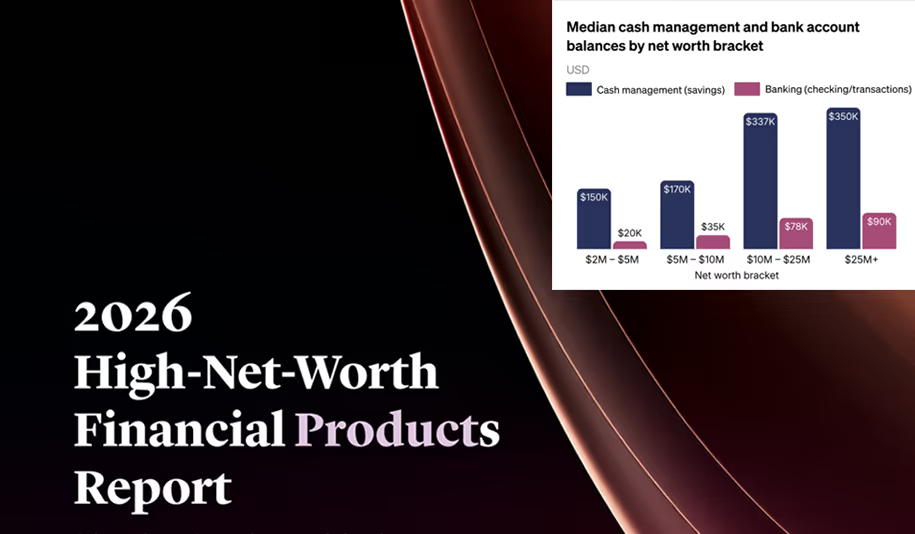
In dollars, cash at this level splits into two pools that behave differently. Respondents to Long Angle's 2026 Financial Products Report kept a median $20,000 in checking at $2 million to $5 million in net worth and $90,000 above $25 million. Their savings, or cash management, balances were several times larger: $150,000 at $2 million to $5 million, rising to $337,000 at $10 million to $25 million and $350,000 above that.
Median Cash Balances by Net Worth
| Net worth | Cash management (savings) | Checking |
|---|---|---|
| $2M-$5M | $150,000 | $20,000 |
| $5M-$10M | $170,000 | $35,000 |
| $10M-$25M | $337,000 | $78,000 |
| $25M+ | $350,000 | $90,000 |
Source: Long Angle 2026 High-Net-Worth Financial Products Report, 165 respondents, fielded July 2026. Self-reported medians.
The step between the $5 million to $10 million and $10 million to $25 million brackets is the largest in the data; above $25 million, the cash management median barely moves. Long Angle's finding on how much cash high-net-worth households hold breaks down both pools in more detail.
Where Millionaires Keep Their Money: Brokerages Over Banks
Most of that cash sits at a brokerage. Fidelity and Schwab are the two most-used cash management providers among respondents, at 28% and 27%, and roughly nine in ten of their users would recommend them. Brokerages are also the providers respondents use most for lending.
Most-Used Cash Management Providers
| Provider | Share of respondents who use it | Share of its users who recommend it |
|---|---|---|
| Fidelity | 28% | 91% |
| Schwab | 27% | 88% |
| Vanguard | 13% | 75% |
| Wealthfront | 7% | 89% |
| Capital One | 6% | 71% |
| Ally | 5% | 50% |
Source: Long Angle 2026 High-Net-Worth Financial Products Report, 165 respondents, fielded July 2026. Cash management means saving and storing cash. Providers with a low respondent count aren't shown.
The reasons respondents give explain the pattern. Asked why they use their bank or cash management accounts, 68% named a high interest rate and 62% said the account sits alongside their brokerage account, the two areas where brokerages have the edge over large banks. Branches still matter to 61%, while 21% cited a wealth management relationship and 19% a private banking relationship. The largest median balances in the study were held at J.P. Morgan and its private bank, PNC and its private bank, and Morgan Stanley.
Who Holds More Cash
Within the investment portfolio, excluding home equity, cash averages 6%, but some groups hold more. Respondents whose wealth came mainly from entrepreneurship keep 10% of their portfolio in cash, against 6% for everyone else, and those with low or moderate risk tolerance keep 8%, against 6% for those with high risk tolerance.
Cash as a Share of Investment Portfolio, by Group
| Group | Cash as a share of investment portfolio |
|---|---|
| All respondents | 6% |
| Wealth mainly from entrepreneurship | 10% |
| Wealth mainly from other sources | 6% |
| Low or moderate risk tolerance | 8% |
| High risk tolerance | 6% |
| Goal: retire early | 7% |
| Goal: leave a legacy to heirs | 6% |
Source: Long Angle 2026 High-Net-Worth Asset Allocation Report, 233 respondents, average net worth about $17M, fielded December 2025-January 2026. Average share of investment portfolio, excluding home equity.
The report doesn't ask why. A founder's higher cash share is consistent with income that arrives in lumps, such as distributions or sale proceeds, and with a portfolio already concentrated in one private company. That concentration is covered in how much company stock founders and employees hold.
Keeping Large Cash Balances Protected
Balances in the hundreds of thousands run past standard insurance limits, so where the cash sits matters. According to the FDIC, deposit insurance covers $250,000 per depositor, per FDIC-insured bank, for each account ownership category, such as single, joint, and certain retirement accounts. Deposits in different ownership categories at the same bank are insured separately. FDIC insurance doesn't cover non-deposit investment products, even when a bank sells them.
At a brokerage, SIPC protection applies if a member firm fails. Its limit is $500,000, which includes a $250,000 limit for cash. SIPC protects money market mutual funds as securities, and it doesn't protect against a fall in market value. Ask your brokerage whether your cash sits in a money market fund, at the firm, or at partner banks, since each is protected differently.
How Much Cash Should You Keep?
No single figure fits every household, and the studies record what households do. They give a reference point. At $10 million to $25 million in net worth, the median respondent kept about $337,000 in cash management and $78,000 in checking, and cash made up about 5% of net worth. A household holding far more than its peers at the same tier can ask what the cash is for: a known expense, a planned investment, or uncertainty about where to put it.
For a large known expense, some households borrow against a portfolio instead of holding cash. Whether to use a securities-based line of credit or sell compares the two.
Long Angle members compare notes on these choices: which cash management account they use, how much they keep in reserve and when idle cash is costing them. Members qualify with more than $3 million in investable assets, excluding a primary residence, verified, with no upper limit, and membership is free. Optional Trusted Circles, small peer groups that meet regularly, cost $4,500 a year.
Final Thoughts
Wealthy households keep a steady 5% to 6% of net worth in cash, and most of it sits in brokerage cash management accounts. In dollars, that's a median of a few hundred thousand dollars in savings and under $100,000 in checking. Before adding more, check where your balance sits, how it's protected and what it's for.
Frequently Asked Questions
Where do millionaires keep their money?
Most of it is invested. Public equities make up about half of net worth for respondents to Long Angle's 2026 Asset Allocation Report, and cash 5% to 6%. The cash itself mostly sits at brokerages: Fidelity (28%) and Schwab (27%) are the most-used cash management providers in Long Angle's 2026 Financial Products Report.
What percentage of net worth should be in cash?
There's no set rule, but respondents to Long Angle's 2026 Asset Allocation Report kept 6% of net worth in cash at $2 million to $10 million, 5% at $10 million to $25 million and 6% above $25 million. Within the investment portfolio, entrepreneurs (10%) and lower-risk investors (8%) held more.
Is $100,000 too much to keep in cash?
For households worth several million dollars, it's below the median. Respondents to Long Angle's 2026 Financial Products Report worth $2 million to $5 million kept a median $150,000 in cash management and $20,000 in checking. Above $250,000 at one bank, check that the excess is insured through separate ownership categories or held elsewhere.
What banks do millionaires use?
For saving and storing cash, the most-used providers among respondents to Long Angle's 2026 Financial Products Report were brokerages: Fidelity (28%), Schwab (27%), and Vanguard (13%), followed by Wealthfront, Capital One, and Ally. The largest median balances were held at J.P. Morgan and its private bank, PNC and its private bank, and Morgan Stanley.
Want to compare notes on where your cash sits?
Long Angle is a free, vetted community of entrepreneurs, executives, and investors with more than $3 million in investable assets, comparing notes on cash, advisors, tax, and estate decisions.
More From Long Angle
Beyond Wealth Newsletter
Navigating Wealth Podcast
Research & Studies
Alternative Investment Education
Blog