Written by Ryan Morrison



The 60/40 Portfolio: Why It Can Be Too Risky Once You Have Enough
Based on a Navigating Wealth conversation with David Stein, former Chief Investment Strategist at FEG and host of Money for the Rest of Us.
The 60/40 Portfolio: Why It Can Be Too Risky Once You Have Enough
David Stein spent a decade allocating billions for endowments. His verdict on the standard balanced portfolio: once you have enough, 60/40 is too risky. Here is his asset garden alternative, and what 233 investors averaging $17M net worth hold instead of bonds.
Ryan Morrison
A 60/40 portfolio puts 60% of investments in stocks and 40% in bonds, a default built to balance growth against stability. It remains a reasonable starting point for investors still accumulating wealth. The case weakens once the goal shifts to preserving capital: the 60% sits in a single asset class that can fall by half and stay down for years. David Stein, former chief investment strategist at the institutional advisory firm FEG, argues that investors who already have enough should treat 60/40 as too risky and diversify across far more return drivers, the way endowments do.
Key Takeaways
- The 60/40 portfolio balances 60% stocks against 40% bonds. It was designed for accumulation, and it is not automatically the right baseline for capital preservation.
- David Stein's core reframe: real risk is losing money, not volatility. For investors who already have enough, he calls 60/40 too risky and holds roughly 20% of his own assets in stocks.
- The equity side has changed underneath investors. The S&P 500's ten largest holdings represent about 37% of the index by Stein's analysis, and he estimates valuation reversion could cost about 4% per year for a decade.
- Long Angle's 2026 Asset Allocation Report (233 respondents, average net worth $17M) shows wealthy investors replacing most of the traditional bond sleeve with private and alternative assets, not cash.
- Endowment-style diversification has real costs: manager selection, illiquidity, and allocation models Stein says relied on made-up volatility assumptions.
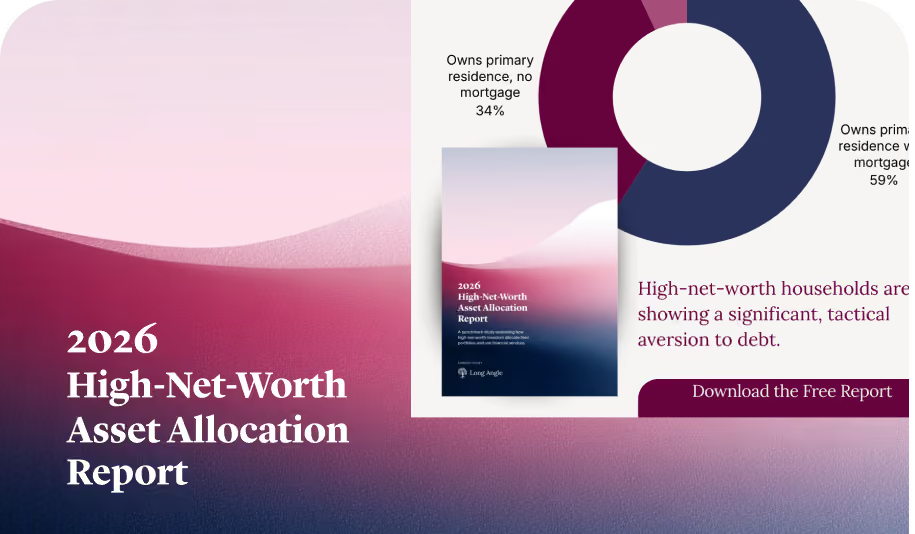
2026 High-Net-Worth Asset Allocation Report
See how high-net-worth investors with an average net worth of $17M are allocating across public equities, private markets, real estate, bonds and cash. Based on benchmark data from 230+ respondents.
Why 60/40 Can Be Too Risky Once You Have Enough
The case against 60/40 for wealthy investors starts with a definition change: risk is permanently losing money, not watching a portfolio fluctuate. Academic finance treats volatility as the measure of risk, and the entire 60/40 framework inherits that assumption. Stein rejects it. "To me, risk is losing money," he says. "It could be one year, it could be 10 years."
That distinction matters most at the point where a portfolio stops being a growth engine and becomes the thing a family lives on. A 60% equity allocation can fall by half and take five years or more to recover, and Stein pushes back on the comfort that stocks become safe if you simply hold them long enough. The average outcome narrows over time, but the distribution of outcomes widens, and Japanese and Argentine investors have lived through 30-year stretches that the US market has simply not experienced. His conclusion about the standard mix for investors focused on not losing money: "It's too risky. It really is."
His institutional reference point is capital preservation as practiced by the best allocators. One of his foundation clients held half its assets with Seth Klarman's Baupost Group, and Stein recalls that Klarman's funds sat at times with 40% in cash, because success for a hedge fund is not losing money. None of this argues that a younger investor building wealth should abandon equities. Someone with decades of earning power ahead can absorb an equity-heavy portfolio, a point that echoes the debate over whether the Boglehead three-fund approach changes at higher wealth levels. The argument is narrower and sharper: once you have enough, the portfolio's job changes, and 60/40 was not designed for that job.
Watch the Full Conversation
This article draws on a Navigating Wealth conversation with David Stein, covering portfolio allocation, the endowment model, and what wealthy investors should do differently. Watch the full episode for the broader discussion.
Subscribe on YouTube · Get weekly episode updates
David Stein spent about a decade as chief portfolio and investment strategist at FEG Advisors, an institutional investment advisory firm serving endowments and foundations with roughly $100 billion under advisement. He has hosted the Money for the Rest of Us podcast for 12 years, with more than 20 million downloads, and built the market analysis tool Asset Camp. In the conversation, he explains why he believes the standard balanced portfolio fails wealthy investors and how he allocates his own money instead.
The S&P 500 Inside the 60 Is Not What You Bought
The equity side of a 60/40 portfolio has quietly changed: the ten largest holdings now make up about 37% of the S&P 500, by Stein's analysis, skewing the index toward what he calls an AI hyperscaler benchmark. An investor who set a 60% allocation to the index a decade ago now holds a meaningfully more concentrated bet on a handful of companies and one technology theme. Current constituent data is published by S&P Dow Jones Indices.
Valuation compounds the concentration. The index returned roughly 15% annualized over the past decade, but Stein notes its price-to-earnings ratio expanded from 22 to 27 along the way, with a dividend yield near 1.1%. His math on what reversion would mean: if the market's multiple fell back to its long-term average of about 18, that alone would cost roughly 4% per year over the next decade. That is his estimate, not a consensus forecast, but the mechanism behind it is basic arithmetic: stock returns come from cash flow, cash flow growth, and the price investors pay for both.
Stein's own equity exposure is globally diversified rather than S&P-only, though he points out that even a total world index is 58 to 59% US stocks. And he is skeptical of the comfort found in a hundred years of US market history. Most of the disasters that crushed other countries' markets did not happen here, which flatters the data. "We're investing for things that could go wrong," he says.
The Asset Garden: How an Endowment Strategist Invests His Own Money
Stein's alternative to 60/40 is what he calls an asset garden: roughly 20% in stocks, with the rest spread across gold, crypto, private capital, preferred stocks, closed-end funds, bonds, and insurance-linked securities. The organizing idea is variety in return drivers, so no single asset class can do decisive damage. He describes his sleeves as roughly even, around 20% each in stocks, bond-like strategies, and private capital and income strategies, without a formal strategic target he must rebalance toward.
Income does a lot of the work. He holds preferred stocks yielding 8 to 9%, closed-end funds bought at wider-than-average discounts, and a catastrophe bond ETF, where natural disaster risk pays 6 to 10% yields uncorrelated with markets. He has owned crypto since 2016 and trimmed it as it grew: he sold Bitcoin near $125,000 because the position had become too large a share of his net worth, and paid the bill without regret. "Successful investors pay taxes," he says.
This is one experienced investor's personal allocation, not a model portfolio, and Stein is explicit that it reflects his stage of life and his risk aversion. It is, however, deliberately more diversified than the endowments he served, which rarely own gold, crypto, preferreds, or closed-end funds, mostly because their size and committee dynamics prevent it. For a primer on the mainstream framework his approach departs from, the SEC's investor education page on asset allocation covers the standard model.
What Wealthy Investors Hold Instead of Bonds
In Long Angle's 2026 Asset Allocation Report, 233 investors with an average net worth of $17 million reported investment portfolios averaging 57% public equities, 31% private and alternative assets, and 12% bonds and cash. Fielded between December 2025 and January 2026 across the Long Angle community, the study shows the traditional 40% bond sleeve compressed to a fraction of its textbook weight, with diversification coming instead from assets carrying equity-like expected returns.
Within those private and alternative holdings, investment real estate leads at 42%, followed by private company equity at 24%, crypto at 13%, private credit at 6%, precious metals at 5%, and hedge funds at 3%. Full segmentation by wealth tier and age is in the 2026 High-Net-Worth Asset Allocation Report.
Two qualifications keep the numbers honest. Respondents are voluntary participants in one community of accomplished investors, not a representative sample of all wealthy households. And this is observed behavior, not advice: it describes what these investors hold, not what anyone should hold. Stein's reaction to the pattern was measured. Investors at this level have high risk capacity, meaning they can absorb losses and be fine, and many pair it with high risk tolerance built during the years they created the wealth. His approach is more conservative, but he sees the logic: "It's a very practical way to invest when you have a large degree of wealth."
Where the Endowment Model Breaks Down for Individuals
Endowment-style investing is harder to execute than to admire, and Stein is candid about the machinery behind it. At FEG, the efficient frontier models that justified allocations ran on invented inputs. "We would make up the volatility numbers," he says, recalling assigning private equity a 27% volatility assumption. He eventually stopped producing efficient frontiers altogether.
The model's other advantages erode on inspection. Private assets look uncorrelated largely because they are priced quarterly rather than daily, so their smoothness is an artifact of timing. Institutional patience is thinner than advertised: the typical endowment committee member, in his experience, gives a strategy about three and a half years before demanding a change. And manager selection, the engine of endowment returns, is brutally hard. Stein spent 17 years meeting stock managers whose full-time job was beating the market, "and I saw how poorly they did at it."
For individuals, the hardest part is diversification within private markets. A real allocation needs something closer to a private capital index fund, dozens of managers across 10 or more vintage years, which is exactly what institutions build and individuals rarely can. Structures that pool that exposure help, and the tradeoffs are covered in Long Angle's guide to how semi-liquid funds work and what they cost. The lesson is not that the endowment model is wrong. It is that adopting its allocation without its infrastructure imports the risk without the machinery.
After a Windfall, There Is No Rush
For sudden liquidity, Stein's advice is patience: learn what you would own before you own it, and deploy gradually, because losses feel roughly twice as bad as equivalent gains feel good. He lived his own version of the problem. When he left FEG, his payout arrived as a large payment every year for seven years, and each one had to be put to work. "There isn't a rush," he says. At meaningful wealth, expenses rarely require beating Treasury bills immediately, and the pressure to deploy is mostly fear of missing out.
The math argues the other way, and honesty requires saying so. Vanguard's research on the question found that lump-sum investing beat cost averaging about 68% of the time across historical and simulated markets, while noting that gradual deployment can make sense for highly loss-averse investors. That caveat is Stein's entire point. A newly liquid founder who deploys $10 million on day one and watches it halve may abandon the plan at the bottom, which is the real catastrophe. The decision framework in Long Angle's sudden wealth checklist for newly liquid investors covers the same ground across taxes, estate planning, and deployment.
Frequently Asked Questions
Is the 60/40 portfolio dead?
No. It remains a workable default for investors accumulating wealth over long horizons. The sharper question is whether it fits investors whose priority has shifted from growing capital to keeping it.
Is volatility the same thing as risk?
Not in Stein's framework. Volatility measures how much prices move; risk is the chance of permanently losing money. A smooth-looking portfolio can still be risky, and a bumpy one can be safe over the holding period that matters.
What is an asset garden portfolio?
Asset garden is Stein's term for his own allocation: roughly 20% stocks plus gold, crypto, private capital, preferred stocks, closed-end funds, and insurance-linked securities, chosen for variety in what drives each asset's returns.Do evergreen funds underperform closed-end funds?
Modestly, in general. Liquidity sleeves and structural costs trim returns versus a well-built drawdown portfolio, which is the price of immediate deployment and periodic access to capital.
Should you invest a windfall all at once or gradually?
Historically, lump-sum investing has beaten gradual deployment about two-thirds of the time, per Vanguard research. Stein still recommends taking time, because abandoning a plan after an early loss costs more than easing in ever does.
What do endowments hold instead of bonds?
Endowments diversify across private equity, real assets, hedge funds, and credit strategies, holding far less in traditional bonds than a 60/40 portfolio. Stein argues individuals can go further, adding assets most endowments avoid, like gold and closed-end funds.
Final Thoughts
The 60/40 debate usually gets argued as a forecasting question about stocks and bonds. Stein's version is more useful because it starts from the portfolio's job. If the job is compounding a salary into wealth, equity-heavy defaults have a long record and the standard mix is a defensible baseline. If the job is making sure generational capital survives everything the next 30 years produces, then a 60% bet on one expensive, concentrated asset class is a strange definition of balanced.
What wealthy investors do in practice, per Long Angle's data, splits the difference: they keep equities as the core, shrink bonds to a sliver, and diversify through private markets and real assets. What Stein does is more conservative still. Both paths take the same first step, which is deciding what the money is now for. The allocation follows from the answer.
Most investors never see how peers with similar wealth are allocated.
Long Angle members benchmark allocations against an annual community study and compare decisions with vetted peers who have made the same calls with their own capital, in a vendor-free community where nobody is selling anything.
More From Long Angle
Beyond Wealth Newsletter
Navigating Wealth Podcast
Research & Studies
Alternative Investment Education
Blog