Written by Ryan Morrison


Semi-Liquid Funds: How They Work and What the Tradeoffs Are
Based on a Navigating Wealth conversation with Mike Elio, Stepstone Group.
Semi-Liquid Funds: How They Work and What the Tradeoffs Are
Semi-liquid funds give individual investors private markets access without capital calls, K-1s, or decade-long lockups, in exchange for capped liquidity and a modest return give-up. A StepStone partner who runs evergreen strategies explains what the structure fixes, where it gets misunderstood, and how to evaluate one.
Ryan Morrison
Semi-liquid funds are perpetual private market vehicles that accept capital on an ongoing basis and allow periodic redemptions, typically capped near 5% of net asset value per quarter. They eliminate capital calls, deploy money immediately, and simplify taxes, in exchange for modest return give-up, valuation complexity, and liquidity that works only when investors treat the money as a long-term hold.
Semi-liquid funds have become the default on-ramp to private markets for individual investors, and the loudest explanations of how they work come from firms selling them. This article takes a different seat. It draws on a conversation with a manager who runs evergreen strategies and spent years representing the institutions on the other side of the table, covering what the structure fixes, what it costs, and how to evaluate one.
Key Takeaways
- Semi-liquid (or evergreen) funds combine private market assets with mutual-fund-like subscriptions and capped periodic redemptions, and held roughly half a trillion dollars by late 2025.
- The structure solves real problems for individual investors: no capital call management, immediate deployment, 1099s instead of late K-1s, and diversification most households could not build alone.
- The liquidity is real but limited by design. Redemption gates protect remaining investors from fire sales; a fund that pays out beyond its gate is weakening its own structure.
- Closed-end drawdown funds still offer the highest return potential. Evergreen structures trade some return for convenience and flexibility.
- Access is not infrastructure. Evergreen investors inherit the same manager selection, valuation, and incentive questions institutions staff entire teams against.
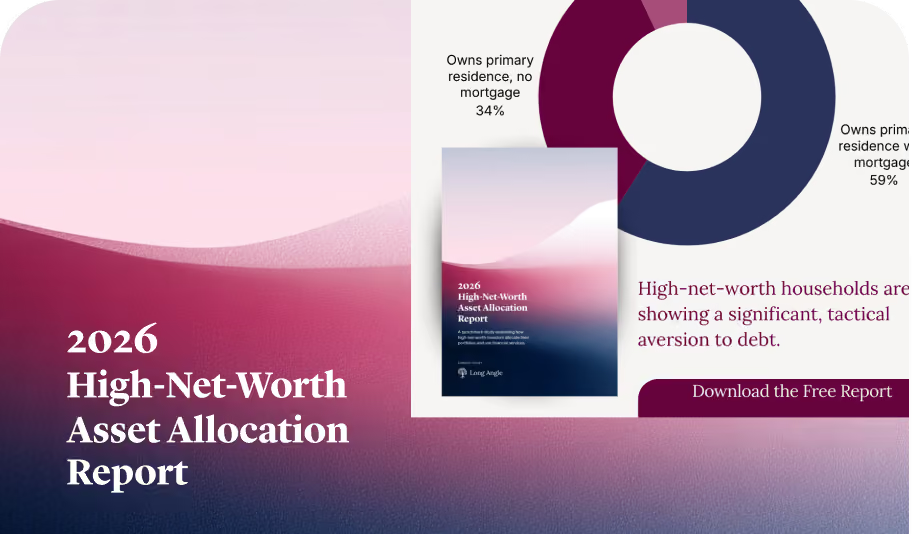
2026 High-Net-Worth Asset Allocation Report
See how high-net-worth investors with an average net worth of $17M are allocating across public equities, private markets, real estate, bonds and cash. Based on benchmark data from 230+ respondents.

What Are Semi-Liquid Funds
Semi-liquid funds are perpetual-life private market vehicles that take in capital continuously and offer limited periodic redemptions, usually quarterly or semi-annually and typically capped near 5% of net asset value. The assets inside remain private market assets: private equity, private credit, real estate, infrastructure. What changes is the wrapper. Investors can subscribe on an ongoing basis, and the exit resembles a mutual fund redemption window rather than a 10-year lockup.
The category has no single legal form. In the United States it spans interval funds, tender offer funds, non-traded business development companies, and non-traded REITs, each with different redemption mechanics. Growth has been rapid: Morningstar reports evergreen funds held more than $493 billion in net assets as of the third quarter of 2025, with projections above $1 trillion by 2029. For a full grounding in the vehicle types and terminology, Long Angle's introduction to evergreen fund structures and types covers the category in depth.
The terms "semi-liquid" and "evergreen" are often used interchangeably. Both point at the same design: long-term private assets inside a structure that opens the door periodically instead of locking it for a decade.
Watch the Full Conversation
This article draws on a Navigating Wealth conversation with Mike Elio, where we discuss evergreen fund mechanics, secondaries pricing, and manager selection. Watch the full episode for the broader discussion.
Subscribe on YouTube · Get weekly episode updates
Mike Elio is a partner at StepStone, where he co-heads US mid-market buyout research, leads secondaries research globally, and serves as portfolio manager for two evergreen private equity strategies. Before StepStone, he ran the Institutional Limited Partners Association, the body representing the institutions committing trillions of dollars to private equity. He has argued both sides of the table: the investor pushing for better terms and the manager building the structures. In the conversation, he explains why evergreen funds work, where they are misunderstood, and what disciplined evaluation looks like.
What Evergreen Structures Fix for Individual Investors
Evergreen structures remove the operational friction that made private markets impractical for individuals: random capital calls, multi-year deployment, late K-1s, and portfolios too small to diversify properly. Elio is blunt about the history. Before these structures, the individual investor's experience ran through single-fund private bank offerings with layered fees, and he describes that client experience as poor.
The specific fixes matter because each one maps to a real cost. Capital calls arrive at unpredictable times, and investors or their custodians hold cash against them, which drags on returns. A traditional drawdown fund takes years to deploy a commitment; an evergreen deploys at subscription. Tax reporting shifts from K-1s that often arrive in late summer, forcing filing extensions, to a standard 1099. Long Angle's K-1 tax reporting in private markets guide covers how much friction that single change removes.
The deeper fix is portfolio construction. An institution deploying billions each year can diversify by vintage year, strategy, and geography across a market where StepStone alone tracks roughly 18,000 general partners. Individuals have neither the volume nor the access to replicate that, and the well-known mega-firms available through private banks represent only the top end of the buyout spectrum. An evergreen fund lets an individual commitment ride inside an institutionally constructed portfolio, which is consistent with how high-net-worth investors allocate to private markets more broadly: private and alternative allocations rise with portfolio size, and structure quality becomes the constraint.
Elio's framing strips the novelty away. Squint, he suggests, and pension funds have run this exact model for decades, using distributions from older funds to pay pension obligations the way an evergreen pays redemptions. The wrapper is new. The methodology is not.
The Liquidity Is Real but Limited by Design
Evergreen fund liquidity is genuine but capped, and the cap is the feature that makes the structure work. Elio's warning is that people underweight the first half of "semi-liquid." These funds should never be mistaken for money market funds. When too many investors want out at once, he compares it to a crowd moving through a hallway: only so many people fit through at the same time.
The early-2026 stress in private credit made this concrete. Redemption requests at some funds far exceeded quarterly allotments; Elio cites a case where investors requested 41% of a fund in a single quarter against a 5% gate. Requests were cut back, headlines followed, and the word "semi-liquid" took public criticism. His read cuts against the panic: credit did not have an investment problem, it had a structure problem. The underlying loans were performing. The wrapper was under pressure because portfolio construction and liquidity design had not kept pace with the promises implied to investors. Long Angle's analysis of the private credit gating episodes of early 2026 reaches a similar conclusion about plumbing versus credit quality.
The gate itself deserves rehabilitation. A fund that honors its stated 5% quarterly limit and no more is protecting remaining investors from forced asset sales at depressed prices. A fund that pays beyond its gate to appear liquid is spending the safety margin of everyone who stays. Wrapper mechanics differ here in ways investors should know: interval funds must honor stated repurchases up to their caps, while non-traded BDCs and tender offer funds can gate at board discretion. The SEC's investor materials describe interval fund repurchase offers as occurring every three, six, or twelve months on disclosed terms.
The practical rule from the conversation is simple: money needed on a schedule does not belong here. Elio's example is an investor planning a house purchase in two years who parks the down payment in an evergreen fund expecting to pull it out at closing. The structure makes no such promise. Treat the allocation as part of the illiquid sleeve of a portfolio, hold liquidity elsewhere, and periods of market stress become opportunities rather than emergencies, since dislocations historically produce some of private equity's best vintages.
How Evergreen Funds Are Valued
Evergreen fund NAVs rest on quarterly fair value marks that general partners have been required to produce since 2007, refined between quarters by the manager's own valuation work. Elio describes private market pricing as public market pricing without the emotion: earnings, multiples, and comparables drive buyout valuations, and managers can track how each GP's interim marks compare with eventual exit values across time.
The interim adjustment is where managers differ. The standard cash-adjusted method, rolling the last GP mark forward for capital calls and distributions, can miss by roughly 400 basis points. Data-driven valuation engines, built on years of observed GP marking behavior across thousands of portfolio companies, can cut that error to 100 to 150 basis points. In a vehicle where investors enter and exit at NAV, that accuracy is not academic. It determines whether new and departing investors transact at a fair number.
Valuation is also where the loudest secondaries headlines mislead. Stories about assets marked up dramatically overnight describe the gap between a transaction's record date, the stale quarterly mark a price was negotiated from, and its close, which can arrive two or more quarters later. Everything that happens in between, exits, write-ups, even IPOs, accrues to the buyer and is still labeled "discount." A negotiated 3-to-5-cent discount on quality assets can equal 11 to 14 cents of realized economics by close. Elio's point is that this is standard as-of accounting, not manipulation, and the same mechanics can cut against buyers when markets fall between the two dates. Long Angle's guide to how private equity secondaries transactions are priced walks through these mechanics in detail.
Evergreen Funds vs Closed-End Funds
Closed-end drawdown funds still offer the highest return potential in private markets; evergreen funds trade some of that return for immediate deployment, flexibility, and simpler ownership. Elio, whose firm runs both, concedes the point directly: an investor who can build a portfolio of primary commitments will earn the most private markets can offer. The evergreen investor gives up some of that in exchange for structure.
The choice is not binary for larger portfolios. A common pattern pairs a diversified evergreen core with selective drawdown commitments where an investor has conviction. But for a household making its first or only private markets allocation, the evergreen tradeoff, modest return give-up for dramatically less operational risk, is often the honest bargain.
Access Is Not the Same as Infrastructure
Elio resists the word "democratization" because access to institutional products does not confer institutional capability. The individual investor in an evergreen fund now owns the same questions institutions employ whole teams to answer: What is the vintage year exposure? What is the geographic mix? What are the manager's incentives? What do the legal terms permit during stress? What is the fund holding to meet redemptions, and what does that holding cost in returns?
Not all evergreens are created equal, and the differences concentrate exactly where individual investors have the least visibility. The better funds hold genuine liquidity discipline, maintain diversified sources of natural liquidity across vintage, geography, and strategy, and carry a base of institutional co-investors who tend not to panic at the worst moment. Weaker funds reveal themselves only under stress, when the redemption queue forms.
This is the honest cost of the wrapper. The operational problems are solved; the judgment problems are transferred. An investor who cannot evaluate a manager's marking behavior, incentive structure, or liquidity design is trusting someone else's answer to each question, usually the seller's.
How to Evaluate an Evergreen Fund
The single most useful test from the conversation is what Elio calls return on par: after a discounted asset is marked up to its holding value, does it still return double digits? An evergreen buyer cannot chase deep discounts on mediocre assets, because the fund looks brilliant for one quarter and then the asset sits flat while every subsequent investor absorbs the dead weight. Closed-end funds can play that game; evergreen funds structurally cannot. Quality assets with modest discounts and durable growth are what make the vehicle work, which is why secondaries-heavy evergreen portfolios lean on mature, cash-generating assets. Long Angle's primer on evergreen secondaries and the early-investor advantage explores how that construction plays out for investors at different entry points.
Beyond return on par, the evaluation checklist that emerges from the conversation looks like this:
- Liquidity design: Can the fund meet its stated gate from natural portfolio yield and realizations rather than forced sales? What happened during the most recent stress period?
- Investor base: A meaningful institutional co-investor presence signals both diligence performed and steadier hands in a drawdown.
- Manager discipline: Elio favors managers who "lather, rinse, repeat," running the same strategy at similar fund sizes across cycles. A manager doubling fund size every vintage has switched, in his words, from value creator to asset gatherer.
- Specialization at the small end: In small and mid-market buyout, sector specialists with defensible niches outperform generalists, and that segment offers wider pricing inefficiency than the heavily brokered large end.
- Valuation credibility: Ask how interim NAVs are set, and whether the manager's historical marks were confirmed or contradicted by exit values.
None of this requires institutional headcount. It requires knowing which questions to ask and refusing to accept fee levels justified by "we're oversubscribed," an answer Elio heard a GP give a public pension fund and calls the worst possible response.
Final Thoughts
Semi-liquid funds are neither the scandal of the gating headlines nor the frictionless access of the marketing decks. They are a genuine engineering improvement on how individuals reach private markets, built on a model pension funds have run for decades, with a cost structure that is knowable in advance: some return given up, some liquidity promised but capped, and a set of institutional judgment problems handed to the investor along with the access.
The investors who do well with these structures share one habit. They size the allocation as illiquid money, they evaluate the manager rather than the wrapper, and they treat the gate as a design specification rather than a betrayal. The ones who struggle expected a mutual fund with private equity returns. That fund does not exist, and the sooner an investor prices the tradeoffs honestly, the better this structure serves them.
Frequently Asked Questions
Are semi-liquid funds really liquid?
Partially, by design. Redemptions are typically capped near 5% of NAV per quarter, so investors can access some capital regularly but cannot exit a position quickly during stress.
What happens when an evergreen fund gates redemptions?
Redemption requests above the cap are reduced, usually pro rata, and unfilled amounts must be resubmitted. Gating protects remaining investors from asset fire sales at depressed prices.
Do all semi-liquid funds gate the same way?
No. Interval funds must honor stated repurchase offers up to their caps, while non-traded BDCs and tender offer funds can restrict redemptions at board discretion.
Do evergreen funds underperform closed-end funds?
Modestly, in general. Liquidity sleeves and structural costs trim returns versus a well-built drawdown portfolio, which is the price of immediate deployment and periodic access to capital.
How are evergreen fund NAVs set if the assets are private?
General partners mark assets to fair value quarterly using earnings, multiples, and comparables. Managers adjust between quarters, and data-rich valuation approaches can materially reduce interim pricing error.
Who should not use a semi-liquid fund?
Anyone who needs the money on a schedule. Capital earmarked for a near-term purchase or obligation does not belong in a structure whose liquidity can be capped or delayed.
Nearly every explainer on semi-liquid funds is written by someone selling one.
Long Angle is a vetted community of high-net-worth investors where the signal comes from peers instead. Members share which evergreen structures they evaluated, what they committed to, what they declined, and why, in a solicitation-free environment where no one earns a commission on the answer. For investors weighing private markets access at this stage, that kind of candid comparison is hard to find anywhere else.
More From Long Angle
Beyond Wealth Newsletter
Navigating Wealth Podcast
Research & Studies
Alternative Investment Education
Blog