Written by Ryan Morrison


FAANG FIRE: How Tech Workers Turn Equity Comp Into Financial Independence
Based on a Navigating Wealth conversation with Andre Nader.
FAANG FIRE: How Tech Workers Turn Equity Comp Into Financial Independence
Meta veteran Andre Nader reached semi-retirement three years after a layoff and now coaches tech workers on FAANG FIRE: financial independence built on a high tech income and equity comp. He breaks down treating all income as income, when to sell RSUs, the "free money" waterfall of tax-advantaged accounts, staying 90 percent boring, and the psychology of deciding you finally have enough.
Ryan Morrison
FAANG FIRE is financial independence built specifically on a high tech income and equity compensation. The underlying math is the same as any FIRE plan: save aggressively, invest in low-fee index funds, and accumulate enough that a safe withdrawal rate covers your spending. What makes it distinct is that the high income and equity-heavy pay package make the math easier while introducing challenges the median earner never faces, including single-stock concentration, RSU tax mechanics, and the psychology of walking away from a large paycheck.
A high tech income makes financial independence easy in theory and surprisingly hard in practice. The math is not the obstacle. Someone earning several hundred thousand dollars a year, most of it in equity, can reach work-optional status faster than almost anyone else in the economy, yet many high earners in tech never quite get there. Andre Nader spent 15 years in technology, nearly a decade of it at Meta, before a layoff pushed him into what he calls semi-retirement three years ago. He now writes the FAANG FIRE blog and coaches other tech workers on the same transition, and his core message is that the people with the best raw material often make the same avoidable mistakes.
Key Takeaways
- FAANG FIRE describes financial independence built on a high technology income and equity compensation. The high pay makes the math easier, but equity comp introduces specific risks the average FIRE plan never confronts.
- Treat all income as income. Base salary, bonus, and vesting RSUs are all taxed as ordinary income when received, so they belong in the same saving and investing plan rather than three mental buckets.
- The most common equity mistake is holding vested RSUs out of inertia or tax confusion. Selling at vest usually triggers little or no additional capital gains, because the shares were already taxed as income at that price.
- "Be 90 percent boring." Consistent investing in low-fee index funds is the single strongest predictor of reaching financial independence; a small speculative sleeve can scratch the tinkering itch without threatening the plan.
- Reaching the number is a math problem. Deciding you have enough is a psychological one, and it is usually the harder of the two.
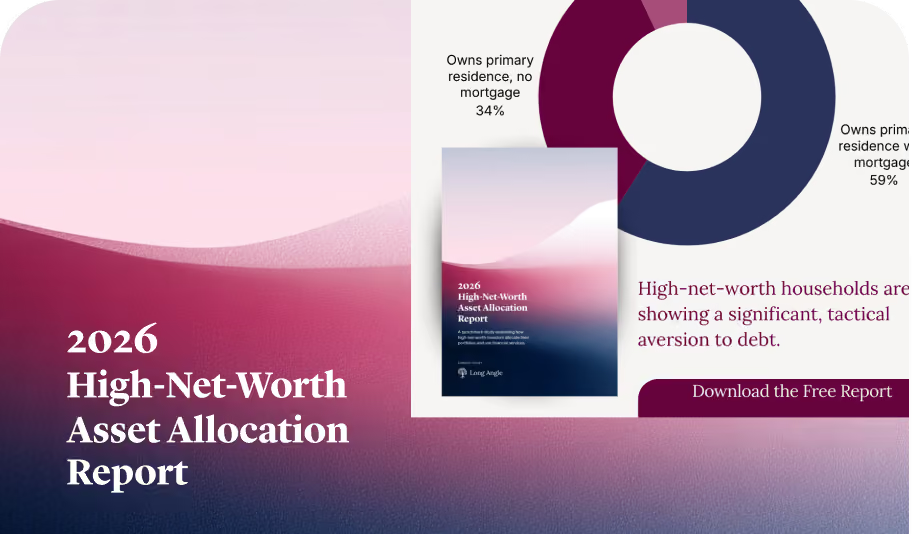
2026 High-Net-Worth Asset Allocation Report
See how high-net-worth investors with an average net worth of $17M are allocating across public equities, private markets, real estate, bonds and cash. Based on benchmark data from 230+ respondents.
What Is FAANG FIRE?
FAANG FIRE is financial independence and early retirement pursued specifically on a high technology income. The acronym FIRE stands for financial independence, retire early; FAANG is the old shorthand for high-paying tech employers. Put together, the term describes the version of FIRE available to people whose compensation is high and heavily weighted toward equity.
The foundational math of FIRE is not complicated. You save more than you spend, invest the difference in low-fee index funds, and build a portfolio large enough that a conservative withdrawal rate, often expressed as the 4 percent rule or a 3 percent rule, covers your living expenses indefinitely. Nader is direct that on a high tech income, this is FIRE on easy mode. When someone earns several hundred thousand dollars a year, keeping expenses in check produces a savings rate that would be impossible for a median earner, and the portfolio compounds accordingly.
The catch is that easy math is not the same as easy execution. A high income creates the capacity to dig a deep hole quickly, because lifestyle can expand to consume it and equity compensation can create the illusion of permanent abundance. The distinct challenges of FAANG FIRE are not about frugality. They are about handling equity compensation intelligently, avoiding concentration risk in a single employer's stock, navigating the tax mechanics of RSUs, and managing the psychology of stepping away from a large and growing paycheck. This makes it a specific discipline layered on top of general FIRE principles.
It is worth saying that while the label comes from tech, the framework applies to any high earner whose income arrives in an equity-heavy or lumpy form. Physicians, attorneys, and finance professionals face closely related versions of the same questions. The equity-compensation mechanics are most acute in tech, which is why the tech framing is useful, but the underlying discipline generalizes.
Watch the Full Conversation
This article draws on a Navigating Wealth conversation with Andre Nader, where we discuss how tech workers turn equity compensation into financial independence, the RSU mistakes that trip up high earners, and the psychology of deciding you have enough. Watch the full episode for the complete discussion, including the live audience questions.
Subscribe on YouTube · Get weekly episode updates
Andre Nader spent 15 years working in technology, including nearly a decade at Meta in growth and data roles, before a layoff three years ago moved him into semi-retirement. He is the author of the FAANG FIRE blog, where he writes about turning high tech income and equity compensation into financial independence and optionality, drawing on his own ongoing experience rather than writing from theory. He also does one-on-one coaching with tech workers navigating the same transition. Nothing in this article is financial, tax, or investment advice; contribution limits and tax rules change, so confirm current figures with a qualified professional.
Start With Your Burn Rate, Not a Budget
The first step in any FIRE plan is knowing your actual spending, because you cannot calculate how much is enough without knowing what your life costs. For high earners, this is about measurement rather than restriction.
Nader approaches personal finance the way he approached growth problems in his tech career: you cannot answer a question without the data, so the first task is to put logging in place. In personal terms, that means understanding your burn rate, separating fixed costs from discretionary ones, and getting a sense of how those costs are likely to change over time. He is emphatic that this is not budgeting in the traditional sense. When you are earning far more than you spend, your checking account grows even if you do nothing, so the point is not to restrict yourself into a smaller life.
The point is that projection is impossible without a baseline. Deciding how much you need to reach financial independence requires knowing what your current life costs, even though that number will change. Someone with an eight-year-old, as Nader notes of his own situation, can see college expenses coming and knows the number will shift. But the shift is only plannable from a known starting point. Having basic tooling in place, even something as simple as reviewing categorized spending periodically, is what makes every later calculation possible.
This foundation also protects against the specific FAANG FIRE risk of lifestyle expansion. Cost-of-living creep of a few percent a year is normal and manageable. What is dangerous is expanding fixed commitments on the assumption that equity compensation will continue forever. Knowing your burn rate, and knowing how much of it is fixed versus discretionary, is what keeps a high income from quietly becoming a high set of obligations.
When to Sell RSUs and How the Taxes Really Work
The most common and most expensive RSU misconception is that you must hold shares for a year to get favorable tax treatment. In reality, RSUs are taxed as income at vest, and selling immediately usually triggers little or no additional tax, because there has been almost no gain since the vesting price became your cost basis.
Here is the mechanic that Nader repeats deliberately, because understanding it changes behavior. At vest, the shares are taxed as ordinary income based on their price that day. That vesting price becomes your cost basis. If you sell right away, there is little or no capital gain to tax, because the sale price and the cost basis are nearly identical. The only thing that creates a capital gain or loss is the price movement between the vesting date and the date you sell. Holding for a year to qualify for long-term capital gains rates only matters for that incremental gain, and it means carrying concentrated single-stock risk for a year to do it.
This clears up the paralysis that traps many tech workers. People look at years of accumulated vested shares sitting on large embedded gains and feel unable to sell because of the tax consequences. Nader's guidance is to focus on the RSUs that just vested: those can usually be sold with minimal additional tax, because they were already taxed as income and have barely moved. For older, appreciated lots, the tax matters more and deserves planning, but it should not paralyze the whole strategy. Tax consequences are a factor, not the entire decision.
The deeper issue is concentration. When your salary and a large share of your net worth both depend on the same company, a downturn hits your income and your portfolio at the same time. Nader points out that the moment you are most likely to lose your job, during a broad downturn, is also when your company stock is likely depressed. To take the emotion out of selling, he and others favor automatic approaches: setting up scheduled sales or predetermined sell orders so that decisions are made in advance rather than in the moment. One host described setting standing instructions to sell at specific price thresholds, which converts an emotional decision into a mechanical one you have already made peace with. The tool matters less than the principle: decide your selling rule when you are calm, and let it run.
For a broader treatment of how high earners think about concentration and diversification, our discussion of how to calculate your FIRE number covers the portfolio side of the same question.
The Free Money Waterfall
Before investing in a taxable brokerage account, high earners should capture every source of tax-advantaged "free money" available through their employer. Done fully, these accounts can absorb a substantial amount of savings each year before ordinary taxable investing even begins.
Nader describes running excess income through a prioritization waterfall, taking the most tax-efficient options first. The specific dollar figures change every year and vary by plan, so treat the following as the shape of the strategy rather than exact current numbers, and confirm the current IRS contribution limits before acting.
The waterfall generally runs in this order. First, capture any employer match in the 401(k), which is the closest thing to guaranteed free money that exists. Next, if your plan offers it, take advantage of an Employee Stock Purchase Plan, where a discount of up to 15 percent and a lookback provision can make the benefit substantial. Then maximize the 401(k), not only to the standard pre-tax limit but, if your plan allows after-tax contributions and in-plan conversions (the "mega backdoor" route), up to the much higher total contribution limit. A high-deductible health plan paired with an HSA adds another tax-advantaged bucket. And a backdoor Roth IRA, the standard route for high earners whose income exceeds direct Roth limits, adds another few thousand dollars of tax-free growth. If a partner is also working, most of these double.
The reason to be systematic about this is that the amounts compound dramatically over a career. Filling these accounts fully, year after year, builds a large tax-advantaged base before a single dollar goes into an ordinary brokerage account. Early on it can feel counterproductive to lock money into retirement accounts when the goal is to retire early and need money before traditional retirement age, but there are established methods for accessing these funds early, and our overview of early retirement strategies for high-net-worth individuals covers how the early-access piece works in practice.
Be 90 Percent Boring
The strongest predictor of reaching financial independence is not clever investment selection. It is investing consistently over a long period in low-fee, diversified index funds, and then doing very little. Nader frames the target as being 90 percent boring.
His portfolio philosophy is to keep the large majority of investments, on the order of 90 to 95 percent, in a straightforward allocation across US equities, international equities, and bonds, held in a tax-efficient way. That means placing income-generating and dividend-heavy holdings in pre-tax accounts where their distributions are not taxed annually, and keeping the overall structure mechanical and unexciting. His memorable test: if an investment makes your heart start racing, that is a sign it probably does not belong in the core of your portfolio.
The remaining 5 to 10 percent can be a place to be more active, whether that means direct indexing, private equity, or more speculative positions. Nader keeps this sleeve as small as he comfortably can, and his key insight is that having a solid, boring foundation is precisely what makes it psychologically possible to be adventurous with a small slice. The boring core removes the pressure for any single speculative bet to work, which paradoxically makes the speculative sleeve less dangerous.
This discipline matters most in the years right after leaving work, when the temptation to tinker is highest. Nader is candid that natural optimizers and engineers feel a pull to do something with a portfolio, especially when the balances are larger than they have ever been. The academic research, and his own experience, point the other way: the size of the number on the screen does not create a reason to make drastic changes. Building the plan so that it does not require constant intervention is itself the skill.
The 33x Rule and Knowing When You Have Enough
The 33x rule is a conservative starting point for estimating how much you need to retire: multiply your annual expenses by 33. It corresponds to roughly a 3 percent withdrawal rate, more cautious than the traditional 4 percent rule, and it is a starting point for analysis rather than a finish line.
Nader uses 33x as a deliberately conservative anchor. Thirty-three times annual expenses implies a withdrawal rate of about 3 percent, which historically has been very durable across a wide range of market conditions. He is clear that it is meant to be obscenely conservative in most cases, a first pass rather than a precise answer. From there, the analysis can get more refined: modeling how expenses change over time, incorporating known future costs like college, factoring in eventual Social Security, and running Monte Carlo simulations that test the plan against thousands of possible market paths.
He offers a useful warning about those simulations. A Monte Carlo tool produces a slightly different result every time you run it, which means someone anxious about the decision can keep refreshing until they get a number they like. That is a way of tricking yourself, not a way of getting more certain. Even after layering in taxes and realistic expense changes, Nader found that 33x still lands in the range of a very high probability of success on most simulations. Past a certain point, additional precision is not really answering the question the person is asking.
Because the real question is rarely mathematical. As Nader puts it, there is no magic number that suddenly announces you are done. The calculations can tell you that a plan is conservative and highly likely to succeed, but they cannot make the decision to stop feel safe. That is a psychological threshold, not a computational one, and it is where most of the genuine difficulty of FAANG FIRE lives.
The Psychology of Enough
The hardest part of FAANG FIRE is not accumulating the money. It is giving yourself permission to stop, to spend, and to trust the plan. High earners are frequently better at building the number than at believing it.
The first psychological trap is what Nader calls the "one more vest" problem. Momentum makes it easier to keep working than to stop: one more vest, one more bonus, one more refresher, one more year. There is always a next threshold, and each one feels like a small, reasonable extension. He suggests gut-checking the distinction between needing to keep working and wanting to keep working. There is nothing wrong with continuing to work on something you find meaningful. The problem is continuing out of an anxiety that no additional amount ever quite resolves. As he frames it, at some point you have won the money game, and the relevant question becomes whether you are winning the purpose game, which is a different challenge entirely.
The second trap is the difficulty of spending after a lifetime of accumulating. Nader says that in his coaching, more than half of the work is convincing people that it is okay to spend more, especially in the final working years when spending on things that give back time or make the work sustainable has close to infinite return. He points to the 0.1 percent rule he encountered in Nick Maggiulli's book The Wealth Ladder: a purchase costing about 0.1 percent of your net worth is small enough that you do not need to agonize over it. On a several-million-dollar portfolio, that covers the everyday purchases people nonetheless stress about, and it reframes the guilt as unnecessary. His advice for those approaching financial independence is to boundary-test spending in specific categories while still earning, so you learn what adds to your life before you are living off the portfolio.
The third challenge is bringing a partner along. Nader is clear that when a spouse is nervous about giving up a salary, it is rarely a math conversation. Spreadsheets and Monte Carlo simulations do not resolve what is fundamentally a question of security: the felt safety of a paycheck arriving every month and health insurance being handled. The productive path is to talk through what life looks like without the job, and to recognize that the decision is not binary. A sabbatical, a trial period, a lower-income encore, are all available, and none of them forecloses the ability to change course. As Nader notes, few people regret taking time off, even the ones who ultimately return to work. For the "enough" question underneath all of this, our conversation on what high earners should stop optimizing for explores the shift from accumulation to purpose in more depth.
Final Thoughts
FAANG FIRE rewards the people who get the unglamorous parts right: knowing their burn rate, treating all income as income, selling equity on a rule rather than a feeling, filling the tax-advantaged accounts, and staying boring for a long time. None of that requires special insight. It requires consistency and the willingness to avoid large, avoidable mistakes when the stakes are high and the paychecks are large.
The harder part arrives after the number is reached. Giving yourself permission to stop, to spend, and to trust a plan you built carefully is a different skill than building it, and it is the one Nader spends most of his coaching time on. The math is the easy game, and high earners in tech usually win it. The purpose game, deciding what the freedom is for, is the one worth preparing for well before the final vest.
Frequently Asked Questions
What is FAANG FIRE?
FAANG FIRE is financial independence and early retirement built specifically on a high technology income and equity compensation. FIRE stands for financial independence, retire early; FAANG is shorthand for high-paying tech employers. The math is the same as any FIRE plan, save aggressively and invest in low-fee index funds, but the high income makes it easier to achieve while adding challenges like single-stock concentration and RSU tax mechanics. The framework also applies to other high earners such as physicians, attorneys, and finance professionals.
When should you sell your RSUs?
Many advisors and practitioners suggest selling RSUs as they vest, because at vest the shares are already taxed as ordinary income and their vesting-date price becomes the cost basis, so an immediate sale usually triggers little or no additional capital gains tax. Holding creates concentration risk in a single company whose stock also determines your income. A common approach is to set up automatic or scheduled sales so the decision is made in advance rather than emotionally. This is general information, not personalized tax advice.
Do you have to hold RSUs for a year to save on taxes?
No, and this is one of the most common misconceptions. RSUs are taxed as ordinary income at vest regardless of whether you hold them. The one-year holding period only affects the tax rate on any gain that occurs after vesting, the difference between the vesting price and the eventual sale price. If you sell at vest, there is little or no gain to tax, so there is usually no tax benefit to holding, only added concentration risk.
How much money do you need for FAANG FIRE?
A conservative starting point is the 33x rule: roughly 33 times your annual expenses, which corresponds to about a 3 percent withdrawal rate. This is deliberately cautious relative to the traditional 4 percent rule. From there, the estimate can be refined by modeling changing expenses, future costs like college, eventual Social Security, and Monte Carlo simulations. But there is no single magic number, and deciding you have enough is ultimately a psychological judgment rather than a purely mathematical one.
What is the difference between FAANG FIRE and regular FIRE?
The underlying principles are identical: spend less than you earn, invest the surplus in low-fee index funds, and accumulate enough to cover expenses at a safe withdrawal rate. The difference is the income and its structure. FAANG FIRE assumes a high income weighted toward equity compensation, which makes the savings math dramatically easier while adding specific challenges: RSU taxation, concentration risk in one employer's stock, larger tax bills, and the psychology of walking away from a large paycheck.
What does "be 90 percent boring" mean in investing?
It means keeping the large majority of your portfolio, around 90 to 95 percent, in a simple, low-fee, diversified allocation of index funds across US equities, international equities, and bonds, held tax-efficiently, and then largely leaving it alone. The remaining 5 to 10 percent can be used for more active or speculative investing. The insight is that a solid boring foundation removes the pressure for any single speculative bet to succeed, which makes consistent long-term investing psychologically sustainable.
Deciding whether you have enough, and what comes after, is easier alongside peers at the same stage.
Long Angle's Trusted Circles are small, confidential peer groups matched by life stage and net worth, meeting monthly with a facilitator who is also a financial professional. For members weighing the "can I really step back" question, it is where that conversation happens without anyone selling a product.
More From Long Angle
Beyond Wealth Newsletter
Navigating Wealth Podcast
Research & Studies
Alternative Investment Education
Blog