Written by Ryan Morrison


What High Earners Should Stop Optimizing For
Based on a Navigating Wealth conversation with Chris Hutchins.
What High Earners Should Stop Optimizing For
At a certain wealth stage, the binding constraint on your life stops being money and starts being time. Chris Hutchins of All the Hacks breaks down what high earners should stop optimizing for — and what a smarter default looks like across credit cards, health, and travel.
Ryan Morrison
For the first part of most people's wealth journey, optimization means one thing: get more. More points, more cash back, more return, more output per dollar spent. Chris Hutchins has spent five years and 250 episodes of All the Hacks working through what that framework gets right and where it starts to work against you. His argument, grounded in credit cards, health, travel, and how he runs his own business, is that the most important optimization shift at a certain wealth stage is not finding a better system, but questioning whether the system is solving for the right thing.
At a certain wealth stage, the binding constraint on your life stops being money and starts being time. The practical implication is that optimization frameworks built around maximizing every dollar (the best card for every spending category, the most efficient supplement stack, the most points-dense travel strategy) start costing more in attention than they return in value. The 80/20 shifts: fewer systems, better defaults, and more deliberate decisions about what is worth optimizing at all.
Key Takeaways
- When money stops being the binding constraint, time becomes it, and most optimization frameworks are not built for that shift
- The two-card credit card strategy beats a complex multi-card setup for high earners: one flat-rate catch-all, one travel card if you enjoy the game
- The health 80/20 is exercise, sleep, and avoiding ultra-processed food; everything else is in the 20
- Award travel requires flexibility in timing, not destination; alerts beat fixed-date planning
- The most useful financial question at high income is not "how do I get this for less" but "do I want this at all"
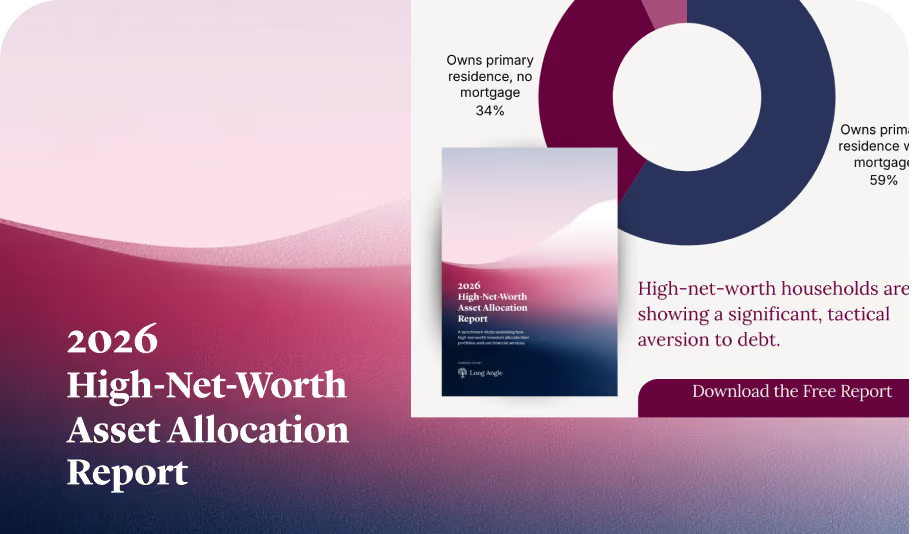
2026 High-Net-Worth Asset Allocation Report
See how high-net-worth investors with an average net worth of $17M are allocating across public equities, private markets, real estate, bonds and cash. Based on benchmark data from 230+ respondents.
The Optimization Inversion
Early in your career, optimizing for money makes sense because money is the binding constraint. Every percentage point of cash back, every avoided fee, every incremental return compounds into something meaningful when the denominator is small.
At some point that logic inverts. The limiting resource is no longer money. It is time and attention. And most optimization frameworks (the credit card spreadsheets, the supplement protocols, the points-maximizing travel strategies) were designed for the earlier stage. They keep running long after their return on investment has dropped below the cost of maintaining them.
Chris Hutchins has lived this arc consciously. He built a model to find the optimal number of credit cards for maximum rewards. The answer was two. He has spent years researching sauna protocols and cold plunge routines. His conclusion is that if you are not doing the fundamentals first, none of the edge cases move the needle. He has flown enough business class on points to know when the game is worth playing and when paying cash is the correct answer.
The 80/20 rule applies in every area of life. The question is not whether to apply it but which areas you want to go deep on deliberately, and which ones you want to set a good default for and leave alone. A card that earns 5% back on streaming sounds appealing until you notice your streaming spend is $500 a year and the marginal gain over a good flat-rate card is roughly $10. The optimization was not wrong in theory. It was just not worth the overhead.
The shortcut that has changed this calculation significantly is what you can now do with an AI assistant. Research that used to require hours of comparison, spreadsheet work, and reading through forum threads can now be structured as a prompt. Throw in your actual spending profile and ask for the card that maximizes return given your specific numbers. The answer will not always be perfect, but it will be good enough faster than any other method.
Watch the Full Conversation
This article draws on a Navigating Wealth conversation with Chris Hutchins, where we discuss how optimization thinking should evolve with wealth, what moves the needle on health and travel, and how to build a life that is worth optimizing for in the first place. Watch the full episode for the broader discussion.
Subscribe on YouTube · Get weekly episode updates
Chris Hutchins is the host of All the Hacks, a podcast covering personal finance optimization, travel, and health that has produced 250+ episodes over five years. Before podcasting, he worked as a venture capitalist and startup founder. He brings an operator's instinct for systems to decisions that most people treat as preferences.
Credit Cards: The Case for Fewer, Better Defaults
The optimal number of credit cards for a high earner who does not want to think about it is two. One card maximizes return on all spending as a catch-all. One card handles a specific category or travel use case if you enjoy that part of the game. Beyond two, the incremental return on a third or fourth card rarely justifies the cognitive overhead.
For the catch-all card, the most straightforward option for anyone willing to maintain $100,000 in a Merrill Lynch brokerage account is the Bank of America Premium Rewards Elite. That $100,000 can be an IRA, a brokerage account holding treasuries, or anything else. It does not need to be actively managed. The result is 2.625% cash back on all spending, with 3.5% on travel and dining. There is no category management, no points transfer, no portal required. That rate is hard to beat at any level of complexity.
For the travel card, the calculus depends on how much you enjoy the points game. The Bilt Palladium card earns points on housing payments (mortgage or rent) up to $120,000 annually, with an effective return of roughly 4% back in points redeemable through their travel portal. The meaningful caveat: Bilt does not earn points on tax payments. For high earners with large quarterly estimated tax bills, that is a real gap in coverage.
The honest version of the cash vs. points math is that it is closer than the points community suggests. When you pay cash on a card that earns rewards, you are earning points on that spending too. The premium of redeeming points for business class over paying cash tends to be meaningful when award availability lines up with your travel dates. It is close to zero when it does not. A fuller breakdown of best credit cards for high-net-worth individuals, including specific card comparisons and Long Angle member preferences, covers the landscape in more detail.
Health: What the Evidence Says vs. What the Internet Sells
The health optimization space has the same 80/20 problem as credit cards, and the incentives that distort it are worse. The fundamentals are unglamorous. The edge cases are photogenic and easy to sell.
The actual 80/20 for longevity is: exercise regularly (cardio and strength training, with the specific modality being far less important than the consistency), get enough sleep, and avoid ultra-processed food. Those three things are probably 90% of the outcome. The rest (sauna protocols, cold plunge, supplement stacks, continuous glucose monitors, methylene blue) may have real benefits at the margin. They do not substitute for the fundamentals, and finding people who have invested heavily in the edge cases without doing the basics first is not difficult.
Sauna use does have research behind it, including associations with reduced all-cause mortality and cardiovascular benefit. The point is not that sauna is useless. The point is that sauna without exercise is optimizing in the wrong order.
Sleep is the variable that gets the least attention relative to its impact. The constraint for most people is not that sleep is unavailable. It is that they do something the night before they already know is a waste of time. Going to bed earlier is less interesting than a biohacking device, but it works. One practical observation: society has become substantially more accepting of early dinners and early evenings than it was a decade ago. There is less social friction now in engineering an earlier schedule than there used to be.
The AI use case here is real and underused. Taking last year's blood test results and this year's blood test results and asking an AI assistant what changed, what matters, and what to look into further is now a 10-minute task. Before, it required either a specialist or a spreadsheet. Neither was fast.
Travel: When Points Are Worth It and When They Are Not
The honest version of the award travel question is that the game rewards flexibility more than expertise. If you can fix the destination and leave the dates flexible, the system works reliably. If you need specific dates (school holidays, cherry blossom season, a family trip with a hard end date) availability will work against you more often than not.
The strategy that works is alerts. Set alerts across a few award search tools for your destination and general timeframe, accept that you will not know exactly when the seats open, and trust that they will open before you need to make a final decision. Chris Hutchins booked business class for four people from San Francisco to Frankfurt for August by doing exactly this: nothing was available the day he decided to go, then availability appeared several months later after an alert fired. The alternative was paying cash at whatever the market rate was at the six-week mark.
For travelers who want the outcome without playing the game, award booking services charge $100–$200 per person to find and book award availability on your behalf. Fly Flat operates in a similar space, sourcing better-priced flights in the background and presenting them as standard bookings.
One structural rule that saves money regardless of points strategy: never buy one-way international business class tickets. Airlines price them at a significant premium over the one-way component of a round trip. If you need to fly from New York to London and back from Paris to San Francisco, pricing a round trip with a throwaway return leg in coach will almost always cost less than two separate one-way business class tickets.
The broader point about travel and wealth optimization is the same as credit cards: at a certain point, the question becomes whether the game is worth the time it takes to play it. For some people, playing is part of the enjoyment. For others, the right answer is to buy the ticket and spend the saved attention on something else.
The Question Underneath the Optimization
The most useful question at high income is not "how do I get this for less." It is "do I want this at all."
Chris Hutchins spent several months seriously considering adding an ADU to his house. He hired an architect, worked through California zoning requirements, and mapped out how the additional square footage would function. Then his au pair finished her year, and he got her room back. For two months, the room sat empty. He and his wife could not figure out what to do with it. The desire for more space, which had felt pressing enough to engage an architect, did not survive contact with the actual experience of having more space and not knowing what to fill it with.
The pattern this surfaces is common among people who have reached a wealth stage where many things are within reach. The availability of something can make you think you want it. The discipline is not in finding a more efficient way to acquire things. It is in testing whether you would know what to do with them once you had them.
This same framework applies to how Chris structured his business. All the Hacks is a top-tier podcast by any measure. He has chosen not to scale it in the direction that would maximize revenue: no team of producers, no YouTube thumbnail optimization strategy, no controversial guests booked for algorithmic performance. Each of those choices gave up income in exchange for time with his family and control over how he spends his days. He makes that trade explicitly, not as a default.
The data on material possessions and lasting satisfaction is consistent: they produce less than expected. The things that do produce lasting satisfaction tend to be experiences, relationships, and autonomy over time. Understanding this does not make the optimization instinct go away. It does change what you point it at.
For those navigating this shift in real time, building wealth while running a business or managing a demanding role and trying to figure out what a good life looks like at this stage, Long Angle members compare notes on how high-net-worth investors allocate capital and structure their lives across the full range of these decisions.
A Few Specific Things Worth Doing Right Now
Three things came up at the end of the conversation that are worth pulling out separately because the effort-to-return ratio on each of them is unusually high.
Check your state's unclaimed money database. Every state maintains a registry of money owed to residents: forgotten bank accounts, insurance payouts, utility deposits, uncashed checks. The National Association of Unclaimed Property Administrators runs a free multi-state search. It takes two minutes. The amounts people find range from nothing to several thousand dollars. The psychological reward of finding money someone owes you is disproportionate to its dollar value. People who would not spend twenty minutes to save a hundred dollars on a trip will spend an hour recovering a hundred dollars owed to them. Worth two minutes to check.
Email the hotel before you arrive. Book direct, find an email address for a manager or sales contact, and send a short note saying you are looking forward to the stay. Do not ask for anything. Just let them know you are coming and that you are excited. The hit rate on an upgrade, a welcome amenity, a room note for a birthday, free parking, or something else unexpected runs at roughly one in three stays at reasonably nice properties. It costs almost nothing in time and occasionally produces genuinely memorable experiences.
Use an LLM to run the optimization research. The blood test analysis, the credit card comparison, the travel routing question: all of these used to require either a specialist, a spreadsheet, or hours of forum reading. They still require good judgment on the output, but the research layer is now fast. Structured prompts that include your actual situation (your spending categories, your health markers, your travel constraints) produce better answers than generic searches. The tools will be better by the time most people read this.
Final Thoughts
The frameworks that build wealth are not always the ones that make wealth worth having. At some point the optimization instinct needs to be pointed at a different question: not how to get more, but what you are trying to build.
Chris Hutchins' answer (a business he controls, time with his family, travel that is worth the complexity it takes to arrange, a health stack built on fundamentals rather than edge cases) is not a template. But the process of arriving at it is. Test what you think you want against the reality of having it. Be honest about which systems are serving you and which ones you are just maintaining out of habit. And use the tools available now to make the research faster, so the time you save can go somewhere that matters.
Frequently Asked Questions
What is the best credit card strategy for high earners?
The simplest high-return strategy is two cards: one flat-rate catch-all and one travel or category card if you enjoy the points game. For high earners with $100,000 in a Merrill Lynch account, the Bank of America Premium Rewards Elite delivers 2.625% cash back on all spending with no category management required. The right second card depends on how much complexity you are willing to maintain.
Is the points and miles game worth it once you can afford to fly business class?
It depends on whether you enjoy the game. If flexibility in travel timing is available to you, the system works: award availability opens unpredictably and alerts catch it when it does. If you need fixed dates during peak periods, award availability is harder to find and the cash alternative becomes more rational. For some people the game is genuinely enjoyable; for others, buying the ticket and reclaiming the attention is the correct trade.
What is the Bank of America Premium Rewards Elite card and who is it for?
It is a cash back card that pays 2.625% on all spending when the cardholder maintains at least $100,000 in qualifying Merrill Lynch accounts. That account can be an IRA, a brokerage holding treasuries, or any other qualifying balance. It does not need to be actively managed. The result is the highest flat-rate no-complexity cash back return available for a high-spending cardholder who does not want to track categories or manage points transfers.
What does the health 80/20 look like for high earners?
The 80 is exercise (both cardio and strength training), consistent sleep, and avoiding ultra-processed food. The 20 (sauna, cold plunge, supplements, biohacking protocols) may have marginal benefit but does not substitute for the fundamentals. Engineering an earlier bedtime is more effective for most people than any sleep supplement. Using an AI assistant to analyze blood test results over time is now a fast, accessible way to track what is changing without requiring a specialist.
How do award travel alerts work and why do they beat fixed-date planning?
Award seat availability is released unpredictably by airlines. Searching for availability on a fixed date at a fixed point in time yields inconsistent results. Setting alerts on award search tools means you are notified when availability opens for your destination and general timeframe, regardless of when that happens. The tradeoff is that you may not know your exact travel dates until relatively close to departure. The system works reliably for travelers who can accept that uncertainty.
How should optimization thinking change as wealth grows?
The core shift is from optimizing for money to optimizing for time and attention. Early in a wealth-building journey, every percentage point of return or cost saved compounds into something meaningful. At a later stage, the overhead of maintaining complex systems (multiple cards, elaborate travel strategies, detailed supplement protocols) starts exceeding its return. The right response is not to stop optimizing but to be deliberate about which areas are worth going deep on and to set good-enough defaults everywhere else.
The shift from optimizing for money to optimizing for life happens gradually, and then all at once.
Long Angle's Trusted Circles are small, confidential peer advisory groups of 6 to 8 members matched by life stage and net worth, meeting monthly with a facilitator who is also a financial professional. For members navigating what a good life looks like now that financial constraints are no longer the binding ones, the High-Intensity Builders with Young Families Circle and the Post-Exit / Next Chapter Circle are designed for exactly this conversation.
More From Long Angle
Beyond Wealth Newsletter
Navigating Wealth Podcast
Research & Studies
Alternative Investment Education
Blog