Written by Ryan Morrison


NAV Lending Explained: A Guide to Borrowing Against Illiquid Assets
Based on a Navigating Wealth conversation with Alex Branton.
NAV Lending Explained: A Guide to Borrowing Against Illiquid Assets
NAV lending lets investors borrow against an illiquid portfolio of private equity, venture, or direct stakes without selling. Alex Branton explains how these loans work, why they price at 450 to 700-plus basis points, the "compared to what" test against selling at a steep secondary discount, and where a concentrated position quietly turns from debt into equity risk.
Ryan Morrison
NAV lending is borrowing against the net asset value of an illiquid investment portfolio, most often a pool of private equity, venture, or direct private-company stakes, rather than against cash or public securities. A specialist lender advances a modest percentage of the portfolio's value (commonly 10% to 30%), takes a pledge over the assets, and is typically repaid from future distributions or a liquidity event. It exists because banks are generally unwilling or unable to underwrite private, illiquid collateral, especially below roughly $50 million in value.
If you hold a few million dollars of public stock, borrowing against it is trivial: a bank writes a margin loan against your portfolio at a low rate the same week. If you hold the same value in private equity funds, venture stakes, or direct positions in private companies, the phone stops ringing. Banks often have no way to underwrite the collateral, and the specialist lenders who can are frequently uninterested below a certain size. Alex Branton runs a non-bank lending firm built specifically for that gap. His account of how borrowing against illiquid assets works, what it costs, and where it quietly turns from debt into equity risk is one of the clearest explanations available of a corner of private markets that most investors never see until they need it.
Key Takeaways
- NAV lending lets an investor borrow against a portfolio of illiquid private assets (fund stakes or direct holdings) without selling them, using the portfolio's net asset value as collateral.
- Loan-to-value ratios are conservative, usually 10% to 30%, and pricing typically runs several hundred basis points above a reference rate, materially more than a margin loan against public stock.
- The main reason to borrow is comparison-based: selling a growing private portfolio on the secondary market at a 20% to 40% discount is often more costly than a short-term loan against it.
- Most facilities are structured as PIK (payment-in-kind), meaning interest accrues rather than being paid monthly, and are repaid from distributions over an average term of about three years.
- The biggest risk for the lender is not loss but extension (the assets taking longer to pay out than expected), and highly concentrated positions stop being debt and become equity risk, priced accordingly.
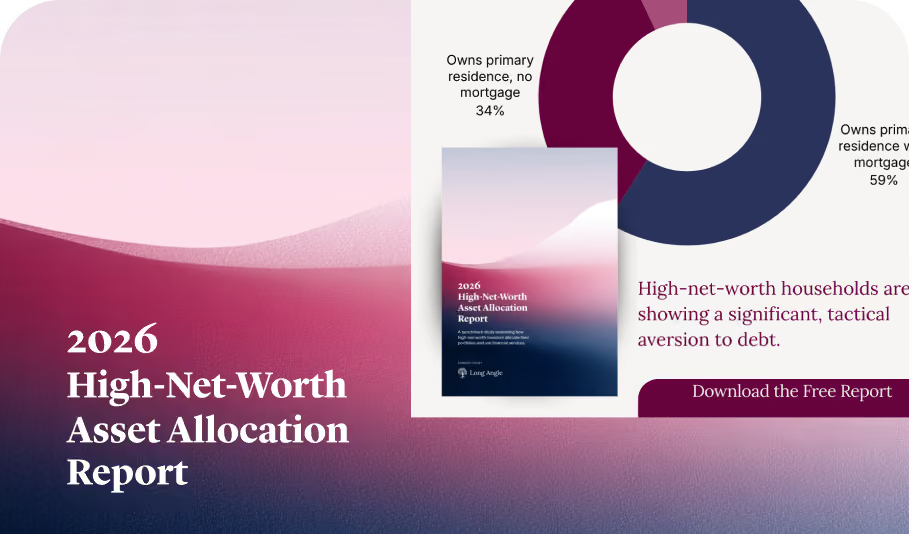
2026 High-Net-Worth Asset Allocation Report
See how high-net-worth investors with an average net worth of $17M are allocating across public equities, private markets, real estate, bonds and cash. Based on benchmark data from 230+ respondents.

What Is NAV Lending?
NAV lending is a loan secured by the net asset value of an illiquid portfolio rather than by cash or publicly traded securities. The borrower pledges a pool of private assets, receives an advance worth a modest fraction of the portfolio's value, and repays the loan over time from distributions or an eventual sale. It is a way to unlock liquidity from private holdings without selling them.
Branton frames the problem by contrast with the public markets. If you hold large-cap public equities, borrowing is straightforward: a Lombard loan or a bank margin line is available quickly and cheaply, because the collateral is liquid, transparent, and easy to sell if the loan goes bad. Private assets break every one of those assumptions. A pool of limited-partner fund stakes, or direct stakes in private operating companies, cannot be priced on a screen or sold in an afternoon, so most banks simply decline to lend against them. Branton notes he has seen portfolios above $100 million that a private bank was unwilling to do the work to underwrite.
The mechanics are consistent across the market. A specialist lender advances a conservative percentage of the portfolio's net asset value, takes security over the assets, and is repaid as the underlying investments generate cash. The loan is not really a bet on any single company doing well; it is a bet that a diversified pool of reasonably valued private assets will, over a few years, throw off enough cash to repay a small advance against it. That structural distinction, lending against the whole pool rather than underwriting one outcome, is what makes the model work.
NAV lending is closely related to the secondary market, which is the other way to pull cash out of a private portfolio. The difference is that a secondary sale permanently disposes of the asset, often at a discount, while a NAV loan keeps the upside in the borrower's hands. Understanding when to sell versus when to borrow is the central decision this article works through.
Watch the Full Conversation
This article draws on a Navigating Wealth conversation with Alex Branton, where we discuss how borrowing against illiquid private assets works, what these facilities cost, how they are structured, and where the line sits between lending and equity risk. Watch the full episode for the complete discussion, including the exchange on how private assets are valued.
Subscribe on YouTube · Get weekly episode updates
Alex Branton is the founder of a specialist non-bank lending firm focused on financing illiquid private-market portfolios for individuals, family offices, and smaller funds. He began his career at Cambridge Associates advising large family offices, then worked in direct and mid-market private equity, before setting out to serve the underserved lower end of the NAV-lending market. Nothing in this article is investment advice; it is an educational summary of one practitioner's perspective.
Why the Market for Small Facilities Is So Thin
The supply of NAV lending drops off sharply below roughly $50 million in loan size. The largest non-bank lenders, funded by insurance capital, generally will not consider facilities under $50 million to $100 million, and banks prefer fund clients who also bring fee-generating business, leaving smaller individual borrowers in what Branton calls "no man's land."
The economics explain the gap. The biggest NAV lenders are financed by insurance money and their own back-leverage, which means the fixed cost of originating and underwriting a deal only makes sense at scale. For them, a loan below $50 million is not worth getting out of bed for. Banks occasionally participate, but they are usually drawn by the broader relationship: a fund that also gives them subscription-line business, which is a near-risk-free way for the bank to make money, is worth serving. A standalone individual with a $10 million private book offers none of that, so the bank passes.
The result is that a classic high-net-worth investor and a smaller GP face a similar problem. Below the $50 million threshold, the institutional market thins out, and what remains is a patchwork of specialist lenders and, frequently, informal arrangements where family offices and friends lend against each other's portfolios. Branton describes this lower end as largely un-institutionalized, the kind of financing that gets done through personal networks rather than a standing desk at a bank. Silicon Valley Bank once did more of this kind of lending on the tech side, but that has receded.
Branton segments the broader market by size. The largest buyout funds, the Apollos and 17Capitals of the world running multibillion-dollar vehicles, seek $100 million to $200 million facilities and are served by the biggest lenders. The mid-market is handled by its own group of lenders writing $30 million to $50 million facilities. Below that sits the underserved territory his firm targets, where the work of understanding an idiosyncratic portfolio is the entire job.
What a NAV Loan Costs and Why
A NAV loan against a diversified private portfolio typically carries a loan-to-value ratio of 10% to 30% and prices roughly 450 to 700 basis points above a reference rate. Concentration pushes both the rate higher (into the mid-teens or beyond) and can lower the available LTV. These terms are materially more expensive than a margin loan against public stock, for structural reasons.
Branton lays out the ranges directly. For a heavily diversified portfolio of fund stakes, a borrower might see around 450 basis points over a reference rate for up to a 30% LTV, and in rare cases of very broad diversification the advance might stretch to 40% or 50%. Most facilities land between 450 and 700-plus basis points, with any meaningful concentration driving pricing well north of 700, sometimes to a fixed rate in the mid-teens. Loan-to-value is deliberately conservative because the collateral is hard to sell.
The natural question, which the hosts pressed, is why the spread is so wide when the loss rates appear low. Branton is candid that the low realized losses are real: across roughly 90 transactions he and his partners have completed, only one led to enforcement. But he explains that the spread is not mainly compensation for expected loss. It reflects three other things. First, extension risk: the genuine danger is not that the loan goes to zero but that the assets take far longer to pay out than the loan's term, leaving the lender stuck holding illiquid collateral. Second, the intensive, bespoke underwriting each idiosyncratic portfolio requires. Third, a degree of pricing power, because so few lenders operate in this part of the market that a specialist can, to some extent, set the price.
He makes one point that matters for how investors should think about the asset class as a whole. Because repayment depends on private cash flows rather than public markets, NAV lending has a low correlation to direct lending, on the order of 0.3, which makes it a distinctive and somewhat dislocated form of private credit. That low correlation is part of why the capital backing these loans behaves differently from ordinary credit, and part of why the pricing does not move in lockstep with broader markets. For a fuller picture of the adjacent market, our guide to how to invest in private credit covers the larger category this sits beside.
Why Borrow at These Rates? The Compared-to-What Test
The case for a NAV loan is not that it is cheap in absolute terms; it is that it is often cheaper than the alternative. Selling a growing private portfolio on the secondary market at a 20% to 40% discount can permanently destroy more value than paying 8% to 10% on a short-term loan against it.
Branton urges borrowers to anchor on the right comparison. People instinctively compare a NAV loan to a margin loan priced around 1% over a reference rate, and by that yardstick it looks expensive. But that comparison is wrong, because a margin loan is secured by liquid, large-cap collateral with little risk to the lender. The right comparison is to the borrower's real alternative for raising the same cash. If the alternative is selling a fund stake on the secondary market, the discounts are steep: a buyout fund stake might clear around 90 cents on the dollar, but many positions sell at 60 to 80 cents. Selling a portfolio that is compounding at, say, 20% a year at a 30% or 40% discount is a permanent loss of value that can easily exceed a couple of years of loan interest.
The use cases that fit this logic tend to be time-bound and opportunistic rather than lifestyle-driven. Branton says the deals his firm likes most are things like buying out a business partner, funding a distressed secondary purchase, or bridging to a known liquidity event. The average term is around three years, and borrowers typically conceptualize the loan as a bridge: a way to get capital now without permanently dismantling a portfolio they believe will be worth more later. The mental model is "I don't want to destroy value permanently," and a NAV loan is the instrument that avoids doing so.
This is why the facility appeals to investors who have strong conviction in their private holdings but a temporary need for cash. They are not trying to lever up permanently; they are trying to avoid selling a good asset at the wrong time. Framed that way, an 8% to 10% cost of capital on a modest advance can be the cheapest option available, even though the headline rate looks high.
The Three Risk Buckets: When Debt Becomes Equity
Branton sorts NAV lending into three risk buckets. The first two, a diversified fund-stake book and a portfolio with some direct names or modest concentration, are genuine lending. The third, a highly concentrated position, stops being debt and becomes equity risk, priced in the mid-20s with profit-sharing rather than as a loan.
The first bucket is the classic diversified book of LP fund stakes in recognizable names. This carries the lowest cost of capital because the collateral is spread across many underlying companies and managers, so no single failure threatens repayment. The second bucket introduces some direct holdings or a degree of concentration; it is still understandable and underwritable, but it requires more work and carries a higher rate. These first two categories, Branton says, are the vast majority of what his firm does, the "down the fairway" NAV loans.
The third bucket is where the character of the deal changes. When a portfolio is heavily concentrated, for example, roughly 90% in a single company, there is, in Branton's words, no honest way to treat it as a straightforward loan. The lender is effectively exposed to the fortunes of one business, which is equity risk regardless of how the paperwork reads. In those cases the pricing jumps quickly into the mid-20s, often delivered through a preferred return plus a profit-share element, and the capital comes from a different pool: family offices that specifically want that kind of special-situation exposure rather than steady lending.
The discipline, he stresses, is knowing which bucket you are in. It is easy to slide from lending into equity risk without adjusting the price or the structure, and a lender who does that is taking equity-like risk for debt-like returns. The same caution applies to the borrower: a facility that looks like cheap debt against a concentrated position may carry terms that behave much more like giving away equity upside. Recognizing the transition point is the core skill on both sides of the table.
How These Loans Are Structured
Most NAV loans are structured with a pledge over the assets held in a single holding company the lender can control in a default, a distribution lockbox that sweeps a negotiated share of incoming cash toward repayment, and payment-in-kind (PIK) interest that accrues rather than being paid monthly. PIK is the default in roughly 90% or more of these facilities.
The security package is designed around the illiquidity of the collateral. The pledged assets are typically moved under a single holding company, giving the lender a clean point of control if things go wrong. Distributions from the underlying funds and companies flow into an account the lender oversees. How much of that cash is swept toward the loan versus released back to the borrower is negotiated deal by deal, often with a repayment holiday for the first couple of years, after which a defined share of distributions pays down the balance and the surplus returns to the borrower. Carve-outs for things like the borrower's taxes are built in so the structure does not create unintended problems.
The interest structure reflects that private assets do not generate predictable monthly cash. Because the collateral itself may not pay out for years, most facilities are PIK, meaning the interest compounds onto the balance and is settled when the loan is repaid rather than serviced monthly. Branton notes that PIK is the default in more than 90% of cases, though some larger facilities include a cash-pay component with quarterly payments, again routed through a controlled account. Revolvers are rare in this corner of the market because reserving undrawn capital is expensive for a fund-structured lender, so most facilities are drawn up front, occasionally with a delayed-draw feature on larger deals.
Branton is transparent that these facilities are heavily bespoke. The exact sweep percentages, holiday length, cash-versus-PIK mix, and security terms all depend on what the underlying portfolio is expected to do. That customization is part of why the underwriting is expensive and why the lenders who do it well treat origination, not capital, as the scarce resource. On the supply side, he explains that banks generally will not lend directly against a $10 million private book but will back-leverage the NAV lenders themselves, which is how a specialist can access cheaper capital at scale and pass some of that pricing down to smaller borrowers.
Borrowing Against Concentrated Pre-IPO Stakes
One of the most in-demand and hardest-to-fill requests is borrowing against a large single-name pre-IPO position, such as SpaceX, OpenAI, or Anthropic. Because a single private company can represent 80% to 90% of a borrower's portfolio, lenders often decline, since there is no reliable way to value the downside case.
Branton says the run-up in private tech valuations has produced a wave of would-be borrowers holding concentrated stakes in the most sought-after private companies. Many arrive having already been turned down elsewhere, including people with $5 million to $100 million tied up in a single name. The problem is not demand; it is underwriting. When one company is 80% or 90% of the collateral, and that company is a late-stage private business whose "valuation" is an unrealized mark that may barely trade, a conservative lender cannot get comfortable with what the position would be worth in a downside scenario. Branton admits he often cannot supply what these borrowers want, not because the asset is bad but because he cannot responsibly value it as loan collateral.
Two things make some of these deals possible anyway. The first is a visible liquidity event on the horizon: if a borrower can point to a lockup expiring in a defined number of months, the lender has a concrete repayment path and can treat the facility as a true bridge. Branton notes borrowers often think this way, planning to repay from an upcoming liquidity event while using the borrowed capital to invest elsewhere in the meantime. The second is accepting that such a deal belongs in the special-situations bucket, priced as equity-like risk rather than as a standard loan, with the higher cost and profit-sharing that implies.
The structural complexity adds another layer. Many of these concentrated stakes are held through special-purpose vehicles rather than directly, which makes the collateral harder to pledge and to value. For a borrower, the practical lesson is that a concentrated pre-IPO position is far harder to finance than an equally valuable diversified book, and that the terms, when a facility is available at all, will reflect the single-name risk. For the broader context of how these private positions get valued and traded, our overview of what growth equity is covers the late-stage private market these stakes come from.
Final Thoughts
NAV lending occupies a strange position: it is simultaneously essential to investors who need liquidity without selling, and almost invisible until the moment they need it. The market has grown meaningfully since around the time of the pandemic, much of it originating in Europe, but the lower end, where individuals and family offices with sub-$50 million portfolios live, remains thin and inefficient. That inefficiency is precisely why the pricing is high and why the terms are so bespoke.
For an investor, the practical takeaways from Alex Branton are worth holding onto. Judge the cost of a NAV loan against the real alternative of selling at a secondary discount, not against a cheap margin loan. Understand which of the three risk buckets your portfolio falls into, because concentration quietly turns debt into equity. And recognize that the hardest positions to finance, concentrated pre-IPO stakes, are exactly the ones investors most often want to borrow against. Used well, borrowing against illiquid assets is a way to avoid destroying value at the wrong moment; used carelessly, it is an expensive way to take on risk you did not price.
Frequently Asked Questions
What is NAV lending?
NAV lending is borrowing against the net asset value of an illiquid investment portfolio, most often a pool of private equity funds, venture stakes, or direct private-company holdings, rather than against cash or public securities. A specialist lender advances a modest percentage of the portfolio's value, takes a pledge over the assets, and is repaid from future distributions or a liquidity event. It lets an investor raise cash from private holdings without selling them.
How much can you borrow against a private portfolio?
Loan-to-value ratios are conservative, typically 10% to 30% of net asset value, and occasionally 40% to 50% for a very broadly diversified book of fund stakes. Concentration reduces the available loan-to-value. The advance is deliberately modest because the collateral is illiquid and hard to sell, so lenders leave a wide cushion between the loan amount and the portfolio's stated value.
How much does a NAV loan cost?
Pricing for a diversified portfolio typically runs about 450 to 700 basis points above a reference rate, with most facilities in that range. Any meaningful concentration can push the rate well above 700 basis points, sometimes to a fixed rate in the mid-teens, and highly concentrated special situations can price in the mid-20s with profit-sharing. Most facilities are payment-in-kind, meaning interest accrues and is settled at repayment rather than paid monthly.
Why would someone borrow against private assets at those rates?
Because the real alternative is often more expensive. Selling a private fund stake on the secondary market can mean accepting a 20% to 40% discount, which permanently destroys value in a portfolio that may still be compounding. Compared with that, an 8% to 10% cost of capital on a short-term bridge can be the cheaper option. Common uses include buying out a business partner, funding an opportunistic purchase, or bridging to a known liquidity event.
What is the difference between a NAV loan and a margin loan?
A margin loan is secured by liquid, publicly traded securities that a lender can sell quickly, so it carries a low rate, often around 1% over a reference rate. A NAV loan is secured by illiquid private assets that cannot be priced on a screen or sold on demand, which requires far more underwriting and carries much higher pricing and a lower loan-to-value ratio. The two are structurally different products despite both being loans against a portfolio.
Can you borrow against pre-IPO shares like SpaceX or OpenAI?
Sometimes, but it is difficult. When a single pre-IPO company makes up 80% to 90% of a portfolio, many lenders decline because there is no reliable way to value the position in a downside scenario, and its valuation is an unrealized mark that may rarely trade. Deals are more feasible when there is a visible liquidity event, such as an expiring lockup, that provides a clear repayment path. When available, these facilities are usually priced as equity-like special situations rather than standard loans.
What are the risks of NAV lending for the borrower?
The main risks are cost and structure. The interest rate is high relative to a margin loan, and because most facilities are payment-in-kind, the balance compounds over time. If the portfolio's distributions are slower than expected, the loan can extend and accrue more interest. For concentrated positions, terms may include profit-sharing that gives up meaningful upside. Borrowers should also understand the distribution sweep and the lender's control rights over the pledged assets in a default.
Deciding whether to borrow against a private portfolio or sell part of it is easier with peers who have navigated the same tradeoff.
Long Angle members work through decisions like these together: whether to sell a stake or borrow against it, how to think about NAV, and which lenders and managers have behaved well. The environment is vendor-free, and members frequently share diligence with one another directly.
More From Long Angle
Beyond Wealth Newsletter
Navigating Wealth Podcast
Research & Studies
Alternative Investment Education
Blog