Written by Ryan Morrison


How to Invest in Private Credit: What the Headlines Are Getting Wrong
Based on a Navigating Wealth conversation with Katie Fowler.
How to Invest in Private Credit: What the Headlines Are Getting Wrong
Private credit returns are down and redemption gates are making headlines. Katie Fowler of Blue Owl Capital explains why falling yields reflect rate mechanics rather than loan deterioration, how BDC redemption gates work, and what forward-looking signals investors should watch to evaluate their private credit exposure.
Ryan Morrison
Private credit has had a difficult six months in the press. Starting with high-profile bankruptcies in September 2025, through the Blue Owl OBDC2 wind-down narrative, through the SaaSpocalypse software exposure fears, the story being told is that private credit is the next systemic risk. Katie Fowler manages institutional and wealth channel relationships at Blue Owl Capital, one of the largest direct lending platforms in the world with over $150 billion in credit assets, and she has spent the past several months having a different version of this conversation with investors. Her argument is not that private credit is risk-free. It is that the specific risks investors are being told to worry about are largely not the risks present in the data.
Individual investors can access private credit through business development companies (BDCs), including both publicly traded and non-traded evergreen vehicles. Publicly traded BDCs offer daily liquidity but trade at discounts to NAV during market stress. Non-traded evergreen vehicles typically offer quarterly redemption windows of up to 5% of assets. Both structures provide exposure to first lien senior secured corporate loans with yields currently in the 8 to 10% range.
Key Takeaways
- Private credit returns have declined from low-teens to 8–10% because the Fed has cut rates, not because loan quality has deteriorated; these are floating rate instruments tied to SOFR
- Direct lending loans are typically first lien, senior secured, at 40% loan-to-value, with PE sponsors holding the majority of the capital stack beneath the debt
- Historical recovery rates in direct lending run approximately 70 cents on the dollar in a default scenario, well above unsecured high-yield bonds
- The quarterly 5% redemption gate in non-traded BDCs exists to protect remaining investors from forced fire sales of illiquid assets; it is a structural feature, not a signal of problems
- Forward-looking signals investors should monitor: internal loan ratings, third-party marks, and BDC discounts to NAV, not trailing default rates, which are backward-looking
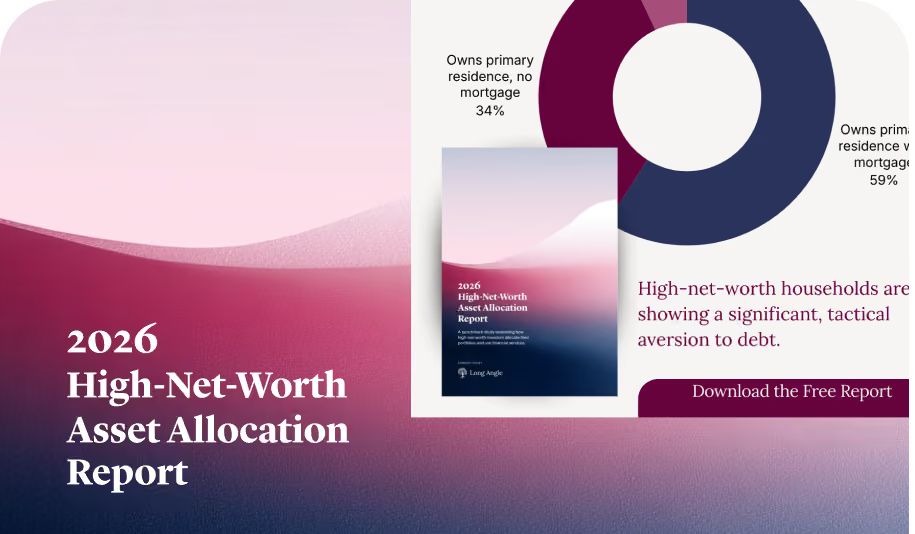
2026 High-Net-Worth Asset Allocation Report
See how high-net-worth investors with an average net worth of $17M are allocating across public equities, private markets, real estate, bonds and cash. Based on benchmark data from 230+ respondents.

The Six Months That Shook Private Credit
The sequence of events that has driven the private credit narrative over the past six months is worth laying out precisely, because the narrative and the data have diverged at several key points.
In September 2025, First Brands and Tricolor filed for bankruptcy and fraud stemming from double-pledging of collateral made headlines. Jamie Dimon's subsequent "cockroach" comment, suggesting that where there are defaults, there are more to come, amplified the concern. What emerged later, and what received far less coverage, was that those borrowers were financed primarily by banks, not by non-bank private credit lenders. The framing had already set.
In November 2025, Blue Owl announced the cancellation of a planned merger between its private fund OBDC2 and its publicly listed vehicle OBDC. The publicly listed OBDC had been beaten down by the post-headlines sentiment, and investors in OBDC2 were unwilling to absorb a haircut to the lower public market price. Blue Owl instead committed to an orderly wind-down of OBDC2 on a pro-rata basis: a return of capital rather than a fire sale.
By January 2026, the emergence of Claude Code and broader AI acceleration raised the SaaSpocalypse question. Given that approximately 20 to 25% of direct lending exposure sits in software companies, the question became: if software businesses are being disrupted by AI at scale, what does that mean for their ability to service private credit debt? The concern was legitimate in framing, even if the underlying loan-level data did not support the apocalyptic conclusion.
The past several weeks have added a wave of elevated redemption requests across major BDC platforms. Blackstone funded $150 million of its own principals' capital to meet a full 7.9% tender. BlackRock held the line at the standard 5%. Cliffwater reported 10%+ redemption requests. None of these responses generated favorable press. The asset manager narrative (that gates exist precisely for scenarios like this, that the underlying loans continue to perform, and that forced selling of sound assets helps no one) has struggled to get traction against the simpler story.
Watch the Full Conversation
This article draws on a Navigating Wealth conversation with Katie Fowler, where we discuss what the data shows about private credit loan quality, how redemption gates work, and what individual investors should be looking at to evaluate their private credit exposure. Watch the full episode for the broader discussion.
o
Subscribe on YouTube · Get weekly episode updates
Katie Fowler is a Managing Director at Blue Owl Capital, where she manages wealth and institutional channel relationships for Blue Owl's direct lending business. Blue Owl manages over $150 billion in credit assets and its flagship OCIC vehicle is the second-largest of its kind at $34 billion. She joined Blue Owl at its founding roughly ten years ago and has spent her career focused specifically on direct lending.
What Is Direct Lending and How Are These Loans Structured
Direct lending is the practice of non-bank lenders making loans directly to companies, typically to finance private equity-led leveraged buyouts, without going through a bank syndicate or public bond market. It has existed for decades, but its current scale is a post-GFC phenomenon.
Before the 2008 financial crisis, large-scale LBO financing ran primarily through bank balance sheets, which would then syndicate that risk to third-party institutional buyers through the broadly syndicated loan market. Post-GFC regulatory changes, particularly capital charges that made it increasingly costly for banks to hold leveraged lending risk on their balance sheets, created a structural gap. Non-bank lenders like Blue Owl filled it. Direct lending now represents approximately 25% of all below-investment-grade US corporate credit, most of that growth representing a share shift away from bank syndication rather than net new credit creation.
The structural terms of direct loans differ meaningfully from publicly syndicated alternatives. Direct lenders hold loans to maturity on their own balance sheet, which allows them to negotiate more lender-friendly documentation than a bank preparing to syndicate risk to hundreds of CLO vehicles. The key structural features:
First lien senior secured position: the lender is first in line against company assets in a default scenario. The loan sits at the top of the capital structure. At a typical 40% loan-to-value, the PE sponsor's equity represents 60% of the total enterprise value, sitting beneath the debt. In a default scenario, enterprise value would need to decline by more than 60% before the lender's principal is impaired.
Illiquidity premium: direct lenders charge approximately 2% additional spread over what equivalent companies pay in the broadly syndicated loan market. This compensates investors for holding an instrument they cannot sell daily.
Negative incurrence covenants: direct loan documents prohibit borrowers from taking specific actions, such as raising additional debt, making acquisitions, or moving pledged collateral, without lender approval. These protections are stronger than what is available in publicly traded loan markets.
Recovery rates: Blue Owl's historical recovery in default scenarios runs approximately 70 cents on the dollar. This reflects both the senior secured position and the ability of a concentrated lender to engage directly with the borrower and sponsor rather than navigating a fragmented syndicate.
Loss rate: across Blue Owl's direct lending business since inception ten years ago, the annualized credit loss rate has run approximately 8 basis points. That is a low number relative to the yield these loans generate.
Why Private Credit Returns Are Falling, and Why That Is Not the Problem
The most widespread misconception driving investor concern right now is that declining private credit returns signal deteriorating loan quality. They do not. They reflect interest rate mechanics.
Direct lending loans are floating rate instruments. Their yield is calculated as SOFR plus a spread. When SOFR was elevated, in 2023 and 2024, it was possible for first lien senior secured loans to produce low-teens yields. Those were unusually high absolute returns for the risk profile involved. The Fed has since cut rates by approximately 2%, and credit spreads have also normalized modestly as market conditions improved and competition from returning bank lenders increased. The result is current yields in the 8 to 10% range.
There is an irony worth understanding. Higher absolute yields in 2023 and 2024 represented a more stressful environment for borrowers, who were paying significantly more to service their debt. The concern at the time was whether borrowers could afford such elevated interest payments. Today, with rates lower and spreads compressed, borrowers are on stronger fundamental footing. Interest coverage ratios in Blue Owl's diversified book have improved from a trough of 1.7 times during peak rates to 2.1 times currently. The borrowers are in better shape. The yield is lower because the macro environment, specifically the rate environment, improved.
Investors who became accustomed to 13% returns in 2023 and are now seeing 9% are not observing a deterioration in the quality of their allocation. They are observing a rate cycle. The relative comparison that matters is not 9% versus 13%. It is 9% versus what high-yield bonds or broadly syndicated loans are yielding over the same period, with materially weaker structural protections.
BDC Investing: How the Structures Work and What Redemption Gates Mean
Business development companies are the primary vehicle through which individual investors access private direct lending. Understanding how the two main BDC structures work is essential to interpreting the recent redemption headlines accurately.
Publicly traded BDCs list on a stock exchange and trade at market prices that fluctuate independent of the underlying loan portfolio's value. During periods of market stress, publicly traded BDCs often trade at 20 to 30% discounts to their net asset value. That discount reflects investor sentiment and market liquidity, not a write-down of the underlying loans. A publicly traded BDC trading at 80 cents on the dollar does not mean its loan book is worth 80 cents; it means the public market is attaching a significant illiquidity discount to the vehicle at that moment.
Non-traded evergreen BDCs operate differently. They price at or near NAV and offer quarterly tender windows, typically 5% of fund assets per quarter. This structure was specifically designed to provide individual investors with periodic liquidity while protecting the fund from forced selling of illiquid loans. The gate is not a penalty. It is the mechanism that allows the manager to continue deploying capital in illiquid instruments while offering some liquidity to investors who need it.
The recent elevated redemption requests, Blackstone meeting its full 7.9% tender by funding $150 million from its own principals' pockets, BlackRock holding firmly at the standard 5%, Blue Owl proceeding with an orderly pro-rata wind-down of OBDC2, represent three different but reasonable responses to the same stress scenario. Each was operating within the stated terms of its fund documents. None of them was a signal that the underlying loans had deteriorated. They were signals that retail sentiment had turned negative and that redemption pressure was exceeding normal quarterly capacity.
The BREIT comparison is instructive. Blackstone's real estate fund went through a period of elevated redemptions in 2022 and 2023 as real estate sentiment soured. It managed through the gates, continued to perform, and has since seen net inflows from the same wealth investor base that initially drove the redemption pressure. Private credit appears to be going through a structurally similar cycle. For more on how these BDC and private credit structures compare to hedge fund vehicles, the post on hedge fund minimums and access mechanics covers the parallel dynamics in the alternative credit space.
The Software Exposure Question
Software represents approximately 20% of the direct lending market, and the SaaSpocalypse narrative raises a legitimate forward-looking question: if AI displaces meaningful revenue from software companies over the next three to five years, what does that mean for the debt sitting on those companies' balance sheets?
The framing matters before the risk can be assessed clearly. The software companies in direct lending portfolios are not early-stage SaaS businesses with thin customer relationships and a generic product. They are primarily large, PE-owned, vertically integrated enterprise software businesses with deep domain expertise in specific niches, owned by institutional PE sponsors with significant equity committed to the same businesses. Blue Owl approved approximately 5% of the deals its originators brought to investment committee, an intentionally high selectivity threshold.
More importantly, AI disruption risk in software is not new information that markets are processing for the first time. ChatGPT launched four years ago. Blue Owl has been underwriting AI displacement risk as part of its standard software diligence process for years. The companies most at risk, horizontally commoditized tools with no proprietary data or workflow lock-in, are the ones that would not typically pass a direct lending investment committee's bar for PE-sponsored, upper-middle-market lending.
The capital structure argument also provides meaningful context. At 40% loan-to-value, a 20% decline in the enterprise value of a software borrower does not impair the lender's position. A 40% decline does not impair it either. The equity sponsors sitting below the debt have committed more capital to the same businesses than the lenders have; they are the first loss position and have every incentive to support the business before it reaches a default scenario.
What Investors Should Watch as Forward-Looking Signals
Trailing default rates are the wrong metric for evaluating the current health of a private credit portfolio. Defaults, by definition, reflect problems that materialized in the past. The useful signals are forward-looking and available in public filings for investors willing to look.
Internal loan ratings. Blue Owl publicly discloses its 1-through-5 internal rating distribution in its BDC 10-Q filings. A rating of 1 means the borrower is outperforming underwriting expectations; 5 means the borrower is in genuine distress. Currently, 3-through-5 rated names represent approximately 5% of Blue Owl's OCIC book and have been consistent at that level for several quarters. If that percentage begins to creep upward, even without an accompanying rise in formal defaults, it is a meaningful early warning signal. The same logic applies to any BDC that publicly discloses its internal rating schema.
Third-party marks. Blue Owl's OCIC portfolio is marked monthly by an independent third-party valuation agent. The weighted average mark of the privately originated book has shown very little movement over the past 12 months and currently sits at par less original issue discount, typically around 98 cents. If the average mark begins to drift meaningfully below that level, into the mid-90s and lower, that is a signal of potential future concern that precedes formal default disclosure. Critically, these are third-party marks, not self-reported values; the $1.4 billion loan sale at 99.7 cents on the dollar referenced in the OBDC2 process provided external validation of Blue Owl's marking approach. Long Angle's Q1 2026 private credit market perspective examines these signals in more detail across the broader market.
Natural repayment rate. Direct lending portfolios generate 6 to 8% natural quarterly repayment as loans mature and are refinanced. This is the liquidity cushion that supports the 5% quarterly tender structure. A manager who offers 5% quarterly redemptions and generates 6 to 8% in natural repayments does not need to sell assets to fund redemptions in a normal environment. Watching whether the natural repayment rate holds gives investors a real-time read on the underlying portfolio's health and the fund's capacity to meet obligations without forced selling.
BDC NAV discounts. A publicly traded BDC trading at a 25% discount to NAV is not signaling that its loans are worth 75 cents. It is signaling market sentiment and the price of illiquidity at that moment. Historically, large NAV discounts in publicly traded BDCs have represented buying opportunities for investors with longer time horizons and genuine conviction in the underlying portfolio quality, rather than exit signals
How Individual Investors Access Private Credit
There are two primary paths for individual investors seeking private credit exposure, and the right choice depends on liquidity needs and holding period.
Publicly traded BDCs, including Blue Owl Capital Corporation (OBDC), FS KKR Capital Corp, and Ares Capital Corporation, trade on major stock exchanges and require no minimum investment beyond the cost of a share. They offer daily liquidity and transparent pricing, but they carry the volatility of public market sentiment and will trade at discounts to NAV during stress periods.
Non-traded evergreen BDCs, including Blue Owl's OCIC flagship vehicle, are designed for the wealth channel and typically require minimum investments in the $25,000 to $50,000 range, with qualification as an accredited investor. They price at or close to NAV, offer quarterly tender windows of up to 5% of assets, and aim to closely replicate the institutional direct lending experience for individual investors. The trade-off is reduced liquidity compared to publicly traded alternatives.
For investors evaluating either path, the due diligence checklist that matters most is: the manager's track record on credit losses relative to the yield generated; portfolio diversification by borrower, sector, and loan size; leverage ratios at the fund level; fee structure and total expense ratio; and the mechanics of the liquidity offering, specifically what natural repayment rate supports the redemption capacity. Long Angle's Private Credit Investment Guide 2026 walks through this evaluation framework in detail, including how to benchmark a private credit manager's performance against relevant liquid market alternatives.
For investors thinking about how private credit fits within a broader alternative investment allocation, including how high-net-worth investors are currently sizing these positions relative to equities, real estate, and other alternatives, the 2026 asset allocation report covers current allocation patterns across 230+ respondents. Long Angle's private market investment offerings provide members with access to institutional-quality private credit opportunities alongside peer diligence.
Final Thoughts
At the time of recording, private credit is going through a period of genuine stress in terms of investor sentiment and redemption pressure. The loan portfolios underlying the major BDC vehicles are, by the measures that matter most, performing in line with or better than historical expectations. That distinction matters for investors trying to decide whether to hold, add to, or exit their private credit allocation.
The specific risks worth monitoring are real but different from the ones generating the most headlines. Rate normalization explains the yield decline. Software exposure at 40% LTV with PE sponsor equity beneath it is not the apocalyptic scenario that the SaaSpocalypse framing implies. Redemption gates are functioning as designed. The data is there for investors willing to read the filings.
Frequently Asked Questions
What is private credit and how does it work?
Private credit refers to loans made directly by non-bank lenders to companies, bypassing public bond and loan markets. The dominant strategy within private credit is direct lending, which typically finances private equity-led leveraged buyouts with first lien senior secured loans. Lenders earn a floating rate return (SOFR plus a spread) and an illiquidity premium of approximately 2% over comparable publicly traded instruments.
What are typical private credit returns in 2026?
Following a period of low-teens yields in 2023 and 2024 when SOFR was elevated, current private credit yields in the direct lending space run approximately 8 to 10% annualized. The decline reflects Fed rate cuts and spread normalization, not a deterioration in loan quality. These returns should be evaluated relative to comparable liquid benchmarks like high-yield bonds and broadly syndicated loans, where direct lending has historically delivered 150 to 200 basis points of premium yield.
What is a BDC and how do redemption gates work?
A business development company is a regulated investment vehicle that provides individual investors with access to private credit strategies. Publicly traded BDCs offer daily liquidity but trade at market prices that can diverge significantly from underlying NAV. Non-traded evergreen BDCs offer quarterly redemption windows, typically capped at 5% of fund assets per quarter. The quarterly gate is a structural feature designed to prevent forced selling of illiquid loan portfolios when redemption demand spikes, protecting investors who remain in the fund. It is not a signal that the underlying portfolio is impaired.
Are private credit default rates rising in 2026?
Default rates in the corporate credit market are running at approximately 2 to 3% based on third-party data from Kroll and Fitch, which is broadly average for the credit cycle. Selective upper-middle-market direct lenders with PE sponsor-backed borrowers have historically performed meaningfully better than broad market default rates, reflecting the structural protections, loan-to-value discipline, and sponsor equity cushion present in that segment.
How does direct lending differ from high-yield bonds?
Direct lending loans are privately originated, held to maturity, first lien senior secured, and documented with stronger lender protections than publicly traded high-yield bonds. They carry less liquidity but have historically delivered higher yields, lower default rates, and higher recovery rates in default scenarios. High-yield bonds trade in public markets, offer daily liquidity, are typically rated by a rating agency, and are more susceptible to broad market sentiment swings.
What should I look for when evaluating a private credit fund?
Key evaluation criteria: the manager's historical credit loss rate relative to the yield generated; borrower diversification (no single name exceeding 2% of the portfolio); portfolio-level leverage; fee structure; and the liquidity mechanics supporting the redemption offering. Forward-looking signals include the distribution of internal loan ratings disclosed in BDC filings and the trend in third-party portfolio marks. A manager whose 3-through-5 rated names are stable and whose marks are holding near par is in a fundamentally different position than one where both metrics are deteriorating.
Navigating a market dislocation in an asset class requires peer-level intelligence, not just manager commentary.
Long Angle's Trusted Circles and Community provide members with the peer diligence and collective intelligence to evaluate private credit positions, share what they are seeing across managers, and make more informed allocation decisions.
More From Long Angle
Beyond Wealth Newsletter
Navigating Wealth Podcast
Research & Studies
Alternative Investment Education
Blog