Written by Scott Nixon


Should I Pay Off My Mortgage or Invest? What Long Angle Members Do
Should I Pay Off My Mortgage or Invest? What Long Angle Members Do
In Long Angle's 2026 study, 73% of members with a mortgage pay under 4%, yet a third own outright. When paying it off beats investing, and why.
Scott Nixon
Pay off your mortgage when its after-tax cost is higher than what the same money would earn after tax at similar risk; otherwise, keep the loan and invest. Among respondents to Long Angle's 2026 Asset Allocation Report, all worth $2 million or more, 59% carry a mortgage, and about three in four of them pay under 4%, at an average of 3.4%. At those rates, keeping the loan usually wins on expected returns, but at top tax brackets keeping it is a bet on market returns. Still, 34% own their home outright.
Key Takeaways
- Among respondents to Long Angle's 2026 Asset Allocation Report, 59% own their home with a mortgage, 34% own it outright, and 7% don't own their home.
- About three in four respondents with a mortgage pay under 4%, and their average rate of 3.4% is the lowest of the four loan types the study asked about.
- Those respondents' portfolio lines of credit average 5.2% and HELOCs 6.1%, so paying off a 3.4% mortgage and later borrowing on a line moves debt the wrong way.
- The mortgage interest deduction only helps above the standard deduction, $32,200 for married couples filing jointly in 2026, and only on the first $750,000 of acquisition debt.
- Long Angle members who paid off early describe it as a decision made for peace of mind, and few say they regret it.
2026 High-Net-Worth Asset Allocation Report
See how high-net-worth investors with an average net worth of $17M are allocating across public equities, private markets, real estate, bonds and cash. Based on benchmark data from 230+ respondents.
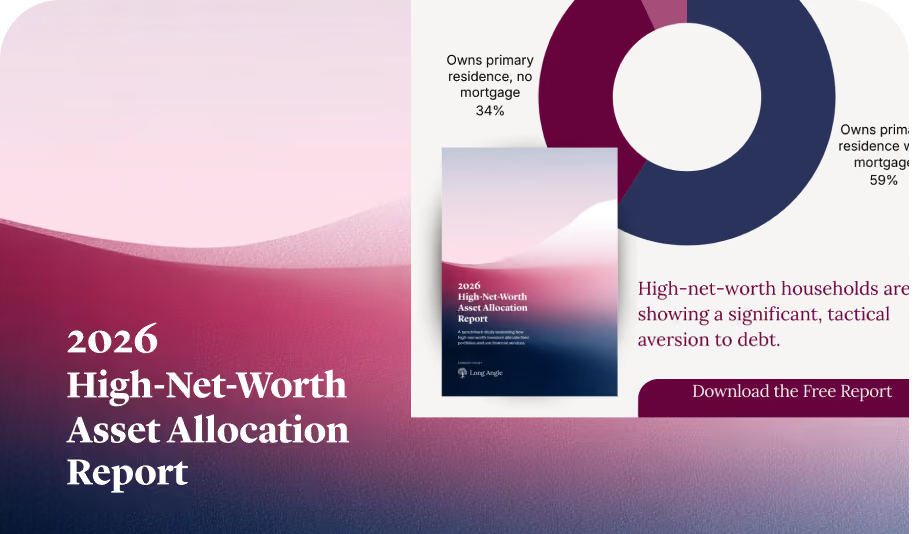

What Long Angle Members Do With Their Mortgage
Most respondents to Long Angle's 2026 Asset Allocation Report keep a mortgage on their home, but a large minority have none. Of 233 respondents worth $2 million or more, 59% own their primary residence with a mortgage and 34% own it outright.
| Home ownership | Share of respondents |
|---|---|
| Own primary residence with a mortgage | 59% |
| Own primary residence, no mortgage | 34% |
| Don't own primary residence | 7% |
Source: Long Angle 2026 High-Net-Worth Asset Allocation Report, 233 respondents with $2 million or more in net worth, average about $17 million, fielded December 2025 to January 2026. Voluntary sample of Long Angle members.
Leverage also falls as wealth rises. Among the same respondents, the mortgage makes up 37% of home value on average at $2 million to $10 million in net worth, 28% at $10 million to $25 million, and 19% above $25 million. Those figures, and the rest of the household balance sheet, are in Long Angle's finding on how high-net-worth investors allocate their portfolios.
A separate Long Angle member poll asked about every kind of personal debt. It's a different sample and a different question, so its numbers don't combine with the study's, but the picture matches: the home mortgage is the debt members carry most, and about a quarter carry none at all.
| Debt currently carried | Share of respondents |
|---|---|
| Primary residence mortgage | 60% |
| Investment real estate mortgage | 24% |
| Asset-backed line (margin, PLOC, PAL, SBLOC) | 21% |
| Auto loan | 18% |
| HELOC | 7% |
| Business loan with a personal guarantee | 7% |
| Credit card balance not paid in full | 2% |
| Other | 1% |
| None: debt free | 27% |
Source: Long Angle member poll, 471 respondents, posted March 2026, votes through July 2026. Select all that apply, so shares total more than 100%. Voluntary sample of Long Angle members.
What Long Angle Members Pay to Borrow: The Mortgage Is Cheapest
For most respondents, the home mortgage is the lowest-cost debt they have. Respondents to Long Angle's 2026 Asset Allocation Report reported an average primary mortgage rate of 3.4%, against 4.5% on investment property mortgages, 5.2% on portfolio lines of credit and 6.1% on HELOCs.
| Loan type | Average rate |
|---|---|
| Primary residence mortgage | 3.4% |
| Investment real estate mortgage | 4.5% |
| Portfolio line of credit (PLOC) | 5.2% |
| Home equity line of credit (HELOC) | 6.1% |
Source: Long Angle 2026 High-Net-Worth Asset Allocation Report, 233 respondents with $2 million or more in net worth, average about $17 million, fielded December 2025 to January 2026. Average rates among respondents with each type of loan.
Most of those mortgages were locked in at low rates. Among respondents with a mortgage, 53% pay under 3% and 73% pay under 4%. Only 17% pay 5% or more.
| Mortgage rate | Share of respondents with a mortgage |
|---|---|
| 1% to 1.99% | 5% |
| 2% to 2.99% | 48% |
| 3% to 3.99% | 20% |
| 4% to 4.99% | 10% |
| 5% to 5.99% | 8% |
| 6% to 6.99% | 7% |
| 7% to 7.99% | 2% |
Source: Long Angle 2026 High-Net-Worth Asset Allocation Report, 233 respondents with $2 million or more in net worth, average about $17 million, fielded December 2025 to January 2026. Respondents with a mortgage on their primary residence.
That ordering matters for the payoff decision. Paying off a 3.4% mortgage with cash, then drawing on a line of credit when you need liquidity, swaps the cheapest debt you have for some of the most expensive. Long Angle's guide to how high-net-worth households borrow covers the other loans in detail.
Pay Off Your Mortgage or Invest: The Math at Your Rate
The right comparison is your mortgage's after-tax cost against the after-tax return on the money at similar risk. Paying down a mortgage is a guaranteed return equal to its rate, so the fair benchmark is a safe asset.
At high incomes, that comparison is closer than it looks. For illustration, a Treasury yielding 4% nets about 2.5% after the 37% top federal rate, and less if the net investment income tax applies. If your mortgage interest isn't deductible, a 3.4% loan costs 3.4%, so paying it down beats the Treasury. Keeping the mortgage then makes sense only if you expect your portfolio to earn more than the loan costs, and you can live with the years it doesn't.
| Your mortgage rate | What usually wins | Why |
|---|---|---|
| Under 4% | Keep the loan and invest | A diversified portfolio is expected to earn more than this over long periods, and inflation shrinks a fixed payment over time. It's still a market bet. |
| 4% to 6% | A judgment call | Safe yields after tax rarely clear this rate. Weigh your deduction, your liquidity, and how long you'll hold the home. |
| Over 6% | Pay it down, or refinance first | Prepaying earns a guaranteed return few safe assets match after tax. Keep the loan only if you're comfortable betting the portfolio beats it. |
Source: Long Angle analysis. A framework to run with your own figures and your CPA or advisor.
Two things change the answer at the member tier. The first is the deduction, covered below. The second is what the cash would otherwise do: money that would sit in a money market fund earns the safe rate, while money that would go into your long-term allocation earns the portfolio's expected return. Be honest about which it is.
Does the Mortgage Interest Deduction Still Matter at High Income?
For many high earners, the mortgage interest deduction is worth less than it looks, because it only helps to the extent your itemized deductions exceed the standard deduction. Under IRS Publication 936, interest is deductible on the first $750,000 of debt used to buy, build, or improve the home ($1 million for mortgages taken out before December 16, 2017). The 2026 standard deduction is $32,200 for married couples filing jointly.
The cap on state and local taxes tightens the math. Per the 2025 Schedule A instructions, the SALT deduction is capped at $40,000 and shrinks above $500,000 of modified adjusted gross income, to no less than $10,000. For illustration, take a married couple at that $10,000 floor with a $750,000 mortgage at 3.4%. First-year interest is roughly $25,500. Together with the $10,000 of state and local taxes, they itemize $35,500, only $3,300 more than the standard deduction. At the 37% rate that saves roughly $1,200 in federal tax, so the loan still costs about 3.2% after tax.
The picture changes if you'd itemize anyway, for example because of large charitable gifts. Then every dollar of mortgage interest is deductible, and a 3.4% loan costs around 2.2% after tax for a top-bracket household. The 2026 law also trims the benefit of itemized deductions slightly for taxpayers in the 37% bracket. Interest on a HELOC or home equity loan is deductible only when the money is used to buy, build, or substantially improve the home.
Why a Third of Long Angle Members Own Their Home Outright
Long Angle members who paid off a low-rate mortgage early mostly say they knew the spreadsheet favored keeping it, did it anyway, and don't regret it. The reasons that come up in their discussions are about risk and cash flow.
| Situation | What members found |
|---|---|
| Paid off a 2% to 3.75% mortgage early | Called it the wrong financial decision and the right family one. The payment was gone, and so was the worry. |
| No regular paycheck: retired, between companies, or living off the portfolio | Paid off, or bought with cash, to avoid cash-flow stress once a regular income stopped. |
| Portfolio heavy in private or risky assets | Counted the paid-off home as part of the safe side of the allocation, like a bond holding. |
| Kept a sub-3% loan | Asked whether they'd borrow at that rate today to invest. If the answer was yes, they kept it. |
| Left the payoff cash invested in Treasuries | Held enough in safe assets to pay off at any time, and planned to pay off when the after-tax spread turned negative. |
Source: Long Angle member discussions, 2023 to 2026. Members are never identified.
One member summed up the case for the outright owners: "when you reach a certain level of wealth you need long-term stability more than you need more money." Members on the other side make an equally plain point: the gap on a low-rate mortgage is small either way, so pick the version you'll stick with.
The Downside of Paying Off Your Mortgage
The biggest cost of paying off a mortgage is liquidity. Cash in home equity can't be spent without selling or borrowing against the house, and the respondents' average HELOC costs 6.1%, nearly double their average mortgage rate.
Three costs are easy to miss:
- Getting a low rate back is hard. A mortgage locked at 3% can't be re-created once it's repaid.
- Prepaying doesn't lower the monthly payment on a standard mortgage. The required payment stays the same until the loan is paid off, unless the lender agrees to recast it over the remaining term.
- Concentration rises. A paid-off house can become a large share of a household's net worth, all in one asset in one market.
If the home is also an investment, the tradeoffs are different again; see how high-net-worth investors allocate to real estate.
After a Liquidity Event: Pay Down, Pay Off or Leave It
After selling a business, paying off the mortgage is tempting because the cash is there and the guarantees are gone, but the decision is harder to reverse than it looks. One member who sold a company described the relief of being debt free after years of personally guaranteeing its loans.
The catch is income. Without a salary, qualifying for a new mortgage is harder: members who tried found asset-based underwriting more complicated than they expected. A paid-off house is easy to create and hard to undo. Members who want to keep both options keep the mortgage and hold the payoff amount in safe assets, so they can pay it off whenever they choose. The rest of the first-year sequence is in what to do after selling your business.
Should I Pay Off My Mortgage Early?
Paying off a mortgage early makes the most sense when the rate is high, the interest isn't deductible, and you have liquidity to spare. It makes the least sense on a sub-4% loan when the cash would otherwise go into your long-term portfolio.
There are middle paths. A partial prepayment followed by a recast lowers the monthly payment while keeping the rest of the loan. Extra principal payments on a schedule reduce interest without draining reserves in one move. And for anyone tempted to replace a mortgage with a portfolio line, the line's rate floats and can be called in a downturn; Long Angle's guide to securities-based lines of credit covers that risk.
Final Thoughts
Start with three questions: what your mortgage costs after tax, what the payoff cash would earn after tax at the same risk, and how much liquidity you'd have left. If the loan is cheap and the cash would stay invested, keeping it is the default. If the rate is high, or a market drop would put the payment at risk, paying it down buys certainty. Either way, decide on a plan you'll keep through a bad year.
Frequently Asked Questions
Is it better to pay off your mortgage or invest?
It depends on your rate after tax. Under 4%, investing usually wins on expected returns, though it carries market risk. Over 6%, paying it down usually wins. Among respondents to Long Angle's 2026 Asset Allocation Report, 59% carry a mortgage and 34% own their home outright.
Should I pay off my mortgage before retirement?
Some Long Angle members do, to cut fixed costs once a paycheck stops. The cost is liquidity, so keep enough outside the house to cover spending without borrowing against it, which is harder to arrange without income.
Is there a downside to paying off your mortgage?
Yes. You lose liquidity, give up a low fixed rate you can't get back, and concentrate more of your net worth in one asset. Prepaying also doesn't lower the monthly payment on a standard mortgage unless the lender recasts it.
Does the mortgage interest deduction matter at high income?
Often less than expected. It only helps to the extent itemized deductions exceed the standard deduction, $32,200 for married couples in 2026, and only on the first $750,000 of acquisition debt. Households at the $10,000 SALT floor may get little from it.
Should I pay off my mortgage or max out my 401(k)?
Fill tax-advantaged accounts first in most cases, especially with an employer match. The tax deferral and the match usually outweigh the interest saved on a low-rate mortgage. Revisit it if your rate is high and the deduction doesn't apply.
The right answer depends on parts of your balance sheet a calculator never sees.
Trusted Circles are small, confidential groups of Long Angle members who meet monthly with a professional moderator. Long Angle is free to join; Trusted Circles is an optional $4,500 a year.
More From Long Angle
Beyond Wealth Newsletter
Navigating Wealth Podcast
Research & Studies
Alternative Investment Education
Blog