Written by Scott Nixon


Wealth Management for Business Owners: What Founders Hold and What Advice Costs
Wealth Management for Business Owners: What Founders Hold and What Advice Costs
Entrepreneurs hold 27% of their portfolio in private company equity, against 11% for others. What advised members pay by wealth tier, from 0.79% to 0.58%.
Scott Nixon
For a business owner, concentration comes before the fee. Respondents to Long Angle's 2026 Asset Allocation Report whose wealth came mainly from entrepreneurship hold 27% of their investment portfolio in private company equity, against 11% for other respondents. At $2 million to $10 million of net worth, advised respondents pay an average 0.79% of assets a year; at $10 million to $25 million, 0.67%; above $25 million, 0.58%. Most respondents (57%) manage their own portfolio. The report surveyed 233 members with an average net worth of about $17 million, from December 2025 to January 2026.
Key Takeaways
- Respondents whose wealth came mainly from entrepreneurship hold 27% of their portfolio in private company equity, against 11% for others.
- Founders and owners keep 61% of their private and alternative holdings in their own company.
- 43% of respondents use a financial advisor, and 14% hand over most or all of their assets.
- Average asset-based fees fall from 0.79% at $2 million to $10 million of net worth to 0.58% above $25 million.
- No firm serves more than 9% of advised respondents, and 40% use firms with under $10 billion in assets.
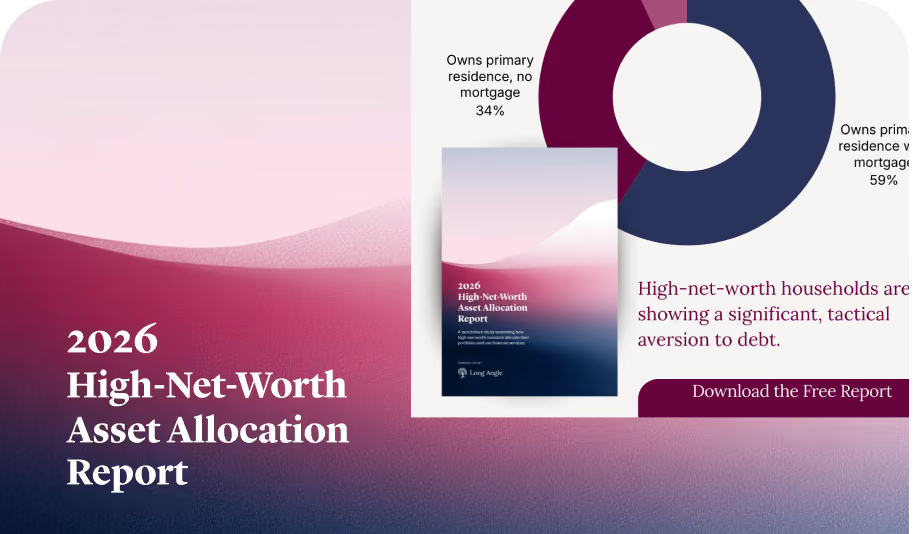
2026 High-Net-Worth Asset Allocation Report
See how high-net-worth investors with an average net worth of $17M are allocating across public equities, private markets, real estate, bonds and cash. Based on benchmark data from 230+ respondents.

When Most of Your Wealth Is Still the Company
A business owner's largest position is usually the business, so wealth management starts by planning around it. Respondents to Long Angle's 2026 Asset Allocation Report whose wealth came mainly from entrepreneurship hold 27% of their investment portfolio in private company equity, against 11% for other respondents.
| Primary source of wealth | Public equities | Private company equity | Investment real estate | Alternatives | Bonds | Cash |
|---|---|---|---|---|---|---|
| Entrepreneurship | 35% | 27% | 15% | 9% | 5% | 10% |
| Other | 61% | 11% | 11% | 5% | 6% | 6% |
Source: Long Angle 2026 High-Net-Worth Asset Allocation Report, 233 respondents, average net worth about $17M, fielded December 2025-January 2026. Average share of investment portfolio, excluding home equity. The entrepreneurship row totals 101% due to rounding.
The entrepreneurship group includes serial investors with large private equity, venture and angel allocations as well as founders. Founders and owners on their own are more concentrated still: their own company is 61% of their private and alternative holdings, with investment real estate next at 19%. The full breakdown is in how much company stock founders and employees hold.
That changes what an advisor is for. Before a sale, most of the balance sheet sits outside any advisor's account, so the work is the liquid remainder, the tax position on the company stake and a diversification plan for the proceeds. After a sale, an illiquid position becomes cash or an acquirer's stock in a single day. What to do before a liquidity event covers the steps ahead of closing, and concentrated stock positions covers proceeds paid in shares.
What a Financial Advisor for Business Owners Costs at Each Wealth Tier
Advised respondents pay an average of 0.70% of assets a year, and the rate falls as wealth rises: 0.79% at $2 million to $10 million of net worth, 0.67% at $10 million to $25 million and 0.58% above $25 million.
| Net worth | Average advisor fee (% of assets a year) |
|---|---|
| $2M to $10M | 0.79% |
| $10M to $25M | 0.67% |
| $25M+ | 0.58% |
| All advised respondents | 0.70% |
Source: Long Angle 2026 High-Net-Worth Asset Allocation Report, 233 respondents, average net worth about $17M, fielded December 2025-January 2026. Respondents with an asset-based advisor fee; net worth used as a proxy for assets managed.
Most advised respondents (71%) pay a percentage of assets under management. Another 21% pay a flat annual fee, and 8% use some other structure. Among those on an asset-based fee, 65% pay under 1% and a quarter pay under 0.5%, though the most common single bracket is 1.00% to 1.24%, reported by 31%. On $10 million, the gap between 0.6% and 1% is $40,000 a year.
These figures cover every advised respondent; the report does not split fees by source of wealth. For an owner, the fee base matters as much as the rate. An asset-based fee applies to what the firm manages, which before a sale is only the liquid part of the balance sheet and after a sale is the proceeds. Fee schedules, breakpoints, flat fees and retainers are compared in wealth management fees for high-net-worth individuals.
How Many Members Hire an Advisor, and for How Much of Their Money
Fewer than half hire one. 43% of respondents work with a financial advisor, RIA or wealth manager, and 14% use one for most or all of their assets.
| Do you work with a financial advisor, RIA or wealth manager? | Share of respondents |
|---|---|
| Yes, for most or all assets | 14% |
| Yes, for some assets | 29% |
| No, but looking | 7% |
| No, not interested | 50% |
Source: Long Angle 2026 High-Net-Worth Asset Allocation Report, 233 respondents, average net worth about $17M, fielded December 2025-January 2026.
Half of respondents have no interest in using an advisor. Portfolios run with an advisor look different from self-managed ones: 18% in private company equity against 10%, and 52% in public equities against 61%. The report traces the gap to larger private equity holdings in advisor-led portfolios. Whether the fee earns its cost at a given tier is the subject of are wealth advisors worth it.
Which Wealth Management Firms Business Owners Use
No firm dominates. Morgan Stanley is named most often, by 9% of advised respondents, and 40% use an independent or boutique firm with under $10 billion in assets.
| Wealth manager | Share of advised respondents |
|---|---|
| Morgan Stanley | 9% |
| J.P. Morgan / J.P. Morgan Private Bank | 7% |
| Fidelity | 6% |
| Charles Schwab | 4% |
| UBS | 4% |
| Other small firm (under $10B in assets) | 40% |
| Other large firm ($10B+ in assets) | 33% |
Source: Long Angle 2026 High-Net-Worth Asset Allocation Report, 233 respondents, average net worth about $17M, fielded December 2025-January 2026. Respondents with a financial advisor; more than one answer allowed, so the total exceeds 100%.
For an owner the choice often narrows to a private bank that can also lend against the company stake or the proceeds, or an independent firm whose business is advice alone. More than 70% of advised respondents use a firm outside the five named in the table, and none of those other firms has more than 2%. The questions that separate good advisors from the rest apply to both kinds of firm. Above $25 million, some owners weigh a family office instead; family office or wealth manager at $20 million covers that choice.
How Founders Build a Financial Team After the Sale
Many build it themselves. In a Long Angle member poll of 116 people who had been through a liquidity event, 47.4% said they manage everything themselves, 37.9% found their team through recommendations from peers and 15.5% through existing financial professionals.
The poll allowed more than one answer and its sample is small. It points the same way as the study: owners lean on their own judgment, and when they hire, they ask people who have already made the choice. What to do after selling your business covers the months after the money lands.
Questions to Settle Before You Hand Over the Proceeds
The questions that separate advisors for a business owner start with the company stake.
- Will part of the price stay at risk? A rollover stake, a seller note or an earn-out keeps you concentrated after closing. Ask how the advisor counts that exposure and whether it sits inside the fee base.
- Is the consideration stock? If the acquirer pays in its own shares, ask for the plan to sell or hedge them, including lockups and the tax cost of each route.
- Could the shares qualify as qualified small business stock? If the company may meet Section 1202, ask whether the advisor has worked through the exclusion with your tax advisor before, and how it changes the timing of a sale.
- When should the advisor start? Gifts of shares into trust and charitable planning often have to happen before a sale is binding. Ask what the firm would have done twelve months before closing, and read when to start estate planning.
- What does the fee cover? Ask whether tax planning, estate coordination and the business stake are included, and what the fee comes to in dollars at your expected proceeds.
- Is the firm a fiduciary on everything it manages? Read its Form CRS and Form ADV Part 2A for the fee schedule, breakpoints and conflicts of interest, and look up the firm and the advisor on the SEC's Investment Adviser Public Disclosure site and FINRA BrokerCheck.
Bring the same questions to owners who sold before you. They can tell you which firm they used and whether they would hire it again. More general screening questions are in questions to ask a financial advisor.
Where an Operator Peer Group Stops and a Wealth Peer Group Starts
Operator peer groups and Long Angle admit on different tests. Hampton, Vistage, YPO and EO admit on role and company, including founders building again after an exit, and have no personal wealth requirement.
Long Angle is the complement for the wealth decisions: which advisor, what fee, what to do with the proceeds. Members qualify with more than $3 million in investable assets, excluding a primary residence, verified, with no upper limit. Membership is free, and Trusted Circles, small moderated groups that meet monthly, are an optional $4,500 a year. Some members keep their operator group and add Long Angle. Hampton vs Vistage compares two operator groups, and peer groups after selling a business covers the choice after an exit.
Final Thoughts
For a business owner, wealth management starts with the company stake: how concentrated it is, when it turns into cash and who helps before it does. Fees fall with wealth, from 0.79% to 0.58% among advised respondents, and most respondents run their own money. Settle the plan for the stake first, then choose the advisor whose fee and scope fit it.
Frequently Asked Questions
Do business owners need a different financial advisor?
They need one who plans around the company stake. Respondents whose wealth came mainly from entrepreneurship hold 27% of their portfolio in private company equity, against 11% for others, so a plan that leaves out the business leaves out the largest position. Ask how the firm handles concentrated stock and the tax and estate steps before a sale.
How much does a financial advisor for business owners cost?
Advised respondents to Long Angle's 2026 Asset Allocation Report pay an average of 0.70% of assets a year: 0.79% at $2 million to $10 million of net worth, 0.67% at $10 million to $25 million and 0.58% above $25 million. 71% pay a percentage of assets and 21% a flat annual fee.
Should I hire a wealth manager before or after selling my business?
Before, where you can. Gifts of shares into trust and charitable planning often have to happen before a sale is binding, and financial planning for business owners works best while those options are still open.
How do founders find a financial advisor after an exit?
In a Long Angle member poll of 116 people who had been through a liquidity event, 47.4% manage everything themselves, 37.9% found their team through recommendations from peers and 15.5% through existing financial professionals. More than one answer was allowed.
Want to know which advisors other owners would hire again?
Long Angle is a free, vetted community of entrepreneurs, executives and investors with more than $3 million in investable assets, comparing notes on advisors, tax and what to do after a sale.
More From Long Angle
Beyond Wealth Newsletter
Navigating Wealth Podcast
Research & Studies
Alternative Investment Education
Blog