Written by Scott Nixon



When to Start Estate Planning: A Framework for High-Net-Worth Founders and Executives
When to Start Estate Planning: A Framework for High-Net-Worth Founders and Executives
Estate planning timing depends less on a threshold number and more on trajectory, access needs, and whether the compounding advantage of acting early outweighs the cost of maintaining what gets built.
Scott Nixon
Most founders and executives have a version of this question sitting on a back burner: the basic estate planning is done, a liquidity event is approaching, and the question is whether to engage with the more complex instruments now or wait. The answer depends less on a threshold number and more on the trajectory of the estate, the flexibility the investor needs, and whether the compounding advantage of acting early outweighs the cost and complexity of maintaining what gets set up. That is a harder calculation than most advisors present it as. What follows is a framework grounded in how Long Angle members approaching this stage have worked through it.
When should high-net-worth founders start estate planning? The foundation (revocable trust, will, powers of attorney, healthcare directives, and beneficiary review) should be in place as soon as there are meaningful assets or dependents. Advanced instruments like GRATs, SLATs, and IDGTs make sense when the estate trajectory clearly exceeds the federal exemption, when there is appreciating pre-liquidity equity to transfer, or when the investor is certain enough about access needs to commit to an irrevocable structure. Below those conditions, simplicity and a five-year review cadence typically serve better than complexity introduced prematurely.
Key Takeaways
- The One Big Beautiful Bill Act permanently raised the federal estate and gift tax exemption to $15 million per individual ($30 million per married couple), effective January 2026 and indexed for inflation, reducing urgency for many estates below that threshold
- Foundation-level planning (revocable trust, will, POA, healthcare directives, beneficiary audit) should be completed before any irrevocable instrument is introduced
- Advanced instruments are most valuable when funded before a liquidity event hardens; once a letter of intent arrives, several of the most effective transfer strategies become unavailable
- Unwinding a SLAT after it is established consumes the lifetime gift exclusion used to fund it, a tradeoff most general guides omit
- Annual maintenance costs for a moderately complex estate structure typically run $5,000-$15,000 per year but shrink proportionally as the estate compounds
- A five-year review cadence, rather than a one-time plan, better reflects how estates, families, and tax law evolve
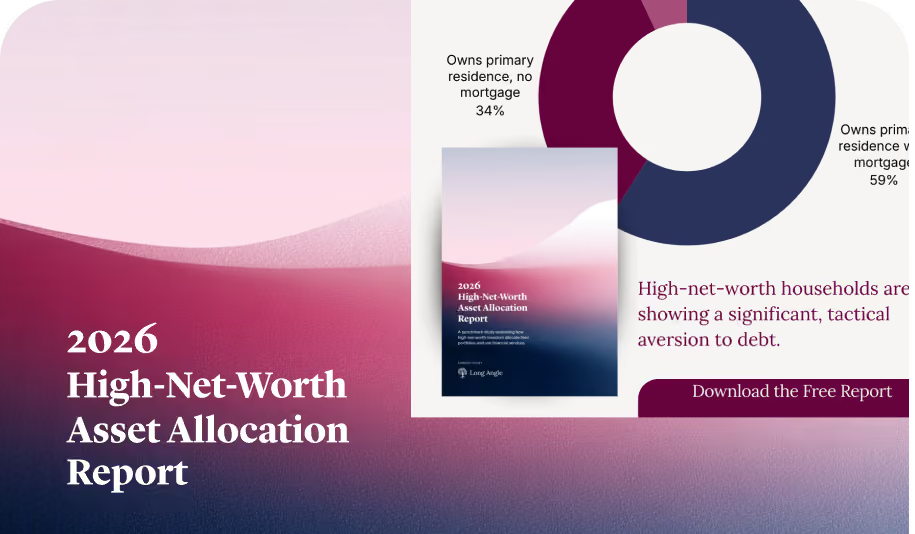
2026 High-Net-Worth Asset Allocation Report
See how high-net-worth investors with an average net worth of $17M are allocating across public equities, private markets, real estate, bonds and cash. Based on benchmark data from 230+ respondents.
The Exemption Has Changed and So Has the Urgency
For most founders and executives below $15 million in net worth, the urgency for advanced estate planning is lower today than it was two years ago. The One Big Beautiful Bill Act, signed July 2025, permanently raised the federal estate and gift tax exemption to $15 million per individual and $30 million per married couple, effective January 1, 2026, indexed for inflation thereafter. The exemption had been scheduled to revert to roughly $7 million per person at the end of 2025. It did not. The race against the sunset that drove a significant amount of 2024-2025 planning activity is over.
What this does not change: the estate tax rate remains 40% on assets above the threshold, and the compounding argument for acting early on instruments like GRATs and SLATs is structural, not deadline-driven. Time is the key variable in most wealth transfer strategies. An instrument funded when assets are valued lower and growth potential is higher transfers more outside the taxable estate than the same instrument funded later. The exemption threshold changes the urgency; it does not change the underlying math.
For founders holding pre-liquidity equity, the legislation also expanded qualified small business stock benefits under Section 1202: the holding period was shortened from five years to three years, the capital gain exclusion was raised from $10 million to $15 million, and the gross asset limit to qualify was increased from $50 million to $75 million, effective 2026. QSBS documentation and eligibility should be confirmed well before any liquidity event.
For the full mechanics of how transfer taxes interact with estate planning instruments, see how transfer taxes work in estate planning.
Start with the Basics Before the Advanced
Asset protection, a revocable trust, powers of attorney, and healthcare directives should be in place before any irrevocable instrument is introduced. This is not a low bar. Most people in the early stages of significant wealth have not fully completed it. But it is the right sequence. Irrevocable structures introduced before the foundation is solid tend to either become irrelevant or create friction that takes years to resolve.
Foundation-level planning covers five areas. A revocable living trust governs how assets transfer at death and can be amended as circumstances change. A will covers anything outside the trust and names a guardian for minor children. A durable power of attorney designates who can act on financial matters if you are incapacitated. A healthcare directive (sometimes called an advance directive or living will) covers medical decisions. Beneficiary designations on retirement accounts, life insurance policies, and other transfer-on-death assets should be reviewed at the same time, because those designations override whatever the will says.
Once those are in place, the question of whether to introduce irrevocable instruments can be evaluated on its actual merits. Many people who engage estate attorneys in their 30s with rapidly appreciating equity spend the early sessions on foundational work they assumed was already done. Finishing that first creates the stable platform on which more complex instruments can be layered thoughtfully. For families with young children, this is also the right time to think through guardianship structures and the question of how and when children should receive assets, a topic Long Angle members discuss in detail when thinking through how much wealth to leave children.
Using a 529 plan as part of the foundational gifting strategy is worth exploring early; it is one of the cleaner vehicles for transferring value while retaining some control. For a detailed look at how it intersects with estate planning, see using 529 plans as part of an estate strategy.
When Advanced Instruments Make Sense
Advanced instruments like GRATs, SLATs, and IDGTs make sense when three conditions are present: the estate trajectory clearly points toward exceeding the exemption threshold, there are appreciating assets that benefit from early transfer, and the investor is comfortable enough with the access restrictions to commit to an irrevocable structure. When all three are present, the case for acting is strong. When one or more is absent, the case for waiting and reviewing in five years is usually stronger.
For a detailed look at the full range of available instruments and how each is structured, see the high-net-worth estate planning guide. What follows is specific to the timing question.
GRATs and the pre-liquidity window. A grantor retained annuity trust transfers future appreciation above the IRS §7520 hurdle rate to heirs with minimal gift tax. The structure works because the grantor retains an annuity stream for a fixed term and only the growth above the assumed rate passes to beneficiaries. For founders and executives holding pre-liquidity equity, the relevant timing constraint is specific: a GRAT must be funded before the liquidity event becomes imminent. Once a letter of intent arrives and a deal is effectively agreed upon, the anticipatory assignment of income doctrine can prevent pre-LOI structures from achieving their intended effect. By the time deal momentum is visible, several of the most powerful transfer strategies are already unavailable. Waiting until the LOI to start the conversation with an estate attorney is the most common and most expensive mistake founders make.
SLATs and the access tradeoff. A spousal lifetime access trust removes assets from the taxable estate while preserving indirect access through a spouse. The grantor cannot access the assets directly, but the beneficiary spouse can, which provides a practical backstop. This makes SLATs more flexible than a purely irrevocable structure for investors who want estate planning benefits but are not ready to fully relinquish access. The tradeoff most guides skip: if a SLAT is later unwound, the lifetime gift exclusion used to fund it is consumed. That cost is real and should be modeled before committing. A second risk is the reciprocal SLAT, in which two spouses each establish a SLAT for the other. Done too symmetrically, the IRS treats the arrangement as a wash and disregards the transfer. The instruments need to differ meaningfully in timing, asset composition, or trustee structure.
The earlier these instruments are established relative to asset appreciation, the more value is removed from the taxable estate. An investor who funds a SLAT when an asset is valued at $3 million transfers all subsequent growth outside the estate. The same investor who waits until the asset is valued at $15 million transfers a much smaller proportion of the total ultimate value.
What Maintaining an Estate Plan Costs
Annual estate planning maintenance costs are real, but often overstated in the abstract and understated in the details. A moderately complex structure (one or two irrevocable trusts, annual gift tax returns, periodic attorney review) typically runs $5,000-$15,000 per year. That range widens with more trusts, more complex Crummey letter production, and whether a professional trustee is used instead of a family member.
The costs become proportionally smaller as the estate compounds. A structure costing $10,000 per year to maintain on a $5 million estate is a meaningful drag. The same cost on a $30 million estate is a different calculation. This is one reason the community consensus around early action is not purely about tax efficiency. It is also about spreading fixed administrative costs over a longer compounding runway.
Several practical levers reduce ongoing cost. Using a spouse as trustee on a SLAT in the home state can reduce trustee fees to near zero year-to-year. The trust itself can typically pay its own legal, accounting, and administrative fees, reducing out-of-pocket burden from personal cash flow.
One cost worth separating out is the initial setup. A well-drafted irrevocable trust from an estate attorney with real experience in high-net-worth situations costs more than a templated document from a legal technology platform. Long Angle members who have evaluated the newer off-the-shelf estate planning platforms note that the documents may look correct but lack the litigation track record that matters when an instrument is challenged. For instruments meant to hold up for decades, the setup cost is not the place to optimize for the lowest number.
Instruments to Be Cautious About
Two instruments come up frequently in pre-liquidity estate planning conversations and deserve more skepticism than they typically receive.
Permanent life insurance inside an ILIT. The standard pitch for an irrevocable life insurance trust is that the death benefit passes outside the taxable estate, providing liquidity to pay estate taxes without forcing heirs to sell assets at an unfavorable time. In specific scenarios (illiquid assets, a closely held business, a real estate portfolio with limited fungibility) this can be a legitimate solution. But for most high-net-worth investors with sufficient liquid assets and investment access, the insurance wrapper adds significant cost and complexity that does not serve the heir better than the alternative. The equivalent premium payments invested in a revocable trust and compounded over the same time period typically produce better terminal value for heirs. The life policy provides certainty of a specific dollar amount; the invested alternative provides growth. For estates that are not primarily composed of illiquid assets, the certainty premium is rarely worth paying.
Estate planning instruments created by sponsors with aligned interests. A recurring pattern in the high-net-worth community is the emergence of preferred equity vehicles, debt funds, and other structures marketed partly on their estate planning benefits but originated by sponsors who also have economic interests in the underlying assets. The self-dealing risk in these structures is real and often understated. When the same entity is advising on the estate planning structure and benefiting from the capital allocated to it, the incentive alignment problem is significant. Estate planning instruments should be evaluated independently of the investment products embedded within them.
A Practical Sequencing Framework
Most founders and executives in their 30s and 40s approaching a liquidity event should work through four sequential stages rather than treating estate planning as a single comprehensive decision.
Stage 1: Foundation. Revocable trust, will, durable power of attorney, healthcare directives, and a full beneficiary audit across retirement accounts, life insurance, and transfer-on-death assets. This is the most important stage and the one most commonly incomplete. It should be done regardless of estate size and reviewed every five years as a baseline cadence.
Stage 2: Asset protection. Umbrella liability coverage, LLC or other entity structures where appropriate for investment assets, and a review of how assets are titled. This stage is often skipped in favor of jumping to estate tax strategies, but asset protection has a different risk profile. It matters before the estate tax threshold is reached, and it is harder to retrofit after a claim has been made.
Stage 3: Income tax efficiency. QSBS eligibility confirmation and documentation, charitable strategy for any philanthropic intent, after-tax return optimization across the full portfolio, and coordination between the estate attorney and CPA on how income from the liquidity event will be treated. This is where concentrated equity holders (particularly those holding pre-IPO stock with near-zero basis) need the most attention before the event closes.
Stage 4: Estate tax efficiency. GRATs, SLATs, IDGTs, and other irrevocable instruments, introduced when the estate trajectory clearly warrants them and when the investor is genuinely comfortable with the access restrictions they create. This stage has the highest cost and complexity and the longest time horizon. Introducing it before stages one through three are complete tends to produce structures that are technically correct but practically difficult to maintain.
The most important single action for most members at this stage is not which instrument to choose. It is engaging an estate attorney before the liquidity event rather than after. Once proceeds are in hand and the estate is significantly larger overnight, the option set narrows meaningfully. Planning that takes years to implement cannot be compressed into the weeks following a closing.
Frequently Asked Questions
When should I start estate planning if I'm under the estate tax threshold?
The foundation (revocable trust, will, powers of attorney, healthcare directives, beneficiary review) should be in place as soon as you have meaningful assets or dependents, regardless of proximity to the exemption threshold. Advanced instruments (GRATs, SLATs, IDGTs) make sense when the estate trajectory clearly points toward exceeding $15 million per individual or $30 million per couple, or when you have pre-liquidity equity that benefits from early transfer before a valuation event.
What is a GRAT and when does it make sense before a liquidity event?
A grantor retained annuity trust transfers future appreciation above the IRS §7520 assumed rate to heirs with minimal gift tax. The grantor retains an annuity stream for a fixed term; any growth above the hurdle rate passes to beneficiaries outside the taxable estate. GRATs are most valuable for pre-liquidity equity with strong appreciation potential. They should be funded before the liquidity event is imminent, because once a letter of intent arrives the anticipatory assignment of income doctrine can prevent the structure from achieving its intended effect.
What is a SLAT and what happens if I want to unwind it?
A spousal lifetime access trust removes assets from the taxable estate while preserving indirect access through the beneficiary spouse. If a SLAT is later unwound, the lifetime gift exclusion used to fund it is consumed, permanently applied against the lifetime exemption. This is the tradeoff most general guides omit. It is worth modeling before committing, particularly for investors uncertain about long-term access needs.
What does advanced estate planning cost to maintain each year?
A moderately complex structure (one or two irrevocable trusts, annual gift tax returns for each, periodic attorney review) typically runs $5,000-$15,000 per year. The range widens with additional trusts, professional trustee fees, and complex Crummey letter production. Using a spouse as trustee in a SLAT can reduce trustee fees to near zero. Costs become proportionally smaller as the estate compounds, which is part of the argument for establishing structures early when the compounding benefit is longest.
Is permanent life insurance a good estate planning strategy?
It depends on the composition of the estate. For estates with significant illiquid assets (a closely held business or a concentrated real estate portfolio) life insurance inside an ILIT can provide targeted liquidity to pay estate taxes without forcing a distressed sale. For investors with sufficient liquid assets and diversified holdings, the equivalent premium payments invested and compounded typically produce better terminal value for heirs than the insurance wrapper.
What changed about estate planning in 2026?
The One Big Beautiful Bill Act, signed July 2025, permanently raised the federal estate and gift tax exemption to $15 million per individual and $30 million per married couple, effective January 1, 2026, indexed for inflation. The exemption had been scheduled to revert to roughly $7 million per person. That sunset did not occur. The legislation also expanded QSBS benefits under Section 1202: the holding period was shortened from five years to three years, the capital gain exclusion was raised from $10 million to $15 million, and the gross asset limit was increased from $50 million to $75 million.
How early before a liquidity event should I engage an estate planning attorney?
Earlier than feels necessary. The most effective pre-liquidity strategies (GRATs, SLATs, IDGTs, and valuations-based gifting) require time to implement and must be in place before the deal is imminent. Once a letter of intent arrives, deal momentum accelerates and the option set narrows. Most estate attorneys who work with founders recommend starting the conversation one to three years before an anticipated liquidity event.
Estate planning timing is not purely a financial decision. It is a life-stage question that involves how much access you need, what you believe your estate will look like in ten years, and what you are willing to commit to irrevocably.
Long Angle's High-Intensity Builders with Young Families Circle brings together 6-8 founders and executives navigating exactly this: active builders raising young families while managing growing wealth complexity. Members meet monthly with a facilitator who is both a trained moderator and a financial professional. The environment is fully confidential and no one in the room is selling anything.
More From Long Angle
Beyond Wealth Newsletter
Navigating Wealth Podcast
Research & Studies
Alternative Investment Education
Blog