Written by Ryan Morrison


How to Sell a SaaS Business: What Buyers Look For and How to Prepare
Based on a Navigating Wealth conversation with Diamond Innabi.
How to Sell a SaaS Business: What Buyers Look For and How to Prepare
SaaS M&A hit a record deal volume in 2025, but valuations split sharply into a barbell. Diamond Innabi of Software Equity Group breaks down what separates an A-plus asset from everything else, how the three buyer types behave differently, and what founders should do before they run a process.
Ryan Morrison
Selling a SaaS business typically takes four to six months and involves preparing financial documentation, positioning the company narrative, running a competitive buyer process, and negotiating through diligence to close. The outcome depends heavily on two things: the quality of the underlying metrics going into the process, and whether the company's story is positioned in terms the current buyer market responds to.
SaaS M&A hit a record deal volume in 2025, but the outcomes split sharply. A small group of assets commanded premium multiples. Everything else landed in the low single digits. The difference between the two groups was not luck or timing. It was preparation, metrics, and positioning. Diamond Innabi has spent 15 years at Software Equity Group advising SaaS founders through exits, and her framework for what separates a strong outcome from a mediocre one is specific enough to act on before you are ever in a process.
Key Takeaways
- A single family office is a private company serving one family, legally excluded from SEC investment adviser registration when it meets the Family Office Rule criteria.
- There is no clean net worth threshold. The decision turns on whether the family wants centralized control and is prepared to run what is effectively a small business.
- A wealth manager and a single family office serve structurally different roles. The wealth manager is selling a service. The family office serves only the family that owns it.
- Operating costs are real. Industry benchmarks place average operating costs around 0.35% to 0.45% of assets under management, with small teams averaging 10-15 staff.
- At $25 million to $50 million, the right answer is usually a well-built team of external professionals plus a trusted peer community, not a family office.
- The most common first-generation mistake is treating "family office" as a status milestone rather than an operating decision.
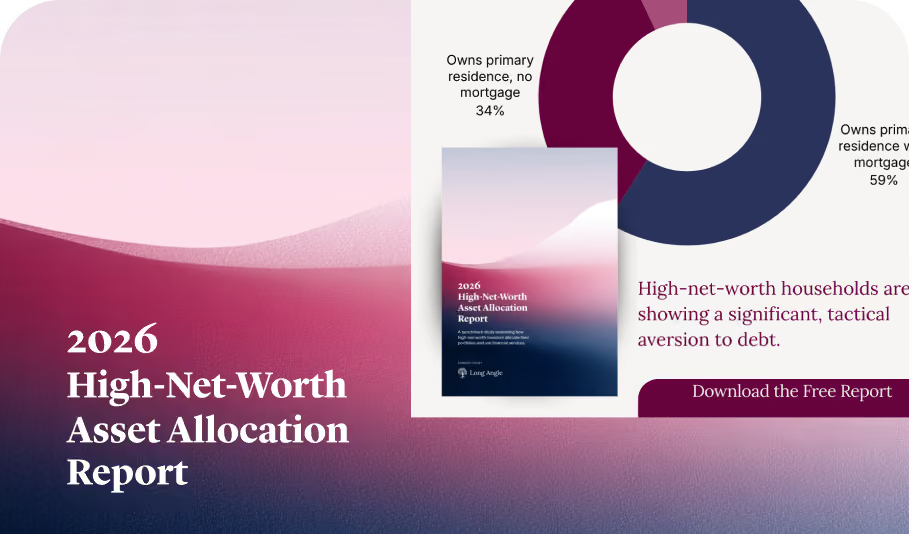
2026 High-Net-Worth Asset Allocation Report
See how high-net-worth investors with an average net worth of $17M are allocating across public equities, private markets, real estate, bonds and cash. Based on benchmark data from 230+ respondents.
The SaaS M&A Market in 2025: Record Volume, Split Valuations
2025 produced the highest software deal volume on record, roughly 5,000 transactions, about 1,000 more than 2022 at the peak of the previous cycle. The driving force is structural: lower barriers to software creation and AI-accelerated adoption have broadened the universe of acquirable assets and kept buyer appetite elevated even as the macro environment tightened.
But deal volume does not tell the full story. The valuation picture in 2025 looks like a barbell. On one end are a small number of assets with durable metrics, AI integration, and genuine defensibility. Those businesses are attracting aggressive multiples and competitive buyer processes. On the other end is everything else, where buyers are still willing to transact but at low single-digit revenue multiples rather than the double-digit figures that defined 2021.
The practical implication for a founder approaching an exit: the market is active, but it is not uniformly generous. Understanding which side of the barbell your business sits on (and what it would take to move it) is the starting point for any serious exit conversation.
Watch the Full Conversation
This article draws on a Navigating Wealth conversation with Diamond Innabi, where we discuss how SaaS M&A works, what buyers look for in 2025, and what founders should do before they ever run a process. Watch the full episode for the broader discussion.
Subscribe on YouTube · Get weekly episode updates
Diamond Innabi is a Principal at Software Equity Group, a sell-side M&A advisory firm that has worked exclusively with SaaS and software companies for over two decades. She has been with the firm since graduating college, giving her a front-row view of how the industry has evolved from 20-slide CIMs to AI-accelerated diligence processes.
What an A-Plus SaaS Asset Looks Like to a Buyer
A-plus SaaS assets share a specific financial profile, and buyers in 2026 are applying it consistently. To score your own SaaS business exit readiness, you can use this interactive tool.
Gross revenue retention above 90% means the customers who are leaving or reducing usage represent less than 10% of the business. Net revenue retention above 100% means existing customers are expanding their usage, not just staying flat. Together these two metrics tell a buyer whether the product is delivering enough value that customers keep paying and pay more over time.
Growth is back as the primary financial signal. A few years ago, buyers were focused on profitability and fundamentals. In 2025, growth above 30%, and ideally closer to 40%, is what separates an A-plus asset from a good one. The Rule of 40, which combines growth rate and profit margin, should land above 40. A business growing at 35% with minimal profit gets there. One growing at 15% needs meaningful profitability to compensate.
Scale matters more than it did two years ago. Buyers see larger revenue bases as inherently less risky. The minimum threshold for A-plus consideration is roughly $10M to $15M in revenue. Deals happen below that number, but the multiple compression below $10M is meaningful.
Beyond the numbers, buyers are looking for mission-critical, defensible assets. The question they are asking is whether a competitor, or an AI tool, could come in and take the business's customers. A vertical SaaS company embedded in specific industry workflows, with years of domain-specific data, is far harder to displace than a horizontal tool with a generic use case.
The Three Types of SaaS Buyers — and Which Pays More
Three buyer types show up in a well-run SaaS M&A process, and they behave differently.
A pure financial sponsor (a private equity firm) acquires a business as a platform investment or an add-on to an existing portfolio company. They model returns on a five-to-seven-year hold, use a leveraged buyout structure, and focus on EBITDA improvement and value creation over the hold period. For what founders should expect once a PE firm is in the picture, the mechanics of that relationship are worth understanding in detail before you get to term sheets. The post on what founders should expect from a private equity acquisition covers the hold period, value creation arc, and post-close dynamics in depth.
A pure strategic acquirer is typically a larger company that sees a specific fit: a product gap they want to fill, a customer base they want to access, or a market position they want to extend. Strategics are generally willing to pay more than financial buyers because they can model synergies that a PE firm cannot. What founders need to understand is that the same synergy logic that drives the premium (cost reduction, product consolidation, market share gain) also drives post-close changes to the business. Strategics tend to make deeper operational changes than PE firms do.
The third buyer type is the PE-backed strategic: a PE firm that already owns a platform investment in the space and is executing a roll-up strategy. These buyers are acquiring add-ons to build out their thesis around a specific vertical or product category. Valuation here involves more variables: how accretive the acquisition needs to be to the platform, where the PE firm is in its hold cycle, and the degree of operational and customer overlap between the target and the platform.
Platform deals and pure strategic acquisitions tend to generate the highest multiples. When valuation and post-close outcome both matter (and for founder-led businesses they almost always do). The right buyer is rarely just the one offering the highest number.
What a SaaS M&A Process Looks Like From the Inside
A SaaS M&A process from engagement to close typically runs four to six months. Understanding the phases helps founders know what they are signing up for.
The process starts with an assessment. If a founder arrives with an offer in hand, the first question is whether the offer is fair and whether a competitive process can improve on it. Sometimes the answer is that the offer is strong and there is not much room to move. More often, the question is how much information the buyer had when they made the offer, and whether going to market with full information would change the number.
If a full process makes sense, the next phase is preparation: building the confidential information memorandum (CIM), positioning the business narrative, and organizing the financial documentation. This is where a good M&A advisor earns a significant portion of their fee. The value is not in producing slides. It is in knowing which story about the business resonates with the specific buyers who are active in the market right now.
Going to market means reaching the buyer universe simultaneously, tracking signals from each party, and managing the competitive tension that produces the best outcome. The signals matter: which buyers are leaning in, which ones are going through the motions, which ones may be close to their ceiling. An advisor who has done dozens of transactions with the same buyer pool has pattern recognition on this that a founder negotiating their own deal cannot replicate.
The negotiation does not end at the letter of intent. It continues through diligence, which is when buyers are doing their deepest work and when the most pressure tends to land on the seller side. Knowing which issues are negotiating positions and which are genuine deal concerns is a judgment call that requires experience on both sides of enough transactions to have seen the same moves before.
How AI Is Changing SaaS Valuations
AI is the most active topic in SaaS M&A right now, but not in the way founders might expect.
The concern founders often have is that AI will displace their business entirely: that someone will build a competing product in weeks using AI coding tools, take their customers, and make the company worthless. That risk is real for commoditized tools with no proprietary data and no embedded workflows. It is much lower for vertical SaaS businesses that are genuinely mission-critical in their markets.
The argument that Diamond Innabi makes, and one buyers are increasingly reflecting in how they diligence, is that a SaaS company with five or ten years of domain-specific customer data is in a stronger position to build AI-powered capabilities than an AI-native startup building from scratch. The SaaS company has the data, the customer relationships, the embedded workflows, and the industry expertise. AI can make those better. A new entrant has to build the infrastructure first.
What buyers want to see is AI implementation in two specific places. The first is internal operations: using AI to close support tickets faster, accelerate product development, help the sales team qualify prospects more efficiently. The second is product delivery: building AI capabilities directly into the workflows the software already supports, not adding a chatbot layer on top. The first signals operational maturity. The second signals product defensibility.
Buyers are now getting deeper faster in diligence on this question. A company serving a sector where AI displacement is an obvious risk needs to have a clear answer about what makes it harder to replace than a new entrant. Companies that can demonstrate real AI integration (not cosmetic) tend to hold their valuation better through the diligence process.
Deal Structure: Earnouts, Rollover Equity, and Seller Financing
Deal structure is where a SaaS exit can get complicated quickly, and where having an advisor who has seen the same structures across dozens of transactions is genuinely useful.
Earnouts are the most contentious structural element. An earnout defers a portion of the purchase price, paying it out only if the business hits specified targets post-close. The key variable is what those targets are tied to.
Revenue growth earnouts tied to the founder's own forecast are generally manageable. If the founder projected 20% growth and the earnout is structured around that number, hitting it is within their control. Earnouts tied to EBITDA are a different matter: after close, the founder no longer controls cost decisions, headcount, or capital allocation. Earnouts tied to customer retention are similarly problematic. The founder cannot control whether customers choose to stay after an acquisition. Both of these structures are near non-starters in a well-run process. The right response is to negotiate them out entirely or find a buyer whose structure does not include them.
Rollover equity (taking a portion of the purchase price in equity in the new combined entity) is generally viewed favorably by founders who have done it. The reason is simple: PE-built value tends to exceed the value at the time of the original acquisition. A founder rolling 10% to 20% of their proceeds is placing a bet on the same team and thesis that just paid them for the business. The terms matter: founders should ensure they are rolling into the same class of equity as the PE firm, not subordinated.
Seller financing (lending a portion of the purchase price back to the buyer) is rare in the SaaS M&A market at this scale. It surfaces primarily when a buyer is trying to bridge a gap between the valuation the seller wants and the risk the buyer is pricing into the deal.
For founders who want to understand how private equity continuation vehicles work on the LP side, including what happens to rollover equity when a PE firm transfers an asset into a new fund. The mechanics are worth understanding before you sign.
Three Things Every SaaS Founder Should Do Before Going to Market
The founders who get the best outcomes in a sale process are rarely the ones who prepared in the final sprint. They are the ones who ran their business in a way that made the preparation straightforward.
Run the business like it is already for sale. This means having a clean MRR file that tracks revenue by customer, by product, and by month. It means knowing your gross margins, calculated correctly (which is more involved for SaaS than founders often realize). And it means having financial statements that a quality of earnings provider can review without spending weeks untangling. A quality of earnings report is a third-party review of where revenue is coming from, whether it is categorized correctly, and whether margins are being calculated in a way that buyers and their diligence teams will accept. Getting one done before going to market removes a major source of friction and surprises during diligence.
Build defensibility and know why you win. Before a buyer will pay a premium for a SaaS business, they need to believe that the business will not lose its customers to a competitor or an AI tool in the next three years. The founder needs to be able to explain, specifically, why they win competitive deals. If the answer is better customer support or lower pricing, that is a commoditization risk, not a competitive moat. The real answer lives in the last 50 wins: why did those customers choose this product over the alternatives? That answer shapes how the business is positioned to buyers and whether the multiple holds through diligence.
Double down on what you do well. The businesses that enter a sale process in the strongest position are the ones that have used AI and every other tool to deliver their core value faster and better, not to pivot into adjacent markets or bolt on capabilities that do not connect to the product's core reason for winning. Buyers are looking for focus and depth, not breadth. A company that does one thing better than anyone else in a specific vertical is a more attractive acquisition target than one that does ten things adequately.
When the process is ready to run, understanding how high-net-worth founders allocate capital after a liquidity event, covering public markets, private allocations, real estate, and cash, is the question that comes immediately after close. Long Angle's 2026 Asset Allocation Report covers the patterns from 230+ respondents at an average net worth of $17M, the cohort that SaaS founders commonly enter after a meaningful exit. For members who want exposure to private market investment offerings alongside peer diligence, Long Angle's investment platform serves that need directly.
Final Thoughts
A SaaS M&A process is largely a validation exercise. The buyer is checking whether the business is as good as the narrative suggests, whether the metrics are real, and whether the value the company says it creates is something its customers experience. Founders who have been running the business with that scrutiny in mind (clean financials, a clear competitive position, genuine AI integration) tend to hold their valuations through diligence. Founders who have not tend to find that the number they saw in the LOI is not the number that closes.
The preparation is not complicated. It is mostly a matter of running the business with the discipline that a buyer would want to see, before a buyer is looking.
The more interesting question, for most households evaluating this for the first time, is what the right structure looks like at their actual stage. That answer usually involves better external service providers, sharper governance, clearer decisions about generational planning, and a peer community that can sanity-check the decisions before they harden. The family office can come later, if it should come at all. The decisions that compound across generations are made earlier than that.
Frequently Asked Questions
How long does it take to sell a SaaS business?
A full competitive process from engagement to close typically runs four to six months. This includes a preparation phase to build documentation and positioning, a go-to-market phase to engage buyers and collect indications of interest, a letter of intent phase, and a diligence-to-close phase. Compressed processes for founders with an existing offer in hand can move faster, but diligence rarely shortens significantly regardless of how the process starts.
What revenue multiple can I expect when selling a SaaS company?
It depends on which side of the barbell the business sits on. A-plus assets with strong retention metrics, growth above 30%, Rule of 40 above 40, and real defensibility can command premium multiples. Businesses below the A-plus threshold (lower growth, weaker retention, smaller scale) are transacting at low single-digit revenue multiples in the current market. Scale matters: $10M to $15M in revenue is roughly the threshold where A-plus consideration begins.
What is the Rule of 40 and why do acquirers care about it?
The Rule of 40 combines a SaaS company's growth rate and profit margin into a single number. A business growing at 35% with 10% profit margin scores 45 and clears the threshold. It matters to acquirers because it captures the tradeoff between growth and profitability in a single metric. A business sacrificing all margin for growth looks different from one that has balanced both. In the current market, growth carries more weight than it did two years ago, so a high-growth business with thin margins can still score well.
What is a quality of earnings report and do I need one before selling?
A quality of earnings (QOE) report is a third-party review of a company's financial statements, confirming where revenue is coming from, how expenses are categorized, and whether margins are calculated correctly. For SaaS businesses, gross margin calculation is a common area where founders are doing it differently than buyers expect. Getting a QOE done before going to market removes a major source of friction in diligence and prevents surprises that can reopen price negotiations after an LOI is signed. A light-scope QOE does not need to be expensive.
How do earnouts work in a SaaS acquisition?
An earnout defers a portion of the purchase price, paying it out only if the business hits post-close targets. Revenue growth earnouts tied to the founder's own forecast are the most workable structure: the founder is being held to a number they said the business would hit. Earnouts tied to EBITDA or customer retention are problematic because the founder loses control of both after close. A well-run M&A process either negotiates earnouts out entirely or ensures the targets are tied to metrics fully within the seller's control.
Should I sell to a strategic buyer or a private equity firm?
It depends on what the founder wants from the outcome. Strategics tend to pay more but often make deeper post-close operational changes: cutting headcount, consolidating functions, replacing the acquired sales team with their own. PE firms tend to pay slightly less but preserve more of the operating infrastructure and team. Founders who care about what happens to their business and employees after close often find PE the better home, even at a lower headline number.
A business sale compresses years of decisions into a short window: pricing, structure, post-close role, what happens to the team.
Long Angle's Trusted Circles are small, confidential peer advisory groups of 6 to 8 members matched by life stage and wealth complexity, meeting monthly with a facilitator who is also a financial professional. For SaaS founders navigating a sale or working through what comes after, the High-Intensity Builders with Young Families Circle and the Post-Exit / Next Chapter Circle are designed for exactly this stage.
More From Long Angle
Beyond Wealth Newsletter
Navigating Wealth Podcast
Research & Studies
Alternative Investment Education
Blog