Written by Ryan Morrison


What Is Investor Relations? How Public Companies Manage the Information You Invest On
Based on a Navigating Wealth conversation with Anil Gupta.
What Is Investor Relations? How Public Companies Manage the Information You Invest On
Anil Gupta spent eight years on Meta's IR team and led Coinbase through its 2021 direct listing. He breaks down what investor relations does, why a first-day IPO pop is a wealth transfer rather than a success signal, how a direct listing differs from a traditional IPO, and what retail investors should know about the information edge institutions do and do not have.
Ryan Morrison
Investor relations is the function inside a public company responsible for managing the flow of financial information between the company and the investment community. In practice, it is a blend of finance and communications: translating the complexity of a business into language the market can act on, preparing quarterly earnings materials, managing the company's investor base, and serving as the primary point of contact between the company and its shareholders.
Even investors who follow public companies closely rarely know what happens on the other side of an earnings call. Anil Gupta spent eight years on the Meta investor relations team, watching the stock go from the low twenties post-IPO to over two hundred dollars. He then joined Coinbase in early 2021 to help the company execute its direct listing, one of the most closely watched market debuts of that era. His view of how the information environment for public investors works is built from inside it, and it challenges a few assumptions that most retail investors carry about who knows what and when.
Key Takeaways
- Investor relations translates business complexity into market-accessible language; earnings preparation alone takes roughly one month of every quarter
- The IR team's goal is to build a stable cap table of long-only institutional investors who absorb day-to-day volatility, not to maximize today's stock price
- A first-day IPO pop represents a wealth transfer from pre-IPO shareholders to initial buyers, not a signal that the offering was a success
- In a direct listing, there is no new capital raised, no dilution, no lockup, and employees can sell on day one; the market determines the price without a bank-led demand book
- Retail investors are less disadvantaged than they believe: companies share consistent messages with institutional and retail audiences alike, and the edge institutions have is on interpretation, not raw data
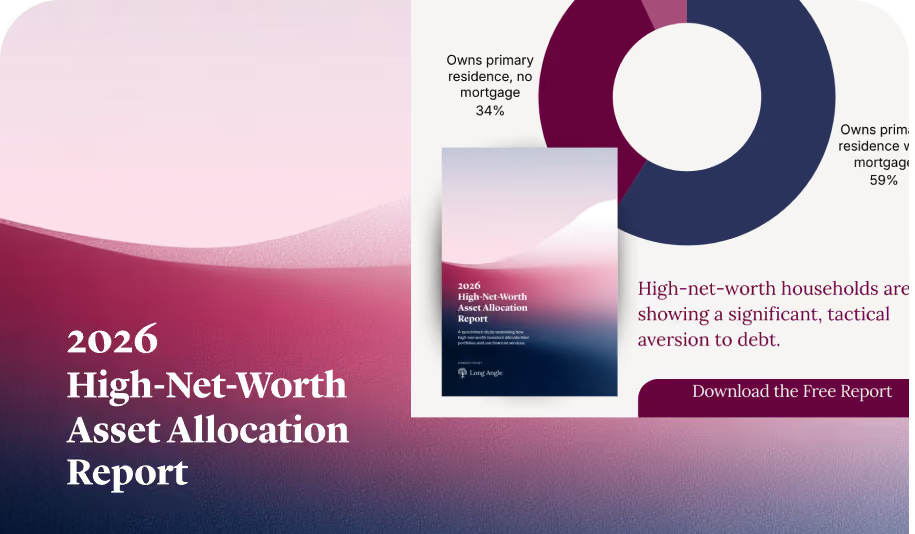
2026 High-Net-Worth Asset Allocation Report
See how high-net-worth investors with an average net worth of $17M are allocating across public equities, private markets, real estate, bonds and cash. Based on benchmark data from 230+ respondents.

What Investor Relations Does and Why It Exists
Investor relations exists because public companies are required to keep the investment community informed about their financial performance, and because the gap between a company's internal complexity and what the average institutional investor can process in a busy week is enormous. The IR team bridges that gap.
The most visible piece of the IR function is earnings. A public company reports results every three months, and each cycle takes roughly a month of preparation. That preparation involves pulling the numbers from accounting and FP&A teams, comparing them against the market's expectations, building the narrative that frames the gap between the two, and preparing the Q&A. For a company that covers a lot of ground, the Q&A preparation alone is substantial: anticipating every difficult question, deciding how to answer it, and aligning on language across the executive team before anything goes on record.
Beyond earnings, the IR team manages the company's ongoing relationship with the investor community. This means identifying which institutional investors are most likely to be interested in the stock, traveling to conferences and road shows, and making sure that senior executives are spending time with the most high-impact investors rather than whoever happens to request a meeting. Over time, the goal is to build a cap table that is dominated by long-only institutional investors: mutual funds, sovereign wealth funds, pension funds, and others whose mandate requires them to hold equities rather than trade them frequently. A cap table heavy in long-only holders tends to be more stable and absorbs more of the day-to-day volatility that shorter-term traders amplify.
What good IR looks like from an investor's perspective, in Anil Gupta's framing, is straightforward: can this person answer my questions, do they know the business deeply enough to serve as a proxy for the CFO, and does talking to them give me something I did not have before the call? An IR team that just schedules meetings between management and investors without genuinely adding knowledge is not doing its job.
Watch the Full Conversation
This article draws on a Navigating Wealth conversation with Anil Gupta, where we discuss how investor relations works from the inside, why a first-day IPO pop is not the success signal it appears to be, what the difference between an IPO and a direct listing means for investors, and how to read an earnings call with more sophistication than most market participants bring to it. Watch the full episode for the broader discussion.
Subscribe on YouTube · Get weekly episode updates
Anil Gupta began his career as an equity research analyst covering internet, technology, media, and telecom stocks for approximately five years before joining the Meta investor relations team in late 2012, just after Meta's IPO. He spent over eight years there before moving to Coinbase in early 2021 to help lead the company's direct listing in April of that year. He recently departed Coinbase.
How the Quarterly Earnings Cycle Works and Whether It Should Change
The quarterly earnings cycle is the recurring structure around which most of public company life is organized. A company reports results, goes into a quiet period where communication with the market is restricted, emerges to road show the next set of talking points, and then starts preparing for the next quarter. Then it repeats.
The preparation is more onerous than most outsiders appreciate. The numbers come from accounting and FP&A teams who run a monthly close regardless of whether it is earnings season. The earnings close is similar but with substantially more rigor: SEC filings, external audit involvement, and formal legal review of every statement that goes into the public record. The IR team then builds the narrative, aligns the executives, and rehearses the Q&A. If the cycle is quarterly, that is one month out of every three consumed by this process before the actual execution of the business gets the full management team's attention.
The debate about moving to biannual reporting has gained momentum. The direction of travel, based on conversations within the industry, appears to be toward allowing companies to opt into six-month reporting cycles rather than quarterly. The argument in favor is that it returns management bandwidth to execution. The argument against is that less frequent disclosure may increase rather than reduce volatility. If investors go longer between data points, the uncertainty premium in the stock price could be higher, not lower. There are also sector-specific considerations: a biotech company awaiting trial results has less meaningful quarterly data to share than a consumer platform with daily active user metrics, and for that company a longer cycle may genuinely make more sense.
The UK has operated on a biannual system for some time. The evidence there does not cleanly resolve the volatility question, partly because many UK companies have voluntarily continued quarterly disclosure anyway, unwilling to appear less transparent than peers with US listings.
One observation from inside the process that is easy to miss from outside: the most important test of an earnings disclosure is whether the information shared publicly is consistent with what is shared at the board level. If the metrics that matter most to the board are different from the metrics presented to investors, something is misaligned. A company that tells its board the business is healthy and tells investors a different story is creating a problem that compounds over time. Consistency between board and public disclosure is the clearest signal that management is being straight with the market.
IPO vs. Direct Listing: What the Difference Means for Investors
The traditional IPO and the direct listing solve the same problem (giving a private company a public market for its shares) but they do it in structurally different ways, and the differences matter for different groups of stakeholders.
In a traditional IPO, investment banks build a demand book. They take the company's shares on a road show, gather indications of interest from institutional investors, and set a price that they believe will clear the market with modest upward pressure on the first day of trading. That first-day pop (the stock going from $20 to $40, for example) is celebrated as a success signal. Anil Gupta's framing of it is more precise: if you issued shares at $20 and they trade to $40 immediately, every pre-IPO shareholder, including employees and venture investors, just transferred $20 per share to whoever received the IPO allocation the night before. The company also raised money on a basis that undervalued itself by half. The bank's institutional clients got a reliable first-day return. The pre-IPO shareholders took a haircut.
The IPO lockup period compounds this dynamic. Employees and insiders are typically prohibited from selling shares for six months after the IPO. By the time the lockup expires, the first-day enthusiasm may have faded, and the employees who built the company find themselves selling into a less favorable market than the institutional buyers who received IPO allocation did.
The direct listing, which Coinbase used for its April 2021 debut, works differently in almost every respect. There is no new capital raised. No primary shares are issued, so there is no dilution. The fees paid to banks are substantially lower because there is no demand-building function to compensate. There is no lockup period, which means employees can sell on day one if they choose. And there is no pre-set price range: the market discovers the price organically based on the supply of insiders willing to sell and the demand from buyers entering the market. One institutional investor Anil respects put it well: the buy side is better at being a price taker than a price maker. Institutions are good at deciding whether they want to own something at a given price; they are less good at setting the right price from scratch.
For founders and shareholders evaluating which path to take, the direct listing is intellectually cleaner when the company does not need to raise new capital, has sufficient brand recognition that the market already has context for valuing it, and wants to reward employees fairly rather than making them wait six months to participate in the upside they helped create.
Do Retail Investors Have the Same Information as Institutions?
The common assumption is that institutional investors get information in private meetings that retail investors do not. The reality is more nuanced than the assumption suggests, and understanding why is useful.
Material non-public information, known as MMPI, is information that would cause a reasonable investor to want to trade a stock, and that has not been disclosed publicly. An IR team that says "we're announcing an acquisition tomorrow" in a private meeting has created a serious legal problem for itself and for whoever received the information. Both sides of that conversation have a very strong interest in making sure it does not happen.
What institutional meetings are about is quite different. Long-only investors, who hold a company for years, want to understand how management thinks. They want to know how executives approach problems, how they allocate capital, how they talk about the trade-offs they are navigating. They are not usually asking about whether Q2 will beat consensus by three cents. They are asking about the direction of travel for the business over three to five years, how management thinks about adjacent markets, and whether the team executing the strategy is the right one to be doing it.
The information companies share is also more consistent than the institutional-access framing implies. When Coinbase prepared for an earnings cycle, the message developed in that preparation went to the press, to sell-side analysts, to institutional investors on conference calls, and to retail investors in Q&A sessions on X. The questions across all those channels were largely the same. The company's prepared answers were the same.
The genuine edge that institutions have is interpretive. A portfolio manager who has covered a sector for fifteen years understands what a particular disclosure means in the context of the company's history, its competitive dynamics, and its management team's track record. They read between the lines of a script better than someone newer to the company. That is a real advantage. But it comes from accumulated knowledge, not from access to information that is structurally unavailable to a careful retail investor who does their homework.
Why the Best Companies Are Staying Private Longer
SpaceX was privately valued at over $350 billion before any public offering. Anthropic's most recent secondary market transactions have implied valuations in the hundreds of billions. OpenAI has raised capital at valuations that would make it one of the largest companies in any index if it were public. None of them has listed.
The primary reason is that private capital markets have matured enough to sustain companies at any scale. Large sovereign wealth funds, institutional private equity, and crossover investors who straddle public and private markets have created a funding environment where the world's most successful companies do not need the capital that an IPO provides. And if you do not need the capital, the costs of being public (the quarterly earnings cycle, regulatory scrutiny, public exposure during early-stage pivots, employee distraction from stock price visibility) are harder to justify.
The employee liquidity question has its own partial solution in the private market. Tender offers, where a company or a private investor purchases shares from employees at a negotiated price, allow insiders to monetize some of their equity without a full public listing. Secondary marketplaces that connect buyers and sellers of private company shares have grown substantially over the past decade. The problem of employee liquidity that used to require an IPO can now be addressed without one.
The implication for investors is direct. The companies that go public today are, on average, later in their growth trajectory than companies that went public a decade ago. The revenue bar has risen over time: where $50 to $100 million in revenue was sufficient to access public markets a generation ago, the current expectation may be several hundred million. This means that a significant portion of the growth that would previously have happened inside publicly traded companies now happens privately, and is accessible only through private funds, secondary marketplaces, or direct investments. For context on how high-net-worth investors are currently splitting allocations between public and private equities, the 2026 asset allocation report covers the patterns across 230+ respondents. And as the best companies stay private longer, the case for alternatives like private credit and private equity alongside public market exposure continues to strengthen.
How to Read an Earnings Call Like an IR Insider
An earnings call is a structured performance, and reading it as an investor means understanding both what is being said and what the structure of the communication reveals.
The fundamental framework Anil Gupta describes is straightforward: a good business builds a product, finds product-market fit, and makes money at decent margins. When you listen to an earnings call, you are listening for evidence that this progression is happening. Are they telling you what milestones they are targeting, and then reporting back on whether they hit them? Are the margins they are generating consistent with the economics they described when the business was earlier stage? Is the management team giving you something to hold them accountable to, or are they speaking in generalities that are hard to verify?
The board-investor symmetry test is one of the most useful filters an outside investor can apply. The metrics a company discusses publicly should be the same ones its board is focused on. A company that presents one set of KPIs to the investment community and tracks a different set internally is either managing perceptions rather than the business, or telling investors something that does not reflect how leadership is running the company. Neither is a good sign.
Founder-led companies deserve a different read than professionally managed ones. A founder CEO with significant equity and long-term vision tends to make decisions on the basis of what is right for the business over years, not quarters. A professional CEO who was brought in from outside and holds more modest equity may face more short-term pressure from a board and a market that wants consistent quarterly delivery. Neither is inherently better, but understanding which dynamic you are observing changes how you interpret the language in an earnings call.
Buyback announcements warrant scrutiny. A disciplined buyback program, like the one Coinbase implemented when its stock was down sharply, is a capital allocation tool: the company has identified a price range where buying its own stock is the best available use of capital, and it executes mechanically when the price enters that range. A buyback announced around the time of a major vesting event, or used repeatedly to support the stock price near option strike prices, is a different kind of signal. Ask whether the company is buying because the stock is cheap or because the stock needs to be supported.
What the Convergence of Stocks, Crypto, and Prediction Markets Means
The traditional boundaries between asset classes are collapsing at the retail level. Robinhood offers stocks, crypto, and prediction market contracts on the same platform. Fidelity and BlackRock have launched Bitcoin ETFs. Morgan Stanley is offering crypto to private wealth clients. Traditional brokerages are adding crypto alongside equities because their customers are asking for it.
Bitcoin presents an interesting interpretive challenge for investors who want to understand its role in a portfolio. In the short term, it trades with a notable correlation to NASDAQ and to macro risk sentiment: when geopolitical uncertainty rises and risk assets sell off, Bitcoin often sells off with them. That behavior is the opposite of what a true store of value or inflation hedge should do in those moments. Anil Gupta's framing is candid: on any given day, there are two competing forces in Bitcoin trading: the risk-on component (where it moves with the tech trade) and the store-of-value component (where it moves against fiat currency concerns). Which one is stronger on a particular day is genuinely hard to predict.
Zoom out and the store-of-value case has been compelling. From around $15,000 when Anil joined Coinbase in early 2021 to the $70s at the time of this recording, the five-year return has been strong despite cycles that included an 85% drawdown. The question for a long-term investor is whether they believe the long-term case justifies exposure to that level of short-term volatility.
For investors who want Bitcoin exposure through an equity account rather than a crypto account, Bitcoin treasury companies like MicroStrategy function as an equity access vehicle: they hold Bitcoin as their primary asset and trade on a stock exchange, giving equity fund managers who cannot hold commodities directly a way to gain exposure through their existing mandates. The selling-to-private-equity post explores a parallel dynamic in private markets, where the structure of an investment vehicle shapes what kind of investor can access it as much as the underlying asset does.
Final Thoughts
Public company investing rewards investors who understand not just what a company reports, but how it reports, why it reports it that way, and what that implies about how management is running the business. The IR function is the interface between those two worlds, and understanding how it works changes what you see when you listen to an earnings call, evaluate an IPO, or decide whether to trust the story a management team is telling.
The information environment for retail investors is more level than it was a decade ago. The gap is closing. What remains is interpretation: the judgment that comes from understanding the structure of corporate disclosure well enough to hear what is not being said as clearly as what is.
Frequently Asked Questions
What does an investor relations team do?
Investor relations manages the flow of financial information between a public company and the investment community. The core functions include preparing quarterly earnings materials (a process that takes roughly one month per quarter), managing the company's relationships with institutional investors, road showing the company's narrative to the market, and serving as the day-to-day point of contact between the company and its shareholders. The goal is to build a stable cap table of long-only institutional investors and ensure the market has an accurate and accessible understanding of the business.
What is the difference between a direct listing and an IPO?
A traditional IPO involves investment banks building a demand book, setting a price range, and issuing new shares to raise capital, with insiders subject to a six-month lockup period. A direct listing involves no new capital raise, no bank-led demand building, no dilution, and no lockup: existing shareholders can sell on day one and the market discovers the price organically. Direct listings typically carry lower fees and are more favorable to pre-IPO shareholders and employees, but are better suited for companies that do not need to raise fresh capital.
What is a first-day IPO pop and is it good for investors?
A first-day IPO pop means the stock closed well above the IPO price on its first day of trading. From the perspective of pre-IPO shareholders, it is a wealth transfer: it means the offering was priced below market value, and the difference went to whoever received IPO allocation the night before the listing. Banks prefer a pop because it keeps their institutional clients satisfied with reliable first-day returns. For the company and its existing shareholders, a large pop typically means money was left on the table.
What is an earnings call and how do I use it as an investor?
An earnings call is a scheduled conference call where a public company's management team presents financial results and takes questions from analysts and investors. To use it as an investor, listen for evidence of product-market fit (did the product find a real market and does it generate good margins?), milestone accountability (are they reporting back on what they said they would do?), and board-investor symmetry (are the metrics they present publicly the same ones they track internally?). The quality of the Q&A is often more revealing than the prepared remarks.
Do institutional investors have access to information that retail investors do not?
Not in the way most retail investors assume. Regulation FD requires public companies to disclose material information broadly rather than selectively. Private meetings with institutional investors are constrained by material non-public information rules: both sides have strong incentives to avoid sharing or obtaining information that would cause someone to want to trade the stock. The genuine edge institutions have is interpretive: experienced investors who have followed a company or sector for years understand the nuances of its disclosures better than someone newer to the company. The raw information is the same; the analytical context is different.
Why are major companies like SpaceX and Anthropic staying private longer?
Private capital markets have matured enough to fund companies at any scale without requiring a public listing. Large sovereign wealth funds, institutional private equity, and crossover investors provide capital that was previously only available through public markets. Without a capital need, companies avoid the costs of public life: quarterly earnings preparation, SEC filings, public scrutiny during early-stage pivots, and the employee distraction of visible daily stock prices. Employee liquidity needs that used to require an IPO can increasingly be addressed through tender offers and secondary marketplaces.
The best preparation for investing in public equities is honest peer conversation with people who have sat on both sides of the table.
Long Angle members include founders who have been through IPOs and direct listings, executives who attend earnings calls as management, and investors who follow public companies closely. The community is solicitation-free and the conversations are candid.
More From Long Angle
Beyond Wealth Newsletter
Navigating Wealth Podcast
Research & Studies
Alternative Investment Education
Blog