Written by Scott Nixon


Asset Location When Your Tax-Advantaged Accounts Are Too Small
Asset Location When Your Tax-Advantaged Accounts Are Too Small
Asset location assumes your tax-advantaged accounts have room. Where private credit and hedge funds go once they fill, and what direct indexing cannot do.
Scott Nixon
Asset location is the practice of holding each investment in the account type that taxes it least: income-heavy assets such as bonds, private credit and most hedge funds in tax-deferred or Roth accounts, and tax-efficient equities in taxable ones. The rule assumes the sheltered accounts have room. At high net worth they rarely do, because 2026 limits cap one earner at roughly $88,000 a year. Beyond that, direct indexing can cut tax on the equity sleeve, and private placement life insurance is the main uncapped wrapper for ordinary-income assets. Neither suits an investor who holds only index funds.
Key Takeaways
- The standard rule puts income-heavy assets in sheltered accounts and tax-efficient equities in taxable ones.
- 2026 limits let one earner under 50 contribute about $88,000 a year, and only if the employer plan accepts after-tax contributions.
- Private credit interest is taxed at up to 40.8 percent federal, against 23.8 percent for long-term gains and qualified dividends.
- Losses harvested by direct indexing offset capital gains, but only $3,000 a year of ordinary income.
- PPLI has no annual contribution cap, but its costs, holding period and investor control rules make it a poor fit for many households.
- An index-only portfolio has little to relocate, because low turnover already keeps its tax drag small.
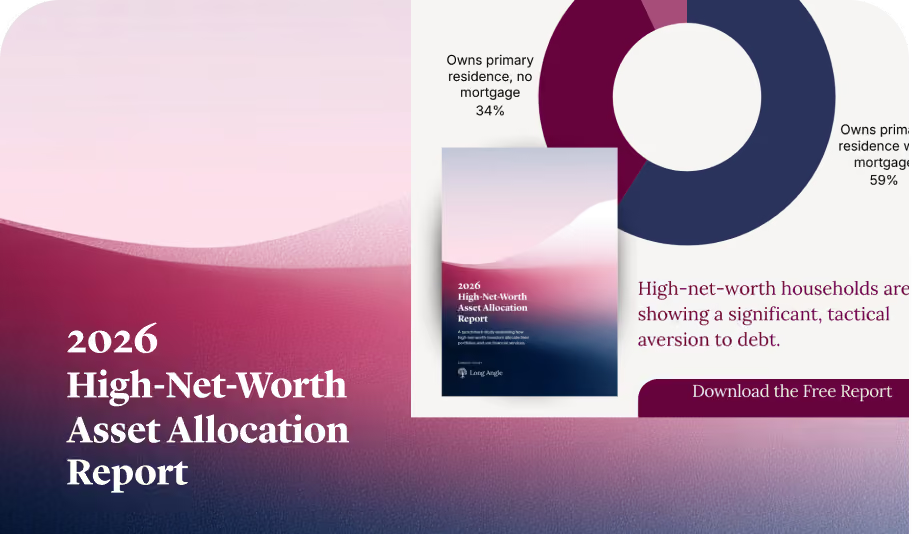
2026 High-Net-Worth Asset Allocation Report
See how high-net-worth investors with an average net worth of $17M are allocating across public equities, private markets, real estate, bonds and cash. Based on benchmark data from 230+ respondents.

How Asset Location Ranks Your Holdings
Asset location ranks holdings by how much of their return the tax code takes each year, then fills the most protected accounts from the top of that list down.
The ranking follows the character of the income, not the asset class label. Interest and short-term gains are taxed as ordinary income, at a top federal rate of 37 percent plus the 3.8 percent net investment income tax. Long-term gains and qualified dividends top out at 23.8 percent, and a gain that has not been realized is not taxed at all until the position is sold. An asset that pays interest every year therefore loses far more to tax in a brokerage account than a low-turnover index fund does.
| Asset | How the annual return is usually taxed | Top federal rate, 2026 | Conventional location |
|---|---|---|---|
| Private credit and direct lending | Interest, taxed as ordinary income | 40.8% | Tax-deferred or Roth |
| Multi-strategy and high-turnover hedge funds | Mostly short-term gains and ordinary income | 40.8% on most of it | Tax-deferred or Roth |
| Taxable bonds | Interest, taxed as ordinary income | 40.8% | Tax-deferred |
| REITs | Mostly nonqualified dividends, partly offset by the qualified business income deduction | Between 23.8% and 40.8% | Tax-deferred or Roth |
| Managed futures | Section 1256 treatment: 60% long-term, 40% short-term, whatever the holding period | About 30.6% blended | Tax-deferred if room remains |
| Private equity and venture | Long-term gains, deferred until exit | 23.8%, deferred | Taxable |
| Broad index funds | Qualified dividends; gains deferred until sale | 23.8% on dividends | Taxable |
| Municipal bonds | Interest exempt from federal income tax | 0% federal | Taxable only |
Source: Internal Revenue Code sections 1, 103, 1256 and 1411. Top federal rates including the net investment income tax, excluding state tax. Typical treatment by category; individual funds vary.
The Roth and traditional accounts are not interchangeable either. Roth money is never taxed again, so its space is most valuable holding whatever you expect to grow fastest. Traditional money is taxed as ordinary income on withdrawal regardless of what earned it, which makes it a natural home for assets that produce ordinary income anyway. The Roth versus traditional decision for high earners changes which of the two you fill first.
Why the Rule Runs Out of Room at High Net Worth
Tax-advantaged accounts are capped by statute, and in a large portfolio the tax-inefficient holdings can be many times larger than a year's contribution room.
For 2026, the IRS limits let one earner under 50 put roughly $88,000 a year into sheltered accounts, and reaching that figure depends on an employer plan that accepts after-tax contributions for a mega backdoor Roth. A two-earner household with access to both plans can roughly double it.
| Account | 2026 limit | What to know |
|---|---|---|
| 401(k) or 403(b) employee deferral | $24,500 | $8,000 catch-up from age 50; $11,250 from 60 to 63 |
| Total 401(k) additions, section 415(c) | $72,000 | Includes the deferral and employer money. The after-tax portion is the mega backdoor Roth, where the plan allows it |
| IRA, including a backdoor Roth | $7,500 | Plus a $1,100 catch-up from age 50 |
| HSA, family coverage | $8,750 | Deductible going in; untaxed for qualified medical spending |
| Most one earner under 50 can contribute | About $88,250 | The 415(c) total, the IRA and the HSA combined |
Source: IRS Notice 2025-67 and Revenue Procedure 2025-19. Limits per person except the HSA, which is per family.
Long Angle members already use this room. In a poll of 351 members on tax optimization, opened in June 2026, 80 percent reported maxing pre-tax 401(k) or 403(b) contributions and only 5 percent selected none of the listed strategies, as of September 2026. Respondents could select all that applied, and it is one voluntary community poll rather than a representative sample of wealthy households. In the discussion that followed, some members argued that the capped accounts do not move the needle at fatFIRE scale. Others countered that a decade of compounding adds up.
Both sides have a point, and the size of the problem decides between them. Respondents to Long Angle's 2026 High-Net-Worth Asset Allocation Report held 31 percent of their portfolios in private and alternative investments, excluding home equity (233 respondents, fielded December 2025 to January 2026). Not all of that is tax-inefficient: private equity and venture mostly produce long-term gains. Private credit and many hedge fund strategies produce ordinary income, and they compete for the same $88,000. Pushing still more into a traditional account creates a different problem at withdrawal, which is the subject of having too much in a 401(k).
What a Taxable Account Costs a Private Credit Allocation
On a hypothetical $5 million private credit allocation yielding 10 percent, federal tax at the top bracket takes about $204,000 of the $500,000 in annual income.
That is before state tax, which adds more in most high-tax states. The income from that one sleeve is more than five times the most a single earner can contribute to sheltered accounts in a year, so the retirement accounts could not hold it even if the fund accepted IRA capital. The figures here illustrate tax mechanics. They are not a return assumption for any fund.
The compounding gap is what makes the location decision expensive to ignore. At the top federal rate, a 10 percent pre-tax yield compounds at about 5.9 percent after tax. Over 20 years, a dollar growing untaxed at 10 percent becomes about $6.73. The same dollar taxed every year becomes about $3.16, less than half as much, before any wrapper costs on the untaxed side.
Private credit and multi-strategy hedge funds are the two holdings where this bites hardest in a large portfolio, because both are held for their income or their trading and neither defers much. The private credit guide covers how the asset class works; this page is about where it sits.
What Direct Indexing Does, and the Sleeve It Cannot Reach
Direct indexing lowers tax on a taxable equity sleeve by harvesting losses, and those losses offset capital gains, not the ordinary income private credit produces.
A direct indexing account holds the individual stocks of an index instead of a fund, so a manager can sell the positions trading below cost and keep the index exposure. The realized losses offset capital gains elsewhere in the portfolio without limit. Against ordinary income, section 1211 allows only $3,000 a year, with the excess carried forward. A $204,000 annual tax bill on interest income is almost untouched.
That is why direct indexing is an asset location tool for one sleeve only. It makes the equities that belong in the taxable account more efficient there. It creates no room for the income-heavy assets that do not belong there. Members are adopting it. In a Long Angle poll opened in June 2026, 27 percent of 296 respondents used direct indexing for at least part of their public equities and another 37 percent were considering it, as of September 2026. The same caveat applies to that poll as to the one above.
When Direct Indexing Runs Out of Road
Harvesting opportunities shrink as positions rise above their cost basis, so a direct-indexed account harvests less each year unless new cash keeps arriving.
Members made the same point in the discussion around the direct indexing poll: loss harvesting fades in a rising market unless new capital keeps flowing in. The high-net-worth tax strategies piece explains why harvesting has an expiry date. The usual extension is long-short direct indexing, which pairs the index holdings with short positions to create more losses to harvest. It extends the window, at the cost of leverage and complexity.
Neither version changes the arithmetic in the section above. Both work on the equity sleeve, and both produce losses whose main use is against capital gains. Once the capped accounts are full and the equity sleeve is efficient, the tax-inefficient sleeve is still sitting in a taxable account.
PPLI: A Tax-Deferred Location Without a Contribution Cap
Private placement life insurance is a variable life policy whose investment account is not taxed while the policy stays in force, and it has no annual contribution limit of the kind retirement accounts carry.
The policy has to meet the tax code's definition of life insurance, and the assets inside it have to satisfy the section 817(h) diversification rules, usually through insurance dedicated funds. The investor control doctrine bars the policyholder from choosing the specific investments. That rule is what keeps the structure's tax treatment intact, and it is why PPLI suits strategies someone else manages, such as private credit or a multi-strategy fund, and does not suit a hand-picked portfolio.
Premiums are paid with after-tax money. Growth inside the policy is deferred, and money comes out through withdrawals up to basis and policy loans, provided the policy has not become a modified endowment contract. The death benefit is generally excluded from the beneficiaries' income under section 101(a). Surrender or lapse turns the accumulated gain into ordinary income. How fast a policy can be funded is set by its death benefit under those rules rather than by a fixed dollar cap, which is why it can hold a sleeve too large for retirement accounts.
It is not free. PPLI carries one-time charges on every premium dollar and annual insurance charges on top of the fund fees, set out in full in what PPLI costs. PPLI economics improve materially with scale and negotiated access, which is why published minimums and fee ranges vary so widely. Our guide to how PPLI works covers the tax mechanics, the ownership question and the rules that size the death benefit.
A Location Map for a Large Taxable Portfolio
Place each sleeve by the character of its return, fill the capped accounts first, and use the uncapped wrappers only for what remains.
| Sleeve | Tax character | First choice | Once that is full |
|---|---|---|---|
| Taxable bonds | Ordinary income | Traditional 401(k) or IRA | Municipal bonds in the taxable account, if the after-tax yield compares |
| Private credit | Ordinary income | Tax-deferred account, watching for UBTI on leveraged funds | PPLI, for a long holding period |
| Multi-strategy hedge funds | Mostly short-term gains | Tax-deferred account | PPLI, for a long holding period |
| Highest-growth equities | Long-term gains | Roth | Taxable, held past a year |
| Broad US equity | Qualified dividends, deferred gains | Taxable | Direct indexing, when there are gains to offset |
| Private equity and venture | Deferred long-term gains | Taxable | Taxable |
Source: Long Angle analysis of the Internal Revenue Code treatment set out above. A general framework, not a recommendation for any household.
Three things move a household off this map. State income tax changes the value of municipal bonds and of deferral. An employer plan's fund menu may not offer the assets you want to hold there. And liquidity needs can rule out the long holding periods that PPLI and private funds both require. Work through the specific placement with a CPA who can see the whole return.
Who Should Skip Both Wrappers
An investor who holds only broad index funds, needs the money within about five years, or wants to choose each holding gets little from either wrapper.
A low-turnover index fund is already tax-efficient, so there is little annual tax drag for PPLI to remove, and direct indexing adds most where there are realized gains elsewhere to offset. PPLI's one-time charges need a long holding period to spread across, and the investor control doctrine rules it out for anyone who wants to direct the investments. It is also built for US tax residents. The full fit test, and what goes wrong for a buyer who ignores it, is in the pros and cons of PPLI. For many households the right asset location answer stays simple: fill the capped accounts, hold broad index funds in taxable, and prefer municipal bonds to taxable ones.
Final Thoughts
Work the placement in order. Fill the capped accounts with the holdings that produce ordinary income, and give Roth space to the assets you expect to grow fastest. Make the equities in the taxable account as efficient as they can be, with index funds or direct indexing. Only then ask whether the tax-inefficient sleeve that is left over is large enough, and will be held long enough, to justify an uncapped wrapper and its costs. Starting from the wrapper and working backwards is how households end up paying for a structure their portfolio did not need.
Frequently Asked Questions
What is the difference between asset location and asset allocation?
Asset allocation decides what you own. Asset location decides which account holds each piece. Location changes the after-tax return without changing the portfolio's risk, because the holdings stay the same.
Should bonds go in a Roth or a traditional IRA?
Usually the traditional account. Bond interest is ordinary income, and traditional withdrawals are taxed as ordinary income anyway. Roth space is worth more holding the assets you expect to grow fastest, since that growth is never taxed.
Does asset location matter if most of my money is in a taxable account?
Yes, but the decision moves inside the taxable account: municipal bonds over taxable ones, index funds or direct indexing for equities, and holding periods past a year so gains qualify as long-term.
Can you hold private credit in an IRA?
Yes, through a self-directed IRA or a fund that accepts IRA capital. A fund that uses leverage can generate unrelated debt-financed income, which is taxed inside the IRA above a $1,000 annual deduction.
Does direct indexing work inside an IRA?
No. Losses inside a tax-deferred account cannot be harvested against anything, so direct indexing belongs in a taxable account. Inside an IRA, a low-cost index fund does the same job for less.
Is PPLI a form of asset location?
It works as an additional tax-deferred location with no annual contribution cap. It suits long-held, income-heavy assets that someone else manages, because the investor control doctrine bars the policyholder from choosing the specific investments.
Asset location gets harder once the sheltered accounts are full.
Long Angle members compare notes on wrappers and providers with peers who have already made the choice, and nobody answering earns a commission on it.
More From Long Angle
Beyond Wealth Newsletter
Navigating Wealth Podcast
Research & Studies
Alternative Investment Education
Blog