Written by Scott Nixon


Private Placement Life Insurance (PPLI): How It Works and Who It Fits
Private Placement Life Insurance (PPLI): How It Works and Who It Fits
How the wrapper works, the four tax benefits, the rules that size the policy, and the investors who should skip it. Written for evaluation, not sale.
Scott Nixon
Private placement life insurance (PPLI) is a variable universal life policy sold as a private placement to accredited investors, that holds institutional investments inside an insurance wrapper so their returns compound without annual income tax. Federal rules cap concentration inside the policy: no more than 55% of the account in any one investment and no more than 90% in any four, which in practice requires at least five positions. The policyholder cannot choose or direct them. That trade, control given up in exchange for tax deferral, is what makes the structure work, and it is what disqualifies most buyers.
Key Takeaways
- PPLI is a variable universal life policy sold under securities exemptions rather than a public prospectus, which is what lets institutional strategies sit inside it.
- It carries four tax benefits. Two are available during life, and two arrive only at death.
- The policyholder cannot choose or direct the holdings. Federal rules cap any one position at 55% of the account and any four at 90%.
- The benefit scales with the tax an asset would otherwise generate each year, so it suits ordinary-income and high-turnover strategies and does little for a low-turnover index portfolio.
- It needs a long horizon and a permanent allocation to tax-inefficient assets. An index-only portfolio, a short horizon, or a wish to pick the holdings each rule it out.
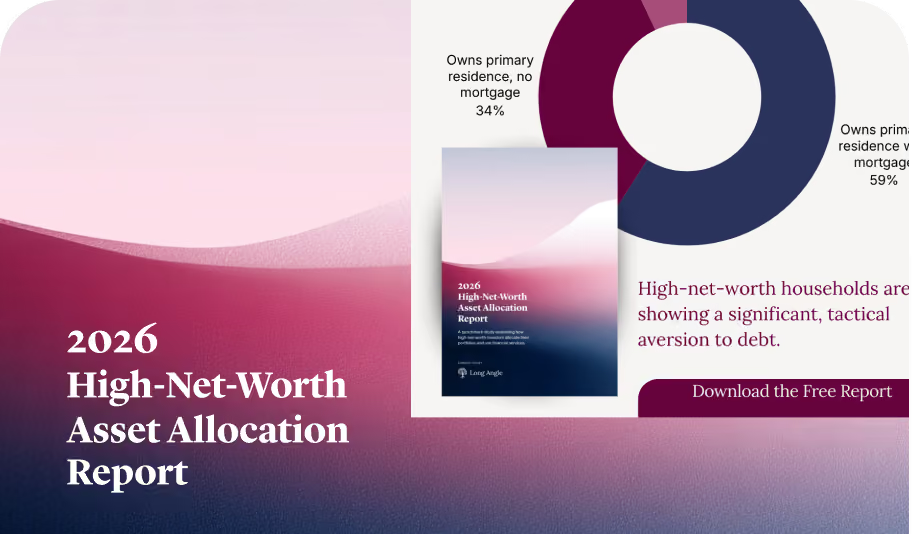
2026 High-Net-Worth Asset Allocation Report
See how high-net-worth investors with an average net worth of $17M are allocating across public equities, private markets, real estate, bonds and cash. Based on benchmark data from 230+ respondents.

What PPLI Is, and Why It Is Sold by Private Placement
PPLI is life insurance sold under securities exemptions rather than a public prospectus, which is what allows institutional funds to sit inside the policy.
PPLI stands for private placement life insurance. The chassis is variable universal life: premium buys a policy, the cash value sits in a separate account held apart from the insurer's general assets, and that separate account holds the investments. The policy is what the tax code recognizes. The separate account is where the money works.
The private placement part describes how it is sold. The policy is offered to accredited investors under a securities exemption rather than registered for public sale, and that exemption is what lets the separate account hold strategies a registered retail product could not offer. A retail variable universal life policy gives you a menu of registered mutual funds. A private placement policy reaches unregistered institutional strategies, including private credit and multi-strategy hedge funds.
The charges are quoted rather than buried in a retail product's pricing, which makes them visible and comparable. What those charges are, and which of them are one-time, is a separate question covered in what PPLI costs.
The Four Tax Benefits, and Which Ones Only Arrive at Death
PPLI delivers four distinct tax benefits, and only two of them are available while the policyholder is alive.
The distinction matters because the benefits that arrive at death are the larger ones, and a buyer evaluating the structure on lifetime access alone will reach the wrong answer.
| Tax benefit | When it is available | Where it comes from |
|---|---|---|
| Income and gains inside the policy are not taxed annually | During life | Section 7702 |
| Cash value reached by withdrawal to basis, then by policy loan | During life | Sections 72(e) and 7702A |
| Death benefit paid to the beneficiary free of income tax | At death | Section 101(a) |
| Proceeds outside the taxable estate when an irrevocable trust owns the policy | At death | Section 2042 |
Source: Internal Revenue Code sections 7702, 72(e), 7702A, 101(a) and 2042. Category description of the treatment, not advice on any individual policy.
Two points keep this honest. Premiums are paid with after-tax dollars, and there is no deduction for paying them, so the benefit is what happens to the money afterwards rather than a reduction in this year's tax. And the growth inside the policy is deferred rather than forgiven: a policyholder who surrenders the contract pays tax on the gain. The treatment becomes permanent only through the death benefit.
Why You Cannot Pick the Investments, and Why That Is the Point
A PPLI policyholder cannot select, direct or advise on the investments inside the policy, and a policy that lets them do so is not insurance for tax purposes.
This is the investor control doctrine. The IRS position, set out in Revenue Rulings 2003-91 and 2003-92, is that a policyholder who retains control over the underlying assets is the owner of those assets for tax purposes and is taxed on their income directly. The Tax Court applied it in Webber v. Commissioner in 2015, taxing a policyholder who had directed the investments held inside his policies. What a policyholder may do is choose among broad strategies or funds. What they may not do is select the holdings, instruct the manager, or arrange to have their preferences followed informally.
A second rule runs alongside it. Section 817(h) requires the account to be diversified, and the regulation sets the test as concentration limits: no more than 55% of the account's value in any one investment, 70% in any two, 80% in any three, and 90% in any four. The regulation names no minimum number of holdings, but the 90% limit means a compliant account holds at least five.
Both rules point the same way. They exist so the wrapper cannot be used as a bare deferral account with an insurance label attached, and a structure that let the buyer pick the assets would be exactly that. The constraint is not a caveat bolted onto the tax treatment. It is the reason the tax treatment holds.
The practical consequence is worth stating plainly, because sellers tend not to. A PPLI buyer is buying someone else's allocation decisions for the life of the policy. An investor who wants to hold particular managers, or to change their mind about them, is buying the wrong structure.
What an Insurance Dedicated Fund Is, and Which Assets It Suits
An insurance dedicated fund is a fund open only to insurance separate accounts, built so a policy can hold an institutional strategy without breaching the diversification rules.
An individual cannot buy into one. Access runs through the policy, the fund is managed to satisfy the concentration limits inside its own portfolio, and the manager rather than the policyholder decides what it holds. That structure is what resolves the tension between wanting a single institutional strategy and needing five positions. Our guide to how an insurance dedicated fund is structured covers the diversification test it has to pass and why no policy can commit to a named manager.
Which assets belong inside one follows from a single question: how much tax would this asset generate each year if it were held in a taxable account? The wrapper defers that tax, so the benefit scales with it.
Private credit distributes interest, which is taxed as ordinary income. Multi-strategy hedge funds turn their portfolios over and generate short-term gains, taxed the same way. At the top federal rate, ordinary income and short-term gains face 37% plus the 3.8% net investment income tax, so 40.8% before any state tax. Qualified dividends and long-term capital gains face 23.8% on the same basis.
A low-turnover index fund sits at the other end. It defers most of its own gain by holding positions rather than selling them, and it distributes qualified dividends taxed at the lower rate. There is comparatively little annual tax to defer, so the wrapper's charges are close to pure cost. This is the same logic that decides the asset location question, applied to the one wrapper with no contribution cap.
Who Runs Out of Tax-Advantaged Room
The investors who look at PPLI are usually the ones who have already filled every capped tax-advantaged account available to them.
The standard set is familiar: a 401(k) or 403(b), a health savings account, a backdoor Roth IRA, a mega backdoor Roth, a 529, and an employee stock purchase plan. Used to their limits, they cap one earner at roughly $88,000 a year in 2026. That is a fixed amount of tax-advantaged room against a portfolio that is not.
In a poll run in the Long Angle community on June 30, 2026 and read on September 23, 2026, members were asked which FIRE tax optimization strategies they take advantage of, selecting all that applied. It drew 1,044 selections from 351 respondents, so shares are of respondents rather than of selections and sum past 100%. Of those 351, 336 reported using at least one of the six named vehicles, or 96%. 204 of them, or 58%, reported using three or more. The full breakdown sits in our guide to high-net-worth tax strategies. This is one voluntary poll of a single community rather than a representative sample of wealthy households, and it describes what members reported doing rather than what anyone should do.
What it says about this structure is narrow but useful. The capped accounts are close to universal at this asset level, and members are systematic rather than casual about them. Which means the question PPLI answers is not whether to use tax-advantaged accounts. It is what happens to the next dollar of tax-inefficient assets once the capped room is gone, and the ordinary answer is a taxable account taxed every year.
How the Death Benefit Is Sized, and Why the Rules Force One
Federal law requires a PPLI policy to carry real death benefit in a fixed relationship to cash value, which is what keeps it insurance rather than an investment account.
Section 7702 sets the definition of life insurance, and a contract meets it through one of two tests: the cash value accumulation test, or the guideline premium test paired with a cash value corridor. Both work the same way in practice. They require the death benefit to exceed the cash value by a margin, and that margin narrows as the insured ages. A younger insured carries a wider corridor, which means the policy buys more insurance per dollar of cash value and pays more for it.
This is why a PPLI policy cannot be funded like a brokerage account. The insurance is not optional packaging around the investment. It is the condition of the tax treatment, and it has a cost that is covered in detail in what PPLI costs.
Section 7702A adds the second constraint. Pay premium faster than the seven-pay test allows and the contract becomes a modified endowment contract. A MEC keeps the death benefit free of income tax, but loses the favorable lifetime access: distributions and loans come out income first rather than basis first, and a policyholder under 59 and a half can face a 10% penalty on top. That single rule is why PPLI premiums are spread across several years rather than paid in one, and why a buyer who cannot commit to a funding schedule is a poor fit for the structure.
Who Owns the Policy, and Where It Is Domiciled
Ownership determines the estate treatment and domicile determines the premium tax, and both are decided before the policy is issued.
Ownership is the consequential one. If the insured owns the policy personally and holds what the code calls incidents of ownership, section 2042 pulls the proceeds into the taxable estate. The death benefit is still free of income tax, but it is counted for estate tax. An irrevocable trust holding the policy as owner and beneficiary keeps the proceeds outside the estate, which is the combination that makes PPLI interesting as an estate structure: growth that is not taxed annually, and proceeds that pass outside the estate. Some policies are owned through a limited liability company for administrative reasons, which does not change the estate analysis by itself.
This decision belongs with the attorney who drafted the rest of the estate plan rather than with the policy. Our guide to high-net-worth estate planning covers how the trust structures fit together.
Domicile is the narrower question. State premium tax is charged by the state where the policy is domiciled rather than where the insured lives, and Alaska and South Dakota hold most US PPLI policies because both tax premium on a graduated basis that applies the meaningful rate only to an initial slice of each year's premium, while most states apply a flat rate of roughly 2% to the whole amount. On a large policy that structural difference is worth more than most negotiated terms, and it is covered with the rest of the cost stack in what PPLI costs.
How Money Comes Out of a Policy
Money leaves a PPLI policy in four ways during life, and only some of them avoid income tax.
The first is a withdrawal. In a policy that is not a MEC, withdrawals come out of basis first, so a policyholder can take back premiums paid without income tax. Once withdrawals exceed basis, the excess is taxable.
The second is a policy loan. Borrowing against the cash value is not a taxable distribution while the policy stays in force. Interest accrues, and an unpaid loan reduces the death benefit by the amount outstanding.
The third is a loan from a third party, using the policy as collateral. The policy stays intact and the tax position is unchanged, at the cost of introducing a lender and an interest rate that the policyholder does not control.
The fourth is surrender. Collapsing the policy taxes the gain above basis as ordinary income rather than as capital gain, which is the most expensive exit available and the one that receives the least attention at the point of sale.
One failure mode deserves naming because it surprises people. A policy that lapses with a loan outstanding is treated as surrendered, so the gain is taxed as ordinary income even though the policyholder receives no cash. Borrowing heavily against a policy and then letting it lapse produces a tax bill with nothing to pay it from.
Portability Under Section 1035
A policyholder is not locked to one carrier. Section 1035 permits an exchange of one life insurance contract for another without recognizing gain, so a policy can move if the carrier's terms, service or investment options stop being competitive. It does not make the policy liquid, and the exchange has to be handled as an exchange rather than a surrender and repurchase, but it means a carrier decision made today is not permanent.
Does PPLI Still Work in Your 60s?
PPLI still works in your 60s, but the arithmetic shifts from tax deferral toward the estate case as the compounding window shortens.
Two forces move in opposite directions with age. The cost of insurance per dollar of death benefit rises, because it prices mortality risk. At the same time the corridor required by section 7702 narrows, so the policy is required to carry less death benefit per dollar of cash value, and the policyholder is buying fewer dollars of the thing that has become more expensive. The net drag is not simply worse at 65 than at 45, which is the assumption most readers arrive with.
What does weaken is the deferral. The benefit of not paying tax annually compounds, so a shorter horizon produces a smaller benefit, and the fixed one-time costs are spread over fewer years.
What strengthens is the estate case. Two of the four tax benefits arrive at death, so a shorter expected horizon brings the largest part of the value nearer rather than further. For a buyer whose objective is transfer rather than lifetime access, age works differently than it does for a buyer chasing compounding.
The real constraints at that age are horizon and health. A horizon under roughly five years does not recover the setup cost, and underwriting that comes back expensive or declined ends the conversation regardless of the arithmetic.
Who PPLI Fits, and Who Should Skip It
PPLI fits investors with a large, permanent allocation to tax-inefficient assets and a horizon long enough to earn back the setup cost.
The profile it suits is specific: a sustained allocation to ordinary-income strategies such as private credit or multi-strategy hedge funds, capped tax-advantaged accounts already full, a horizon measured in decades rather than years, a willingness to let someone else choose the holdings, and US tax residency.
The list of people who should not buy it is longer, and it is the more useful list.
An investor who holds index funds should skip it. A low-turnover index portfolio is already close to tax-efficient, so there is little annual tax to defer and the policy's charges are close to pure cost. An investor with a horizon under roughly five years should skip it, because the one-time costs do not amortize. An investor who wants to choose the managers should skip it, because the investor control doctrine makes that impossible rather than merely discouraged. An investor who cannot fund on a schedule that satisfies the seven-pay test should skip it, because the resulting MEC removes the lifetime access that justified the structure. And an investor who is not a US tax resident should treat the whole analysis as inapplicable, because it depends on US tax rules throughout.
A large share of people who can afford a PPLI policy should not own one. That is the least commercial sentence available on this subject, and it is the one most worth taking seriously, because the structure's credibility rests on fit rather than on features.
Final Thoughts
Work the question in this order. Start with what you would hold inside the policy, because the wrapper is worth roughly what the annual tax on those assets is worth, and an index portfolio generates little of it. Then test your horizon, since the one-time costs only amortize across decades. Then decide whether you can accept never choosing the holdings, because that is a permanent condition rather than a phase you pass through. Only after those three does any cost comparison mean anything. The common failure here is not choosing wrongly. It is deciding on the wrapper before deciding what belongs inside it.
Frequently Asked Questions
What does PPLI stand for?
PPLI stands for private placement life insurance. The private placement part describes how the policy is sold, under a securities exemption to accredited investors rather than registered for public sale. That exemption is what allows unregistered institutional strategies to be held inside the policy, which a registered retail product cannot offer.
Is PPLI legal?
Yes. PPLI relies on the treatment Congress wrote for life insurance in sections 7702 and 101 of the Internal Revenue Code, and on the diversification requirement in section 817(h). The treatment is codified, and it holds only while the policy meets those tests. A policy that fails the diversification rules, or whose owner directs the underlying investments, loses the treatment and its owner is taxed on the account's income directly. The compliance burden sits on the policy satisfying the tests rather than on the structure being permitted.
What is the minimum for PPLI?
There is no minimum in the tax code. The market sets one, and the Wall Street Journal reported in August 2026 that private placement life insurance is practically available from around $5 million of premium. PPLI economics improve materially with scale and negotiated access, so the practical threshold depends on how a policy is arranged rather than on any rule.
Can you take money out of a PPLI policy before death?
Yes, in three ways: withdrawing to basis, borrowing against the cash value, or pledging the policy to a third-party lender. In a policy that is not a modified endowment contract, withdrawals come out of premiums paid first and loans are not taxable while the policy stays in force. Surrendering the policy is the exception. It taxes the gain above basis as ordinary income.
Who chooses the investments inside a PPLI policy?
The carrier or the manager it appoints. A policyholder may choose among broad strategies or funds but cannot select the underlying holdings or instruct the manager. The limit comes from the IRS investor control doctrine, and a policyholder who crosses it is treated as the owner of the assets and taxed on their income directly.
How is PPLI different from a Roth IRA?
Both hold investments that are not taxed annually, and both are funded with after-tax dollars. The differences are contribution room and control. A Roth IRA caps annual contributions and gives complete freedom over the holdings. PPLI has no contribution cap and gives no control over the holdings. A Roth pays out through qualified distributions in retirement, while PPLI's lifetime access runs through withdrawals to basis and policy loans, with the largest benefits arriving at death.
The assets this structure suits are the ones hardest to evaluate alone.
Private credit and multi-strategy funds are where diligence matters most. Long Angle members see the full investment memo, question the sponsor on a webinar, and debate it in the forum. Every offering is reviewed with no expectation to invest.
More From Long Angle
Beyond Wealth Newsletter
Navigating Wealth Podcast
Research & Studies
Alternative Investment Education
Blog