Written by Chris Bendtsen

Multi-Strategy Hedge Funds: Returns, Role in a Portfolio, and Risks
Multi-Strategy Hedge Funds: Returns, Role in a Portfolio, and Risks
A guide to multi-strategy hedge funds: the pod-shop model, sub-strategies, historical returns and Sharpe, and the leverage and fee risks investors weigh.
Chris Bendtsen
Multi-strategy hedge funds combine several uncorrelated trading strategies, such as equity long/short, global macro, relative value and credit, inside one fund vehicle, shifting capital toward whichever strategies have the best current opportunity. Most large platforms use a multi-manager or "pod shop" model that allocates across semi-autonomous teams under a central risk function. Investors choose multi-strategy funds for equity-like long-term returns with lower volatility and limited correlation to public markets. The main constraints are high leverage, substantial pass-through fees and a wide performance gap between the strongest and weakest managers.
Key Takeaways
- Multi-strategy funds run many uncorrelated strategies in one vehicle. The dominant pod-shop model shifts capital toward the best opportunities and cuts underperformers quickly under a central risk team.
- Over the five years ending December 2025, the category posted a Sharpe ratio of 2.83, against 0.53 for equities and negative 0.68 for bonds (Aurum). Returns were roughly equity-like at far lower volatility.
- Correlation to the S&P 500 has historically been low (0.17 for multi-manager platforms over the ten years ending March 2024) but has risen since the pandemic. The diversification thesis will be tested in the next equity drawdown.
- Cost and leverage are the central risks. Many top platforms use pass-through fee models that bill operating expenses directly to investors, and average gross leverage reached 444% in November 2025.
- Manager selection matters more here than in most asset classes. The return gap between the 10th and 90th percentile manager was roughly 18 points in 2025.
2026 High-Net-Worth Asset Allocation Report
See how high-net-worth investors with an average net worth of $17M are allocating across public equities, private markets, real estate, bonds and cash. Based on benchmark data from 230+ respondents.

What Are Multi-Strategy Hedge Funds?
Defining the asset class
A hedge fund is a private investment vehicle that uses sophisticated tactics to pursue returns independent of broader market direction (e.g., the S&P 500). Tactics include short selling, leverage, derivatives, arbitrage, and others across asset classes.
Multi-strategy hedge funds combine multiple uncorrelated investment strategies within a single fund vehicle. Instead of specializing in a single approach, the fund allocates capital dynamically across a broad range of hedge fund tactics and asset classes. Multi-strats are built so that at least one or more strategies are working at any given time.
Pod shop model
The dominant multi-strat model today is the multi-manager platform, or “pod shop” structure. Under this approach, capital is allocated across multiple semi-autonomous trading teams, known as pods, each with its own sub-P&L. Capital is shifted between strategies based on evolving risk and return profiles, while a central risk management team sets exposure limits across pods. This allows the fund to concentrate capital in outperforming sub-strategies and pull back from lagging ones, while maintaining broad fund-level diversification. The model operates on a strictly sink-or-swim basis, driven by performance-based bonus incentives for teams that deliver alpha.
The Sub-Strategies Inside a Multi-Strategy Fund
Multi-strategy funds combine several distinct investment approaches under one investment offering:
Equity long/short
Equity long/short takes long positions in equities expected to appreciate and short positions in equities expected to decline, generating returns from both sides of the book. In practice, this means researching companies based on fundamentals, financial outlook, sector, market perception, and valuation to identify comparable companies that have become mispriced relative to one another. Managers then buy the undervalued names and short the overvalued ones as that mispricing narrows.
Variations include:
- Value versus growth orientation
- Large cap versus small cap
- Sector specialization in areas like technology, healthcare, or energy
- Discretionary versus quantitative security selection
Returns are driven by security selection skill rather than market direction, with net exposure adjustable based on the manager's view.
Famous examples: Point72 and its predecessor SAC Capital helped popularize the modern multi-manager equity pod model; Viking Global and Coatue are prominent long/short equity managers.
Event-driven
Event-driven strategies invest around corporate events that create a predictable price catalyst. Sub-strategies include:
- Merger arbitrage goes long the acquisition target and, in stock-for-stock deals, typically short the acquirer, profiting from spread convergence when a deal closes.
- Index rebalancing trades the forced buying and selling flows from passive ETFs and index funds when securities are added to or removed from major market benchmarks.
- Activist strategies take a significant stake and advocate for management or strategic changes.
- Special situations broadly covers spinoffs, rights offerings, and regulatory events.
Famous examples: Elliott Management and Third Point are iconic event-driven specialists; Davidson Kempner and Farallon Capital also run event-driven/opportunistic strategies within broader multi-strategy platforms.
Global macro
Global macro strategies invest across equities, fixed income, currencies, and commodities based on top-down views about macroeconomic trends. These include interest rate cycles, inflation regimes, central bank policy, and geopolitical shifts.
Macro is flexible enough to go long or short virtually any asset class or geography, and tends to perform well in high volatility or trend-driven environments. Performance can be episodic, with long stretches of flat results punctuated by sharp gains during major market moves. Macro often provides the strongest diversification benefit against equity drawdowns.
Global macro is typically categorized by the following:
- Discretionary macro is judgment-driven, with a portfolio manager forming a thesis and expressing it across markets.
- Systematic macro uses computer-generated signals to identify price trends, typically over longer time horizons than discretionary approaches.
- Fixed income identifies opportunities across rates, mortgages, and credit. Managers use instruments such as sovereign, agency, and corporate debt, foreign exchange, futures, and derivatives. Positions are typically hedged to reduce interest rate, credit, and other risks.
- Commodities involve trading spreads in energy, metals, and agricultural markets using futures, options, swaps, and structured notes.
Famous examples: Bridgewater’s Pure Alpha is the best-known flagship macro fund; Citadel and Millennium also run macro-oriented teams within multi-strategy platforms.
Relative value
Relative value strategies, also referred to as arbitrage, exploit pricing discrepancies between related securities, going long the cheap security and short the rich one. The return profile resembles an income stream, and these strategies use leverage and derivatives to amplify returns while hedging downside risk.
Types of relative value / arbitrage include:
- Fixed income relative value trades pricing discrepancies across government bonds, yield curves, and rate derivatives.
- Convertible arbitrage identifies convertible bonds, preferred shares, or warrants that appear mispriced yet offer a favorable rate of return.
- Options arbitrage profits from market turbulence, or the lack of it, as reflected in option price movements.
- Closed-end fund or asset arbitrage identifies discounted or high-premium closed-end funds, shares priced below net asset value, or mispriced parent-subsidiary situations.
Famous examples: Citadel began with convertible bond arbitrage, a relative-value strategy; Capula is a major fixed-income relative-value specialist.
Credit strategies
Credit strategies seek to capture returns from credit spread movements, balance sheet dislocations, and corporate restructuring across debt markets and capital structures. Operating across the full rating spectrum, these strategies span corporate bonds, leveraged loans, distressed debt, structured credit, and credit derivatives. Sub-strategies include:
- Investment grade and high yield long/short strategies take directional or relative value views on credit spreads across rating categories.
- Capital structure arbitrage exploits pricing dislocations between different securities issued by the same company (e.g., long senior debt vs. short junior debt, long debt vs. short equity).
- Distressed and restructuring invests in debt or equity of companies undergoing bankruptcy, financial re-organization, or operational turnaround.
- Credit derivatives use credit default swaps (CDS) and indices to express views on credit risk without owning the underlying bond.
- Structured credit trades asset-backed securities (ABS), collateralized loan obligations (CLOs), and other securitized instruments.
Returns are driven by credit spread movements and issuer-specific fundamental analysis. The strategy can be managed market-neutrally to isolate specific credit selection, or dynamically to capture broader macroeconomic trends. Credit generally benefits from elevated dispersion and default cycles, which create greater pricing divergence between strong and weak issuers. Additionally, higher base rates increase the short rebate income earned on cash proceeds generated from short positions.
Famous examples: King Street, Silver Point, and GoldenTree are established credit and distressed debt specialists; Millennium and Citadel also run large credit-oriented teams.
Quantitative / Systematic
Quantitative strategies use mathematical models and statistical analysis to make investment decisions, removing human bias and emotion from the process. This means creating proprietary algorithms that identify over- or under-valued securities, updating those models as market paradigms shift, and applying them across equity, interest rate, foreign exchange, and commodity markets.
Several approaches fall under this umbrella:
- Statistical arbitrage exploits short-term price discrepancies between related securities using statistical models.
- Algorithmic trading uses programmed rules to execute orders based on market conditions.
- High-frequency trading leverages ultra-low latency technology and algorithms to trade microsecond price dislocations and capture order-flow imbalances.
- Factor-based strategies capture market anomalies by focusing on characteristics historically linked to higher returns.
- Market neutral strategies eliminate market risk by balancing long and short positions.
- Trend following trades on recent price movements, also known as momentum.
Famous examples: Renaissance is the canonical quant pioneer; D. E. Shaw and Two Sigma are leading systematic platforms.
Why Investors Consider Multi-Strategy Hedge Funds
Multi-strats offer a combination of strategy-level advantages and portfolio-level benefits that, together, can provide portfolios with diversification, reduced volatility, and alpha.
Multi-Strategy Hedge Funds: Reasons to Invest
Limited correlation, downside protection
Correlation measures how closely an investment's returns move with a benchmark, on a scale from -1 to 1. A correlation near 1 means an asset tends to rise and fall in step with the benchmark, while a correlation near 0 means its returns are largely independent. Multi-strategy funds have historically exhibited limited correlation to equities by hedging broad market risk, deploying market-neutral strategies, and enforcing risk controls to isolate individual trade alpha from overall market direction.
Over the ten years ending March 2024, multi-manager platforms showed a correlation to the S&P 500 of just 0.17 (Morgan Stanley, MSIM Hedge Funds and HFRI data). By comparison, the broader hedge fund category came in at 0.52. Multi-managers’ beta to the S&P 500, meaning the degree to which their returns have tended to move in tandem with the size of the market's own moves, was just 0.03, versus 0.24 for the broader hedge fund universe.
Historically, fixed income served this role of low correlation to public equities, but is increasingly viewed as a less reliable cushion against stock downturns. Driven by post-pandemic inflation and rising interest rates, bonds have increasingly moved in tandem with equities, particularly during sharp selloffs (IMF, Bloomberg data). In the five years leading up to March 2020, bonds and equities were negatively correlated almost 60% of the time on a rolling 120-day basis (a reliable source of diversification). In the five years following the pandemic, that figure dropped below 10% (Reuters, Bloomberg data). Consequently, investors evaluating multi-strategy funds may think of them as supplementing or replacing the ballast role that bonds have traditionally held.
This portfolio stabilizing role is most evident during periods of market stress. As shown in the chart below, during the largest monthly S&P 500 declines from 2014 to March 2024, multi-manager platforms (Peer Group Composite Index) consistently delivered roughly flat-to-positive returns while equities suffered sharp drawdowns.

Higher interest rates are a tailwind for the asset class
Interest rate normalization since 2022 has been a structural tailwind for multi-strategy funds. Multi-strats earn interest income on uninvested cash balances and short rebates on cash proceeds generated from short sales. Higher base rates elevate this baseline yield, lifting overall gross returns.
For nearly two decades following the global financial crisis, low interest rates and quantitative easing suppressed volatility and kept asset correlations tight, an environment that favored traditional long-only portfolios and worked against hedge funds. In the decade leading up to 2022, the broader hedge fund industry underperformed a 60/40 portfolio. That era ended when the Federal Reserve began raising rates. From 2022 through 2025, hedge funds have outperformed a 60/40 portfolio by nearly 190 basis points per year (Goldman Sachs).
Historical Performance
Annualized returns
Multi-strategy funds have delivered positive returns in every calendar year from 2015–2025, a period that includes the 2018 rate shock, the COVID-19 collapse, and the 2022 simultaneous drawdown in stocks and bonds. Over those 10 years, the annualized return of multi-manager funds was 7.5%, modestly ahead of both the broad hedge fund universe and a global 60/40 portfolio.
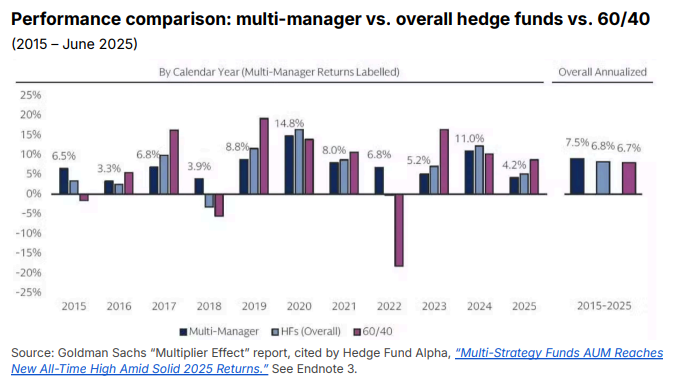
The absence of a down year over a decade with multiple market shocks reflects the structural design of the strategy. When equities fall sharply, macro and relative value strategies tend to hold steady or benefit. When credit markets seize, equity long/short books can be hedged down quickly.
Sharpe ratio
The clearest evidence for multi-strategy's structural advantage may be its risk-adjusted return, rather than its return in isolation. A useful way to measure this is the Sharpe ratio, which quantifies how much excess return an investment generates per unit of risk (the volatility of returns over time). A Sharpe ratio above 1.0 is considered strong and above 1.5 exceptional. Over the five years ending December 2025, multi-strategy delivered a Sharpe ratio of 2.83, above every other hedge fund master strategy tracked, none of which exceeded 1.06 over that period (Aurum). Both are well above either public market benchmark: equities produced a Sharpe ratio of 0.53 over the same five years, and bonds posted a negative 0.68.
Hedge fund sub-strategy comparison
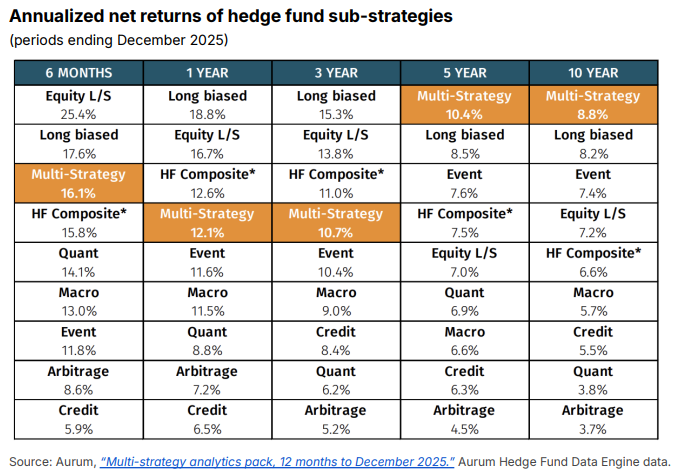
When comparing multi-strategy’s performance against single-strategy funds, multi-strategy isn’t the best performing over shorter time periods (3 years or less). Directional approaches such as equity long/short and long biased strategies can capture greater upside during strong market rallies. Multi-strategy platforms deliberately limit market beta, sacrificing short-term upside during bull runs to protect capital during downturns. Over longer time horizons, that downside protection pays off. According to Aurum, multi-strategy ranks first in performance among hedge fund strategies over the 5-year and 10-year periods ending December 2025, returning 10.4% and 8.8% annualized respectively. These returns are consistent with the Goldman Sachs data shared above.
What Drives Multi-Strategy Returns
As previously discussed, by combining several uncorrelated strategies, multi-strategy funds capture alpha from sources unrelated to the direction of stocks or bonds. Realizing that edge requires active management: the central risk team's ability to cut losing strategies quickly and redeploy capital into winning ones is itself a source of excess return. The remainder of this section looks at three additional drivers beyond strategy diversification and dynamic capital allocation: talent, infrastructure, and leverage.
Talent density
Talent quality is a critical driver of hedge fund returns, and the pod model functions as a talent arms race. The best platforms attract the best portfolio managers by offering infrastructure, capital, and operational support that an independent fund manager cannot easily replicate. Large hedge fund managers also employ hundreds of technologists and PhDs across different fields of study (Citadel).
Infrastructure as a competitive advantage
The largest platforms compete on the depth of the operational ecosystem built around that talent, which tends to fall into a few recognizable categories:
- Financing relationships: Equity financing, prime brokerage, and repo counterparties determine how efficiently a platform can fund positions and how resilient it is to a shock at any single counterparty.
- Research relationships: the breadth of sell-side and third-party research providers that a platform draws from widen the information available to any given portfolio manager. Managers process hundreds of thousands of external data files a day (Millennium).
- Execution capability: the number of executing brokers and the sophistication of trade execution technology augment a strategy's theoretical edge.
- Market access: the breadth of exchanges, currencies, and instruments a platform can trade widens a manager's opportunity set. The largest hedge fund managers tout executing millions of trades daily across more than a hundred exchanges (Millennium).
Leverage
Most multi-strategy platforms employ significant leverage, deploying borrowed capital on top of investor AUM to amplify returns. Leverage is typically used within strategies that would otherwise generate modest spreads or edges on a per-trade basis. Leverage amplifies returns, but it amplifies risk in equal measure, a point covered further below.
Risks and Considerations
Leverage
Leverage means a fund controls a position much larger than its capital base. A small adverse price move in a heavily leveraged position significantly amplifies the loss. Leverage also introduces forced selling. If a position moves against a fund and a lender demands more collateral, the fund may be forced to sell immediately regardless of price. Leverage has been rising to near all-time highs across the industry. In November 2025, multi-strategy funds carried average gross leverage of 444% (JPMorgan, cited by Reuters).
Rising correlation to equities
The correlation between multi-strategy funds and the S&P 500 has risen since the COVID-19 pandemic (PivotalPath, cited by Pensions & Investments). A rising correlation during a strong equity market is not necessarily a warning sign. If multi-strategy funds are participating in broad market strength while still holding up during periods when equities decline, correlation should moderate over time. The real test of the diversification thesis is whether that decoupling reappears the next time equities see a drawdown.
Fees
While traditional hedge funds rely on a “2 and 20” structure (a 2% management fee plus a 20% performance fee on profits), premier multi-strategy platforms have increasingly shifted toward pass-through fee models. Under this structure, operational expenses including portfolio manager compensation, technology infrastructure, prime brokerage costs, and legal fees are all billed directly to investors. Many top platforms no longer charge a fixed management fee at all, operating on a pass-through expense model alongside a performance fee. Because operating costs are substantial, if a fund’s gross alpha fails to comfortably outpace its talent and technology overhead, net returns to investors can materially suffer.
Taxation
Frequent trading within most hedge fund strategies produces short-term capital gains, taxed at ordinary income rates rather than the lower long-term capital gains rate. Strategies trading regulated futures (common in global macro) benefit from Section 1256 tax treatment, with gains automatically split 60% long-term and 40% short-term. Certain strategies, particularly those using leverage, can generate Unrelated Business Taxable Income, which remains taxable within otherwise tax-deferred accounts such as IRAs. See Long Angle’s Private Markets Tax Guide to learn more.
Manager dispersion
The gap between top and bottom performing multi-strategy managers can be significant. In 2025, the difference in returns between the 10th and 90th percentile multi-strategy manager was roughly 18 percentage points (Aurum). Manager diligence and selection, covered in the next section, are critical.
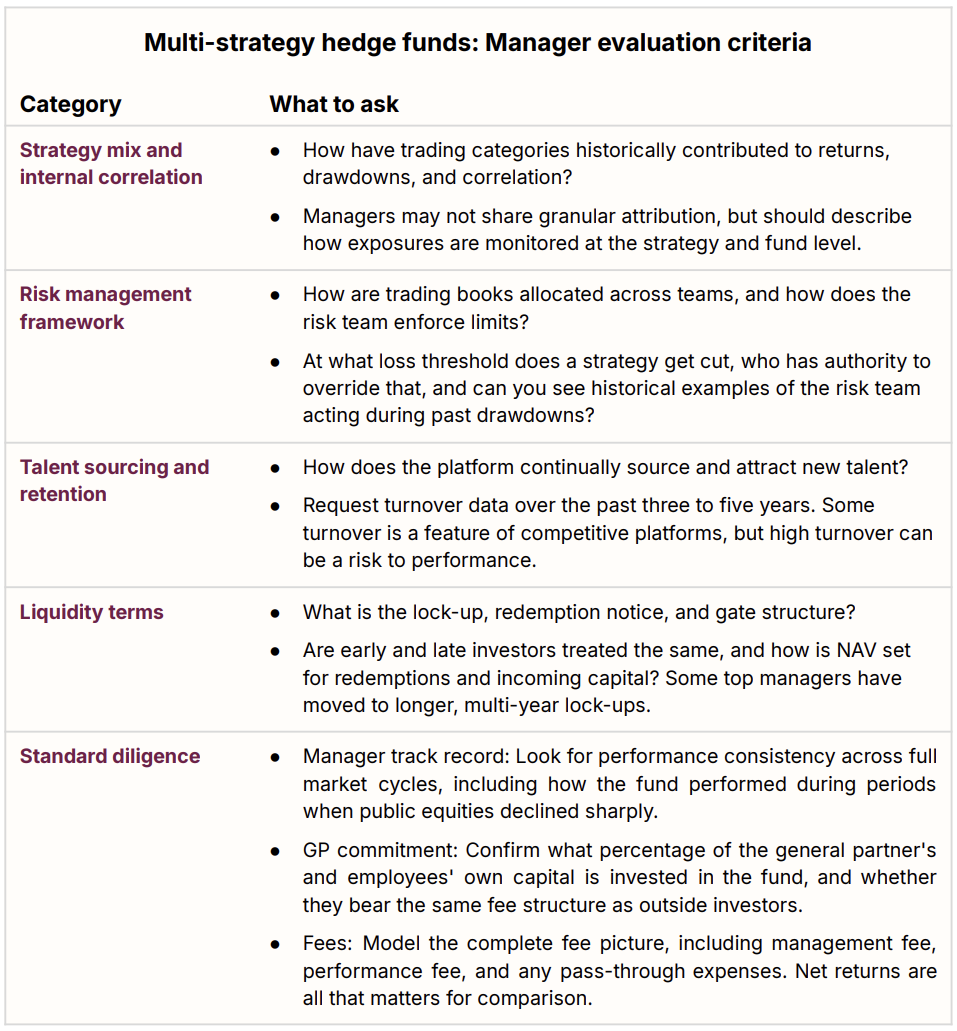
How to Evaluate Multi-Strategy Managers
Contact the Long Angle Investments team with any questions on multi-strategy hedge funds and opportunities to invest.
Frequently Asked Questions
What is the difference between a multi-strategy and a multi-manager hedge fund?
Multi-strategy describes the approach; multi-manager (or "pod shop") describes the dominant structure for delivering it. Most large multi-strategy funds run capital across semi-autonomous pods under a central risk team.
What returns do multi-strategy hedge funds generate?
The category returned about 7.5% annualized over the ten years to 2025 and 10.4% over the five years ending December 2025 (Aurum, Goldman Sachs). Returns were roughly equity-like at far lower volatility. Past performance does not predict future results.
Are multi-strategy hedge funds correlated to the stock market?
Historically low. Multi-manager platforms showed 0.17 correlation to the S&P 500 over the ten years ending March 2024, though correlation has risen since the pandemic and will be retested in the next drawdown.
What are the fees for multi-strategy hedge funds?
Increasingly through pass-through fee models rather than "2 and 20." Operating expenses are billed directly to investors, often with a performance fee and no fixed management fee, so total cost can be high.
What are the main risks of multi-strategy hedge funds?
High leverage (a 444% average gross level in November 2025), rising equity correlation, substantial fees, tax inefficiency from short-term gains, and a wide gap between top and bottom managers.
Who can invest in multi-strategy hedge funds?
Access is generally limited to institutional investors and individuals who meet the qualified purchaser (QP) threshold.
Most financial decisions at this stage are made without anyone to compare notes with.
Long Angle is a vetted community of 8,000+ founders, executives, and investors who discuss private markets allocations, manager relationships, tax strategy, and the full complexity of wealth at this stage, with their real names attached and no one in the room trying to sell them anything.
Alternative investments