Written by Ryan Morrison


Dollar Depreciation: What a Weakening Dollar Means for Your Investment Portfolio
Based on a Navigating Wealth conversation with Daniel Altman.
Dollar Depreciation: What a Weakening Dollar Means for Your Investment Portfolio
The dollar declined more than 13% against the euro through 2025, and the structural pressures behind that move have not resolved. For US investors carrying heavy domestic concentration, that shift changes the portfolio math. Here is what dollar depreciation means for real returns, international allocation, and real assets.
Ryan Morrison
Most portfolios built during the last decade were built during a period of dollar strength. That strength made home bias feel rational, kept US-denominated returns looking clean, and meant that the question of international exposure could be deferred indefinitely. That deferral is now getting expensive. The dollar declined more than 13% against the euro and the Swiss franc through most of 2025, and the structural pressures behind that move (sovereign debt levels, fiscal imbalances, and eroding growth premium) have not resolved. For investors carrying heavy US concentration, the question is no longer whether dollar depreciation matters. It is whether their portfolio was built to handle it.
Dollar depreciation reduces the purchasing power of US-denominated assets and increases the relative value of foreign holdings. For US investors carrying heavy domestic concentration, a sustained decline raises the real cost of that position. The portfolio response involves three moves: reducing home bias through international equity exposure, adding real assets that hold value independent of paper currency, and distinguishing between markets that offer fundamental upside and those that offer only a currency play.
Key Takeaways
- Dollar depreciation erodes the real return on US-denominated assets and amplifies the relative value of international holdings and real assets
- US investors typically hold 70-80% of equities domestically despite the US representing roughly half of global market capitalization, and that concentration is now a headwind
- Buying international equities is not simply a currency play; markets that combine strong governance with growth fundamentals offer a different kind of upside
- Gold has outperformed since the Great Recession, driven by sovereign debt levels above 100% of GDP in major economies, a structural condition and not a temporary one
- Real assets (real estate, commodities, infrastructure) store value outside the paper currency system and have historically held purchasing power through dollar depreciation cycles
- The question is not whether to diversify but how to do it deliberately, using a framework that separates currency exposure from fundamental country quality
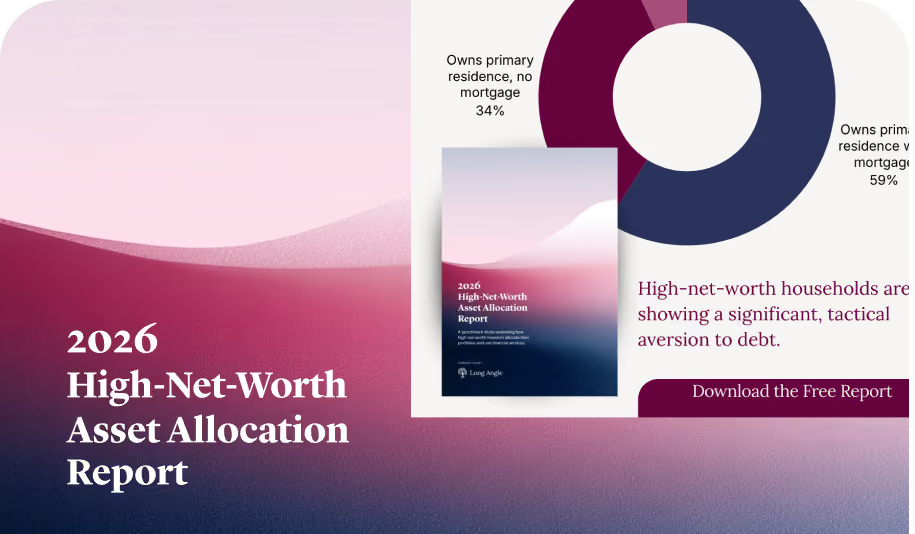
2026 High-Net-Worth Asset Allocation Report
See how high-net-worth investors with an average net worth of $17M are allocating across public equities, private markets, real estate, bonds and cash. Based on benchmark data from 230+ respondents.
What Dollar Depreciation Means for a US Portfolio
Dollar depreciation means that each dollar buys less of a foreign currency than it did before. As a result, assets priced in foreign currencies become more valuable in dollar terms while assets priced in dollars lose relative purchasing power. For a US investor whose portfolio is largely domestic, the practical effect is a quiet drag on real returns that does not show up in nominal performance figures but does show up in what the portfolio can buy.
The move in 2025 was not subtle. The US Dollar Index fell roughly 10% through September, with the dollar depreciating 13.5% against the euro and 13.9% against the Swiss franc. That kind of decline materially changes the relative performance math for investors holding unhedged foreign assets versus those holding domestic ones.
What makes the current episode structurally different from past cycles is the confluence of pressures behind it. Rising US debt burdens (sovereign debt levels now above 100% of GDP), persistent fiscal deficits, and the gradual erosion of the US growth premium that drove a decade of dollar strength have combined in a way that is not easily reversed by a single policy shift. Dan Altman, author of the High Yield Economics newsletter and creator of the Baseline Profitability Index, frames this as a structural condition rather than a temporary dislocation: governments facing unsustainable debt loads have historically inflated their way out of them. The dollar's decline, on this view, is the early expression of a longer adjustment.
That is not a prediction about timing. It is an argument about positioning, and about whether a portfolio built during dollar strength is still the right portfolio for what comes next.
Watch the Full Conversation
This article draws on a Navigating Wealth conversation with Dan Altman, where we discuss dollar depreciation, international diversification, the Baseline Profitability Index, and why the portfolio questions investors defer the longest tend to be the most expensive ones. Watch the full episode for the broader discussion.
Dan Altman is an economist, author, and creator of the Baseline Profitability Index, a quantitative framework for evaluating foreign direct investment across countries. He has served as chief economist at Instawork, as an economic advisor to the British government, and as a contributor to the Economist and the New York Times. His forthcoming book, Economics for the Win, applies economic thinking to sports investing and beyond.
In this conversation, he explains why US investors have systematically underestimated their exposure to dollar risk and why the standard diversification tools may not be doing what investors expect them to do.
Subscribe on YouTube · Get weekly episode updates
Why US Investors Are More Exposed Than They Think
Home bias, the tendency to concentrate investments in domestic assets, has made US investors structurally more vulnerable to dollar depreciation than their portfolio allocations suggest they understand. The US represents roughly 47% of global stock market capitalization, yet US investors typically hold 70-80% of their equity allocation domestically. That gap between market weight and actual allocation is not a rounding error. It is a deliberate or habitual bet on continued US outperformance, and it is a bet that has recently started losing.
The bet paid off for a long time. US stocks returned 12.8% annualized from 2009 to 2024 while international developed markets returned 5.7%. That kind of sustained outperformance rewarded home bias and made the case for international diversification feel academic. The decade before that, from 1999 to 2009, international stocks outperformed the US by roughly 4% annually. The cycle turns, and when it does, the portfolio that never adjusted bears the full cost.
Since January 20, 2025, the iShares Core S&P 500 ETF has underperformed the iShares MSCI EAFE ETF by 15.1% annualized. The reversal has been sharp and broad. US family offices, the segment of investors one might expect to be most sophisticated about currency exposure, reached 86% North American portfolio allocation in early 2025, the highest concentration of any regional investor group globally, according to UBS data. That figure was recorded just as the tariff announcements that upended global markets were beginning to take effect.
Dan Altman puts the longer-term shift this way: US home bias has declined from roughly 90% to roughly 60% over recent decades, but that still leaves a significant majority of US investor wealth in US-denominated assets. The question is not whether some international exposure is appropriate. It is whether the current level of domestic concentration still reflects a deliberate view or simply an inherited one. For investors who built their portfolios on a US-index foundation, whether a US-indexed approach still holds its original logic is worth revisiting explicitly.
The Case for International Equities and Why an ETF Is Not Enough
Buying international equities is not simply a bet on currency appreciation. It is a bet on the fundamentals of foreign economies: their governance quality, growth trajectory, and resilience independent of what happens to the dollar. Understanding that distinction matters because the two types of international exposure have different risk profiles and different expected payoffs.
Dan Altman's Baseline Profitability Index provides a framework for navigating that distinction. The BPI separates countries into two groups. The first group consists of governance leaders (Singapore, Denmark, Switzerland) where institutional quality, property rights, and rule of law are strong. These economies tend to offer lower but more reliable returns, and their assets benefit from dollar depreciation without requiring strong underlying growth. The second group consists of fast-growth markets (India, Vietnam, Indonesia) where growth rates are high but governance quality is more variable. These markets offer different upside and different risk.
The US, on the BPI framework, sits in the middle of the pack. It is not a governance laggard, but it no longer occupies the top tier it might have claimed two decades ago. That positioning has consequences for how international diversification should be constructed. A standard international ETF blends both groups indiscriminately, which means an investor buying a broad international fund is getting exposure to both without necessarily intending to.
The tariff environment and ongoing supply chain reorientation add a second layer to this argument. Companies with meaningful non-dollar revenue streams have a structural advantage when the dollar weakens: their foreign earnings translate back into more dollars, and the input costs they pay in foreign currency become relatively cheaper. That tailwind is not captured by hedging the currency out. It is captured by holding the exposure unhedged and letting the fundamental business benefit from the shift. US investors allocate roughly 75% of equity portfolios to US stocks compared to roughly 62% in a global benchmark like the MSCI All Country World Index. The gap between those two numbers represents a standing bet against the rest of the world's fundamentals, not just its currencies.
Investing During Inflation: Real Assets as the Structural Hedge
Real assets (real estate, commodities, infrastructure, timberland) hold value through currency depreciation because their worth is grounded in something physical rather than a promise denominated in paper. When a government inflates its way out of a debt problem, the nominal price of real assets typically rises to preserve their purchasing power. That is the structural logic behind holding them, and it is distinct from the momentum or yield arguments that often dominate the discussion.
The historical record supports this. Precious metals and international equities are among the only asset classes to consistently deliver positive real returns for dollar-denominated investors during sustained eras of dollar depreciation, according to Barclays Private Bank research. Cash and nominal bonds, the default defensive positions in many portfolios, have historically provided limited protection in these environments because their real value erodes alongside the currency.
Real estate deserves specific attention within this category. Property generates income through rents that can be revised upward as replacement costs and general price levels rise. The asset itself is a store of value that does not depend on any single government's willingness to maintain purchasing power. For investors thinking about how HNW investors allocate to real estate as part of a broader portfolio, the inflation hedge argument is one of several compounding reasons the asset class tends to hold a meaningful share of HNW portfolios across market cycles.
Commodities operate differently. Most are priced globally in dollars, which means a weaker dollar tends to push their dollar-denominated prices higher even when underlying demand has not changed. That dynamic benefits commodity-exposed positions but also illustrates how dollar depreciation operates as a tax on domestic purchasing power rather than a generalized wealth event. Private credit as a complement to real asset exposure is worth examining in this context: floating-rate private credit denominated in foreign currencies adds a layer of non-dollar income that is distinct from equity exposure while still keeping the portfolio productive.
The broader principle Altman articulates is that a portfolio heavily concentrated in paper instruments (stocks, bonds, cash, and funds denominated in dollars) is implicitly long on the US government's willingness and ability to maintain purchasing power. Real assets represent a partial hedge against the failure of that implicit assumption.
Gold as an Inflation Hedge: Why It Has Outperformed Since the Great Recession
Gold's outperformance since the Great Recession is not primarily a story about inflation expectations or safe-haven demand during market volatility. It is, on Altman's reading, a structural story about sovereign debt. When major governments carry debt above 100% of GDP and show no credible path to reducing it through fiscal restraint, the pressure to inflate it away grows over time. Gold, as an asset that cannot be printed or devalued by any central bank, benefits from that structural condition. Not from any particular crisis, but from the persistent background probability that paper currencies will gradually lose ground.
That is a different framing than the standard "gold as a hedge against a market crash" argument. Gold does not perform reliably in equity bear markets. Its record during short-term risk-off events is inconsistent. What it has done more consistently is outperform during extended periods of dollar weakness and fiscal strain, which are the same conditions produced by sustained sovereign debt loads. Vanguard's research estimated the dollar was roughly 12% overvalued against a basket of five major currencies heading into 2024, with a 75% probability of some depreciation over the following decade, a backdrop that is structurally supportive of gold as a portfolio position.
The Kirchner-era Argentina parallel Altman draws is instructive here. Argentina under Kirchner combined high sovereign debt, fiscal deficits, and a government unwilling to accept the political cost of genuine adjustment. The result was a series of currency devaluations and inflation episodes that wiped out the real value of peso-denominated assets. The structural conditions are not identical to those in the US or other major economies, but the mechanism (governments inflating away debt when the alternative is too politically costly) is the same one that creates the long-run tailwind for gold and non-dollar assets. The lesson is not that the US is Argentina. It is that the playbook for managing unsustainable debt loads is well understood, and gold has historically been one of the better-placed assets when that playbook is running.
How Much International Exposure Is Right
There is no universal answer to the right level of international exposure, but there is a reasonable starting framework: the question is less about a target percentage and more about whether the current allocation reflects a deliberate view or a structural default. A portfolio at 80% domestic equity is not necessarily wrong. A portfolio at 80% domestic equity that has never been examined through the lens of dollar risk probably is.
Long Angle members, investors with an average net worth of roughly $17M, are a useful benchmark here. The 2026 Long Angle High-Net-Worth Asset Allocation Study documents how peers at this wealth stage are currently allocated across public equities, private markets, real estate, bonds, and cash. That data matters because what peers at the same wealth stage and complexity are doing is a more relevant reference point than what a standard financial planning model recommends for the median household.
The global picture shows movement. Year-to-date in 2026, investors have added $35 billion to US-listed broad emerging market equity ETFs, up 21% from the prior year. Single-country ETF flows have exceeded total 2025 inflows already, led by South Korea, Brazil, and Japan. Something is shifting in how sophisticated investors are thinking about non-dollar exposure, and the shift is being expressed through specific country and regional allocations rather than broad international index products.
Dan Altman's practical framing is straightforward: the US is not being abandoned as an investment destination. It is still a governance-quality economy with deep capital markets and strong institutions. The question is whether the concentration premium that US assets have commanded, the extra weight in most domestic portfolios relative to global market share, is still warranted given the dollar outlook, the sovereign debt trajectory, and the increasing attractiveness of governance-quality markets elsewhere. Answering that question deliberately, rather than letting the portfolio answer it by default, is the relevant exercise. Understanding how institutional allocators approach currency exposure and hedging is a useful input to that exercise, even for investors who are not operating hedge fund strategies themselves.
Final Thoughts
The household that built wealth during the last decade of dollar strength built it under conditions that are no longer fully in place. That does not make the portfolio wrong. US institutions are sound, US capital markets remain deep, and the dollar is not losing its reserve currency status. What it does mean is that the concentration decisions embedded in most US-heavy portfolios were made during a period that may not repeat in the near term.
Dollar depreciation is not a reason to abandon the domestic portfolio. It is a reason to examine the domestic concentration deliberately rather than by default. The investor who holds 80% in US equities and has thought carefully about why, and what conditions would cause that to change, is in a different position than the investor whose allocation reflects inertia from a period that has now passed. Reviewing the international allocation, adding real asset exposure, and understanding which foreign markets offer fundamental rather than only currency upside are the structural moves that the current environment is making harder to defer.
Dan Altman's broader point is about sequencing: most of the value in this conversation comes from examining the portfolio structure before the conditions harden further, not from reacting to them after the fact. The same logic that applies to tax planning and exit planning applies here. The portfolio that gets reviewed early, when options are open and positions are not yet underwater, is the portfolio that tends to come out ahead.
Frequently Asked Questions
What is dollar depreciation and how does it differ from inflation?
Dollar depreciation refers specifically to the decline in the dollar's value relative to other currencies, a foreign exchange concept. Inflation refers to the general rise in domestic prices. The two are related but not identical. Dollar depreciation can occur without domestic inflation and vice versa, though sustained dollar weakness often contributes to higher import costs and can feed into broader price levels over time.
What assets perform best when the dollar weakens?
International equities, precious metals, real assets such as real estate and commodities, and foreign-currency bonds have historically delivered better real returns during dollar depreciation cycles. The common thread is that their value is grounded in something outside the US dollar system, either in a foreign currency, a physical asset, or a combination of both. Nominal domestic bonds and cash-equivalent instruments tend to lag in these environments.
Is gold a reliable hedge against dollar depreciation?
Gold has outperformed during extended periods of dollar weakness, but its record during short-term volatility events is inconsistent. The more durable argument for gold is structural: when major governments carry sovereign debt above 100% of GDP with no clear path to fiscal adjustment, the long-run pressure to inflate that debt away creates a persistent tailwind for an asset that cannot be printed or devalued by any central bank. It is less a crisis hedge and more a structural position thesis.
How does a weak dollar affect real estate investments?
Dollar weakness improves the relative return math for unhedged international equity positions. Foreign earnings translate back into more dollars, and the assets appreciate in dollar terms as foreign currencies strengthen. But the better question is whether the underlying businesses and economies are fundamentally sound, independent of the currency move. International equities that combine governance quality with growth fundamentals offer a different and more durable kind of upside than a pure currency play.
Should US investors buy international stocks during dollar weakness?
A single family office serves one family with full control and full operating cost. A multi-family office spreads cost across multiple unrelated families, trading customization for scale. Single family offices fit families that want full control and have the wealth and complexity to support a captive structure. Multi-family offices fit households that want sophisticated services without building a captive business.
How much of my portfolio should be in international assets?
There is no single right answer. A useful starting point is to compare current domestic allocation against the US share of global market capitalization, which sits around 47%. Most US investors hold 70-80% in domestic equities. The gap between those two numbers represents a standing concentration bet. Whether that bet is deliberate and defensible given the current dollar outlook is the question worth answering explicitly rather than by default.
What is home bias and why does it matter now?
Home bias is the documented tendency of investors to hold a disproportionate share of assets in their domestic market relative to that market's global weight. For US investors, it was reinforced by a decade of US equity outperformance and a strong dollar. Both of those tailwinds have recently reversed. Home bias matters now because the same concentration that produced strong nominal returns during dollar strength creates structural underperformance when the dollar weakens and international markets outperform.
Where do peers allocating away from dollar-denominated assets compare notes on which international markets, real asset strategies, and private credit managers are worth the complexity?
Long Angle is a vetted community where members share what they're deploying, what their diligence found, and what they passed on. The environment is solicitation-free: no salespeople, no commissions. Recommendations come from firsthand experience.
More From Long Angle
Beyond Wealth Newsletter
Navigating Wealth Podcast
Research & Studies
Alternative Investment Education
Blog