Written by Scott Nixon


High Net Worth Mortgages Explained
High Net Worth Mortgages Explained
Navigating high-net-worth mortgages? Our guide discusses how to get the best rates and terms tailored to your lifestyle.
Scott Nixon

High-net-worth mortgages offer more flexibility and accommodate higher amounts than traditional mortgage products. This guide explores the essentials of mortgages for high-net-worth (HNW) individuals, from their benefits and types to the qualifications needed for approval.
By familiarizing yourself with these issues, you can often get better terms. And for insights from peers who have been in similar situations, consider joining the Long Angle community.
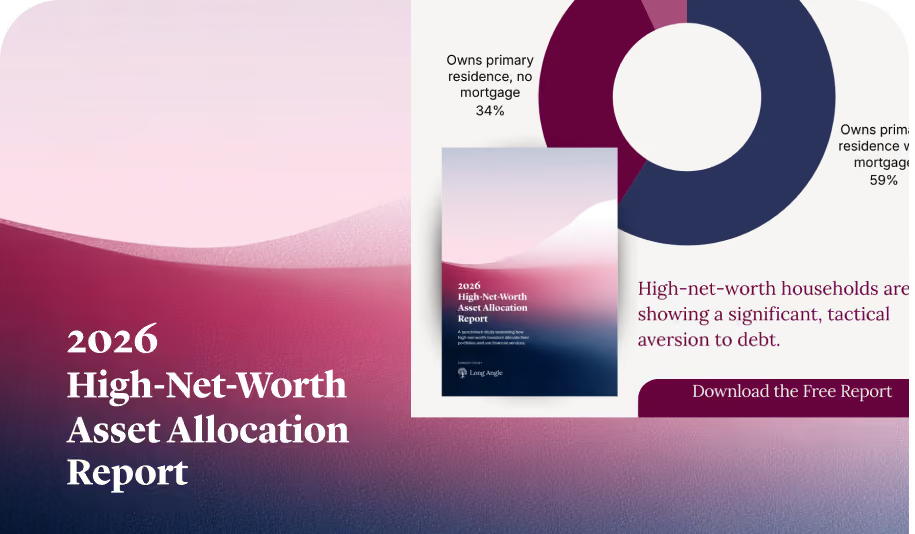
2026 High-Net-Worth Asset Allocation Report
See how high-net-worth investors with an average net worth of $17M are allocating across public equities, private markets, real estate, bonds and cash. Based on benchmark data from 230+ respondents.

What Are High-Net-Worth Mortgages?
HNW mortgages are crafted for people with abundant assets and high liquidity who might be seeking large loan amounts to facilitate the purchase of expensive properties or real estate projects.
High-net-worth mortgage lenders consider the borrower's complete financial picture to allow for more personalized and flexible solutions.
What Makes High-Net-Worth Borrowers Unique?
The financial profiles and property investments of HNW individuals have distinctive characteristics. These specialized mortgages address these unique needs:
- Larger Loan Amounts: The real estate deals of HNW individuals often require loan amounts that exceed the caps of standard mortgages.
- Complex Financial Situations: The wealthy possess more intricate portfolios combining diverse income sources, investments, and multinational assets—far more complex than standard mortgage products can handle.
- Tax Benefits and Financial Strategy: HNW mortgages often offer tax advantages, such as allowing borrowers to use portfolios as collateral without liquidating their assets.
- Privacy and Personalized Service: Specialized mortgage providers offer discreet services and personalized attention, assuring the confidentiality of their clientele.
- Speed and Flexibility: Providers offering specialized HNW mortgages can help wealthy clients close property deals quickly.

Benefits of a High-Net-Worth Mortgage
Customized Lending Solutions
Lenders work closely with clients to tailor mortgage terms to the specific needs of the borrower, structuring the loan to match cash flow requirements, investment timelines, and tax planning strategies.
Access to Larger Loan Amounts
Conventional mortgages cap loan amounts at federally set limits, but HNW mortgages cater to high-end purchasers of luxury properties and real estate investors.
Competitive Interest Rates
Lenders offer more competitive interest rates to high-net-worth individuals. Lower rates lead to significant cost savings over the life of the loan, making these loans advantageous for large-scale property investments.
Streamlined Underwriting Process
HNW mortgage lenders are accustomed to the complex financial affairs of wealthy clients and streamline the underwriting process, reducing the paperwork and time required for loan approval.
Enhanced Privacy and Security
HNW mortgage providers understand the importance of privacy for wealthy clients, offering enhanced confidentiality measures.
Integrated Wealth Management
HNW mortgage lenders often service their clients’ real estate investments as part of a broader financial strategy, including asset management, tax planning, and estate planning.
Types of High-Net-Worth Mortgages
HNW mortgages come in various forms:
Jumbo Mortgages
Designed for loan amounts that exceed the limits set by government-sponsored enterprises like Fannie Mae and Freddie Mac, jumbo mortgages are typically reserved for those financing luxury properties or premium real estate.
Adjustable-Rate Mortgages (ARMs)
These come with more favorable initial rates than those offered in traditional markets, which is good for those planning to hold a property for only a few years or expecting income growth to cover higher payments later.
Fixed-Rate Mortgages
With predictable payment schedules and rates that don’t change over the life of the loan, these are ideal for HNW individuals seeking stability, especially during volatile economic periods.
Interest-Only Mortgages
Interest-only loans allow borrowers to pay only interest on the mortgage for a period, after which they pay for the principal, too. This is well-suited to individuals expecting large cash inflows at a future date.
Balloon Mortgages
These have relatively low monthly payments, with a large payment due at the end of the mortgage term. This is suitable for HNW individuals who plan to sell the property or refinance the mortgage before the balloon payment “pops.”
Portfolio Mortgages
Kept in a lender’s investment portfolio and not sold on the secondary market, portfolio mortgages offer greater flexibility in terms and qualifications. They reflect the borrower's overall financial situation, not just assets, income, and credit score.

Challenges in Securing High-Net-Worth Mortgages
Despite the benefits, securing an HNW mortgage can present some challenges:
- Stringent Documentation Requirements: Borrowers must provide proof of income, asset statements, and tax returns, with considerably more paperwork than regular mortgages.
- Complex Income Structures: An intricate portfolio spanning investments, multiple businesses, and international ventures can complicate income calculation and risk assessment by the lender.
- Asset Verification: Similar concerns apply to assets, including overseas investments, which are hard to document, translate, and evaluate. This can add time and increase the risk of rejection.
- Legal and Tax Considerations: Large real estate transactions often involve arcane local laws and especially complicated taxation considerations when properties are overseas or the borrower holds dual citizenship.
- Risk Assessment: Lenders must assess the risks of lending large sums of money. The higher the loans, the more careful the lender must be, even with the affluent.
- Privacy Concerns: The wealthy require higher confidentiality in their financial dealings, an acute concern when lenders evaluate mortgage applications.

How to Qualify for a High-Net-Worth Mortgage
Prepare Comprehensive Financial Documentation
Ensure all financial documents are up-to-date and readily available: tax returns, bank statements, investment account statements, proof of assets, etc. Prepare for paperwork.
Strengthen Your Credit Score
Clear any outstanding debts and ensure your credit report is free from errors and black marks.
Demonstrate Sufficient Income and Assets
You’ll need to prove stable and sufficient income to cover new mortgage payments on top of your other financial obligations and demonstrate the extent and liquidity of your assets.
Evaluate Your Debt-to-Income Ratio
Keep your debt-to-income ratio low by reducing your debts, assuring lenders that you can handle the extra obligations.
Get a Professional Appraisal
For HNW mortgages, secured against luxury properties or high-end real estate, get a professional appraisal to establish the value of the property being mortgaged.
Work with Specialized Lenders
Banks, credit unions, or private lenders specializing in this area are experienced in the nuances of HNW mortgages.
Consult with a Financial Advisor
Financial advisors experienced in HNW mortgages can provide insights and guidance throughout the application process, helping to optimize your portfolio, prepare your paperwork, and improve your chances of approval.
One often underestimated factor in evaluating HNW applications is how your property assets are allocated. It’s a great idea to check out Long Angle’s guide to HNW real estate asset allocation to help optimize your qualification profile.

Final Thoughts
High-net-worth mortgages are complex, but they are often worth the hassle. Understanding the nuances of these specialized loans helps you secure better terms for high-end properties.
By joining an exclusive high-net-worth community like Long Angle, you can connect with peers with experience in high-end real estate. Apply to join our HNW community and benefit from the collective know-how of like-minded colleagues.
Frequently Asked Questions
How much of a high-net-worth portfolio should be in real estate?
There is no universal answer, but Long Angle's benchmark data shows members averaging roughly 11% across home equity and investment real estate — lower than the 20-30% range often cited by advisors. That figure reflects investors who are also allocating to private equity, private credit, and public markets. The right allocation is the one that fits within your full portfolio given your liquidity needs, tax situation, and return objectives.
What is the difference between LP-led and GP-led real estate secondaries?
LP-led secondaries occur when a limited partner needs liquidity and sells their fund stake at a discount — typically 20% or more off NAV — driven by their own financial needs rather than the performance of the underlying assets. GP-led secondaries are initiated by the fund manager, often to extend the fund's life or provide liquidity to some LPs. They tend to trade closer to NAV, at 0-5% discounts, and require more scrutiny of incentive alignment because the GP is on both sides of the transaction.
Why are non-traded private REITs riskier than they appear?
Non-traded REITs determine their own NAV, and the methodology matters significantly. Some large vehicles used discounted cash flow models during the rate-rising cycle rather than cap rate models, which masked the impact of rising rates on asset values. The result was a stated NAV that did not reflect what public markets were pricing for comparable assets. Investors who relied on that NAV for allocation or redemption decisions were working from a misleading number.
How do real estate debt funds compare to BDCs for yield-seeking investors?
Both offer yield in the 9-13% range, but institutional BDCs generally offer better underwriting, larger and more experienced teams, greater diversification across borrowers, and public market liquidity. Small and mid-market real estate hard money funds may offer similar headline yields, but limited workout capacity and higher opacity at the smaller end of the market reduce the risk-adjusted appeal. For most investors, institutional credit managers represent a better trade-off at comparable yield levels.
Which real estate sectors offer the most opportunity in 2026?
Multifamily in supply-constrained markets is showing realistic entry prices after 25-30% corrections from 2022 peaks. Build-to-rent continues to attract interest due to the US housing shortage. Self-storage and manufactured housing may see more distressed opportunities in the second half of 2026 as loan maturities arrive. Hotels are creating regional buying opportunities as institutions exit and lender-forced sales come to market.
What is a cap rate and why does it matter for real estate allocation decisions?
A cap rate (capitalization rate) is calculated by dividing a property's net operating income by its current market value. It functions as a yield measure for real estate. When interest rates rise, cap rates tend to rise too — which means asset values fall to maintain the spread over risk-free rates. The disconnect between how quickly public REITs repriced and how slowly private real estate valuations adjusted is the core risk in non-traded private vehicles. Whether a vehicle's stated value reflects current cap rate assumptions is one of the most important questions an investor can ask.
How does real estate fit into an overall alternative investment allocation?
Real estate typically functions as an income-generating and inflation-sensitive component of the alternatives sleeve, distinct from private equity (growth-oriented, longer duration, less cash flow) and private credit (higher in the capital stack, more protective). At the 10-15% range that Long Angle members tend to show, real estate sits alongside meaningful allocations to private equity and private credit rather than dominating the alternatives sleeve. The right balance depends on how each component behaves in the macro scenarios most relevant to your portfolio.
Jumbo mortgage terms vary more than most borrowers expect going in.
Long Angle is a free, vetted community of founders, executives and investors who compare notes on jumbo mortgages, lenders and rates with peers who have made the same calls, and no one in the room is selling anything.
More From Long Angle
Beyond Wealth Newsletter
Navigating Wealth Podcast
Research & Studies
Alternative Investment Education
Blog