Written by Ryan Morrison



Investing in Music Royalties: What High-Net-Worth Investors Need to Know
Based on a Navigating Wealth conversation with Jason Peterson
Investing in Music Royalties: What High-Net-Worth Investors Need to Know
Investing in music royalties gives high-net-worth investors access to a long-duration income stream with no maintenance costs, low market correlation, and a royalty base that grows without new recordings. Jason Peterson, CEO of Go Digital, explains how the two-copyright structure works and where the real opportunity sits today.
Ryan Morrison
Music royalties have attracted serious institutional capital for years. What changed recently is the access layer — and the asset class itself. Streaming reversed a decade of piracy-driven decline, AI settled as a licensing opportunity rather than a copyright threat, and emerging markets are adding a compounding growth dimension that earlier buyers never had. Jason Peterson is the founder, chairman, and CEO of Go Digital, a company he started in 2005 that now manages nearly $1 billion in music IP assets across several hundred thousand copyrights worldwide. His view on investing in music royalties is not theoretical. It comes from two decades of acquiring, managing, and compounding catalogs — including Daddy Yankee, T.I., and Jason Derulo.
Music royalties are income streams generated every time a song is streamed, broadcast, licensed for film or television, or performed publicly. Investors access them by acquiring one or both of the two copyrights embedded in every recorded song: the master recording and the publishing rights. Once acquired, a catalog generates royalties for decades with no maintenance costs, no physical depreciation, and low correlation to public markets — making it structurally similar to a very long-duration fixed-income asset with an equity-like growth component.
Key Takeaways
- Every recorded song contains two separate copyrights — the master recording and the composition — and investors can acquire either, both, or a fractional share of each
- Under US law, music copyright protection lasts for the life of the author plus 70 years, making a catalog acquired today a potential century-long income stream
- Streaming permanently expanded the royalty base by making legal consumption more convenient than piracy, solving a problem that had damaged the industry for a decade
- Catalogs compound without new recordings: one catalog in Go Digital's portfolio generates approximately twice its original royalty income eight years after acquisition with no new music released
- AI companies are now licensing music catalogs directly rather than using unlicensed training data, creating a new royalty income stream that did not exist five years ago
- The fastest royalty growth today is in emerging markets where streaming penetration is still expanding — Latin America, West Africa, Southeast Asia, and South Korea
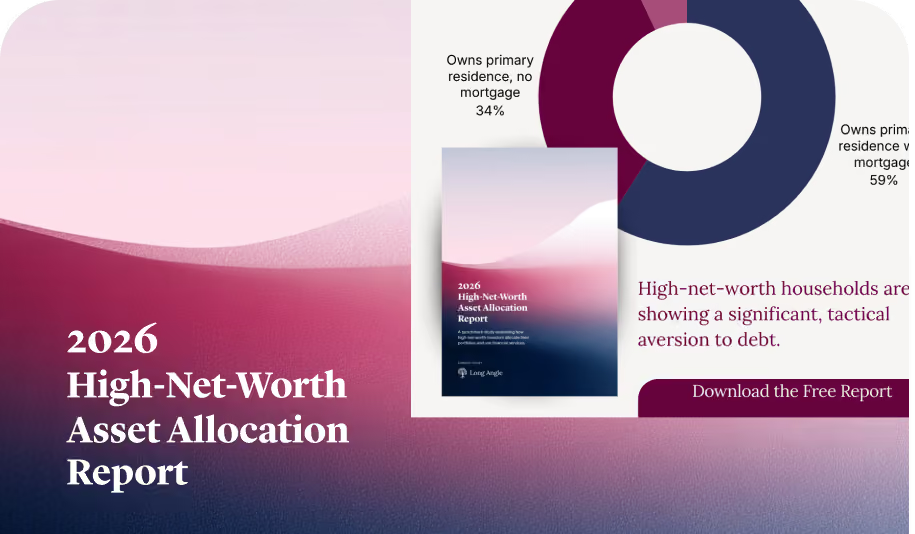
2026 High-Net-Worth Asset Allocation Report
See how high-net-worth investors with an average net worth of $17M are allocating across public equities, private markets, real estate, bonds and cash. Based on benchmark data from 230+ respondents.
How Do Music Royalties Work?
Music royalties are payments made to rights holders every time a song is streamed, broadcast on radio, licensed for a film or TV production, or performed publicly. They flow through a collection infrastructure — performance rights organizations like ASCAP and BMI for radio and live performance, mechanical royalties for streaming and downloads, and sync licensing fees for commercial and editorial placements — and they arrive whether or not the underlying artist records another song.
What changed the investment case for catalog buyers was streaming. Peterson describes the shift using what he calls the bottled water analogy: in the Napster era, music was effectively free. But free had a cost. An adult earning $20 an hour could spend three minutes finding a song on a peer-to-peer network, risk downloading malware and a corrupted file, or pay a dollar on iTunes and have it instantly. As earning power rose, the time threshold fell. Legal consumption became the economically rational choice — the same reason people buy bottled water at Disneyland even though tap water is free. Quality assured, delivered instantly, and the opportunity cost of the alternative is too high.
Streaming took that logic to its natural conclusion. For $12 to $15 a month, a listener gets the entire history of music on every device. That offer competes with free in a way a dollar-per-download model never could. According to IFPI's Global Music Report 2025, global recorded music revenues reached $29.6 billion in 2024, the eleventh consecutive year of growth, with streaming revenues exceeding $20 billion for the first time. The royalty base that piracy had nearly destroyed is now larger than it has ever been — and it compounds without requiring new recordings from the artists whose catalogs are held.
For investors evaluating how alternative assets differ from traditional investments, music IP sits in an unusual position: the income is contractual, the duration is measured in decades, and the underlying asset has no physical form to depreciate.
Watch the Full Conversation
This article draws on a Navigating Wealth conversation with Jason Peterson, founder, chairman, and CEO of Go Digital, where we discuss how music royalties work as an investment, why artists sell their catalogs, the platform economics reshaping the industry, and where the emerging markets opportunity sits today. Watch the full episode for the broader discussion.
Subscribe on YouTube · Get weekly episode updates
Jason Peterson is the founder, chairman, and CEO of Go Digital, a music IP rights management company he founded in 2005. Go Digital manages nearly $1 billion in music IP assets across several hundred thousand copyrights worldwide, with a focus on large and fast-growing emerging markets. Peterson began his career as a film and commercial producer and holds degrees from business school, film school, and Pepperdine University School of Law.
The Two Copyrights Every Investor Should Understand
Every recorded song contains two separate copyrights — the master recording and the musical composition — and investors can acquire either, both, or a fractional share of each.
The master recording covers the specific recorded version of the song: the performance, the production, the particular artifact that was captured in a studio. This is typically owned by the performing artist or their record label. The musical composition covers the underlying melody and lyrics as written — what you would see on sheet music. This is owned by the songwriter and their publisher, and it applies to every version of the song ever recorded by anyone.
Peterson explains the distinction in terms that make the investment logic clear. If one of the podcast hosts wrote a commercially released song, all three of the other hosts could legally record their own version of it. They would simply owe the songwriter the statutory royalty rate each time they exploited their recording. The composition generates income from every cover, every sync use, every performance — regardless of which recording is used.
The Taylor Swift re-recording situation illustrates exactly how these two rights interact. Her original recordings were owned by Big Machine Records. But her compositions were hers. When the contractual restriction on re-recording expired, she made new recordings of her own songs. Her original masters — owned by Ithaca Holdings — were not destroyed by this. In Peterson's telling, the re-releases actually created renewed interest that helped the original catalog. She is, as he describes her, a phenomenon of one: her recorded music market share globally reportedly exceeds four percent, making her alone nearly the size of a major label.
When Go Digital acquires a significant catalog, it includes a contractual provision that the artist will not re-record without consultation. The Taylor Swift situation was possible because no such restriction existed in perpetuity. For institutional buyers, that provision is now standard.
Why Music Catalogs Grow Without New Hits
A music catalog can increase its royalty income over time without any new recordings because streaming surfaces back catalog to audiences continuously and globally.
The compounding mechanism works like this: a song recorded in 1994 finds new listeners every day. Streaming algorithms surface catalog music to people who were not alive when it was made. A 19-year-old in São Paulo discovers an artist through a playlist recommendation, streams that catalog repeatedly, and generates royalties for a rights holder who has not invested a dollar in new production. The market does not require new releases to grow.
Peterson points to the T.I. catalog as the clearest proof point in his own portfolio. Go Digital acquired that catalog in May 2017. Today, eight years later, it generates approximately twice the royalty income it produced at acquisition. No new hits. No new recordings. The growth came entirely from market expansion — more subscribers, more markets, more streams on existing catalog.
The duration structure reinforces this. Under US copyright law, protection for works created after January 1, 1978 lasts for the life of the author plus 70 years; for joint works, the clock starts at the death of the last surviving co-author. A catalog acquired today from a 40-year-old artist could generate royalties for well over a century. Peterson describes this as a 100-year annuity — one that, unlike most annuities, is actually growing. There are no property taxes. No maintenance costs. No tenants to manage. The asset is pure income stream with a very long tail.
This is where music IP begins to look genuinely different from most private market alternatives. High-net-worth investors typically allocate roughly 28% of their portfolios to private and alternative assets — but most of those allocations involve assets with maintenance requirements, capital calls, and finite holding periods. Music catalog does not.
Why Artists Sell Their Music Catalogs
Artists sell their catalogs primarily to convert a long-duration income stream into immediate capital, driven by tax treatment, personal liquidity needs, or the desire to redeploy equity into new ventures.
Peterson identifies three primary motivations. The first is tax. Bob Dylan's sale was explicitly tax-motivated. At the time, capital gains rates were low, and trading decades of future royalty income for an immediate lump sum taxed at long-term capital gains rates made the math work. Catalog sales are typically taxed at long-term capital gains rates rather than ordinary income — a meaningful difference at the highest income levels, where traditional catalog multiples of 8 to 12 times net publisher share have historically been the norm, with peak multiples reaching 20 to 30 times during the 2019 to 2022 acquisition boom.
The second motivation is personal liquidity. Divorce is common. An artist whose primary asset is a catalog needs to produce liquidity in order to settle with a spouse. The catalog is illiquid until it is sold or partially monetized, and a partial sale to a buyer like Go Digital — where the rights holder retains a fractional interest while receiving an upfront payment — is often the practical solution.
The third reason is the present-value calculation. In the CD era, an artist made most of their money in the first six months after release. They had a pile of cash and could reinvest immediately. In the streaming era, that same economic value arrives as a smaller payment every month for a hundred years. In present-value terms, depending on the discount rate, the streaming model may actually be worth more in aggregate. But many artists cannot or do not want to wait two decades to realize that value. They have things to buy, reinvest in, or protect now. Factoring that future value to the present is simply a capital allocation decision, the same one any HNW individual makes when evaluating whether to sell a concentrated position or hold.
Music Royalties vs. Real Estate: A Direct Comparison
Music IP and real estate share structural similarities as long-duration income assets, but music catalogs carry no maintenance costs, no physical depreciation, and no management overhead.
Peterson makes the comparison directly. Real estate at the right location — beachfront, he says — is a strong asset. But even beachfront property has vacancy rates, maintenance requirements, property taxes, and the ongoing management work of keeping it occupied. Music IP has none of that. The tenant is the global streaming infrastructure, and it pays royalties every day without a lease negotiation or a repair call.
The chart below maps the two asset classes across the dimensions that matter most for portfolio decision-making.
The key structural difference is the growth dynamic. Real estate appreciates based on location, physical condition, and local supply-demand. Music catalog royalties grow because more people are streaming, more markets are coming online, and the underlying catalog keeps finding new audiences without requiring new investment. A real estate asset improves when capital is deployed into it. A music catalog improves when the market grows around it.
For high-net-worth investors evaluating real estate allocation, music IP offers an instructive contrast: similar income profile, similar private-market illiquidity, but with the operational overhead removed and a technology-driven growth component added.
How Streaming and Platform Economics Changed the Investment Case
Streaming converted music from a piracy-damaged industry into a growing royalty base, while simultaneously creating a structural dynamic in which the largest technology companies in the world have an incentive to keep that royalty base expanding.
Peterson explains the platform economics with a single example. Amazon spent approximately $1 billion producing The Rings of Power — $200 million for the rights and $800 million to produce 16 episodes, roughly $50 million per episode. When he asked the team whether they intended to profit from the show directly, the answer was no. The show existed to acquire and retain Amazon Prime subscribers. The content is the customer acquisition cost, not the product. Amazon's lifetime value from a subscriber — across e-commerce, Prime shipping, cloud services, and everything else in the ecosystem — dwarfs the revenue contribution from a streaming subscription. The content budget makes sense because the customer it acquires is worth far more than the content cost.
Apple Music and Amazon Music operate on the same logic. Neither platform needs to profit from music. They need music to keep users in their ecosystems — buying devices, using cloud storage, staying subscribed. That structural incentive means the largest technology companies in the world are permanently motivated to grow the streaming market. Catalog holders benefit from that growth passively.
The Spotify equity deal demonstrates how music companies have learned to negotiate inside this dynamic. When Spotify launched, the major labels — Sony, Universal, Warner, and the Merlin collective of independent labels including Go Digital — accepted below-market royalty rates in exchange for equity in Spotify. When Spotify went public, that equity returned billions. The labels made the same mistake earlier with Apple, accepting favorable terms on iTunes without taking equity. They did not repeat it with Spotify. The industry is now negotiating equity positions with AI companies on the same basis.
The lesson for catalog investors is structural: the largest platforms in the world are incentivized to grow the market that generates royalty income. That tailwind does not require any action from the catalog holder.
AI and Music Royalties: A New Income Stream
AI companies are now licensing music catalogs directly rather than using unlicensed training data, creating a royalty income stream that did not exist five years ago.
The initial industry concern was that generative AI would devalue catalog IP by flooding the market with synthetic music and creating legal uncertainty around training data. Neither outcome materialized in the way the concern suggested. Faced with substantial legal exposure — with cases filed against companies including 11 Labs, Suno, and Udio — AI companies moved toward licensing agreements rather than litigation losses. Peterson notes that several of these agreements settled recently, resulting in licensing terms that he describes as favorable. Go Digital is party to some of them.
The noise floor problem — the risk that AI-generated content would dilute royalty pools by claiming small fractional payments from a massive number of low-stream tracks — is also being managed structurally. Spotify and other premium platforms have implemented minimum stream thresholds for monetization. Recordings that receive fewer than a thousand streams are demonetized — excluded from the revenue-sharing calculation. That policy protects established catalog income while effectively filtering out the long tail of synthetic tracks that no meaningful audience is listening to.
The net effect is that AI resolved as an additional income stream rather than an existential threat. The industry learned from its earlier mistakes with Apple and Google — accepting unfavorable terms without equity — and negotiated from a position of legal and cultural strength with AI companies instead. Catalog holders now receive royalties from AI training use in addition to streaming, radio, and sync income. That is a new cash flow that did not exist at acquisition for any catalog bought before 2020.
The Emerging Markets Thesis
The fastest-growing royalty income in music today is not in legacy Western catalogs but in markets where streaming penetration is still expanding — Latin America, West Africa, Southeast Asia, and South Korea.
Peterson's framework for emerging markets is specific. He looks for leading indicators: smartphone penetration, high-speed wireless availability, banking participation rates, and the growth of a middle class with discretionary income to spend on digital subscriptions. When those indicators are low, catalog prices reflect current revenue. When they converge toward Western levels, royalty income grows structurally — not because the music gets better, but because the infrastructure to monetize it catches up to the size of the audience.
Latin music is the most mature proof point. Fifteen years ago, smartphone penetration and banking participation rates across Central and South America were a fraction of current levels. Go Digital entered the market early, beginning a relationship with Daddy Yankee in 2009. Over the following decade, those leading indicators matured across the region. Banking participation in some markets rose from roughly 10 to 20 percent to 50 to 70 percent. People who could not previously purchase digital subscriptions can now. The revenue from Latin catalog has grown accordingly — and continues to grow, because the United States alone has 62 million residents who identify as Hispanic, making it the second-largest Spanish-speaking country in the world by that measure. IFPI's 2025 Global Music Report confirms this trajectory: recorded music revenues in Latin America grew 22.5% in 2024, with Sub-Saharan Africa growing 22.6% and the Middle East and North Africa growing 22.8% — all dramatically outpacing the global average of 4.8%.
The formula Peterson describes is simple: acquire music from markets that are going to be consumed in mature markets. Colombian music consumed in the United States. Nigerian Afrobeats consumed in the UK and European diaspora communities. Indonesian pop consumed by a domestic market of 270 million people as smartphone penetration reaches scale. K-pop, which has already demonstrated that non-English language music can achieve global streaming reach.
For alternative investments for high-net-worth individuals, the emerging markets dimension adds a growth component that most fixed-income alternatives lack: not just a stable income stream, but one with a structural tailwind from demographic and infrastructure convergence across several of the world's largest populations.
What Investing in Music Royalties Actually Looks Like
For institutional and high-net-worth investors, music royalty exposure typically comes through specialized funds or direct catalog acquisitions — not fractional retail platforms.
The access spectrum runs from retail to institutional. Platforms like Royalty Exchange, ANote, and SongVest allow individuals to purchase fractional interests in individual royalty streams, usually at relatively small minimums. These are legitimate products for retail investors seeking exposure. For HNW investors, the more relevant vehicles are institutional fund structures, where a manager like Go Digital, Hipgnosis, or Primary Wave acquires and manages catalogs at scale, and distributes royalty income to limited partners.
Go Digital's model adds an active management layer that Peterson describes using the real estate rehabilitation analogy. Buying a catalog with strong underlying IP but underperforming sync placement is like buying a well-located but dilapidated apartment building. The asset has good bones. The work is operational: improving sync licensing placements, expanding streaming surface area, connecting the music to brand partnerships and live experiences. When that work raises the royalty income, the catalog value increases — and the financing model lets a buyer borrow against that appreciated value to acquire additional catalogs. Rinse and repeat. This is structurally the same as a real estate operator who rehabs a building, raises rents, refinances at the higher value, and deploys the proceeds into the next acquisition. Except there are no renovation costs, no contractors, and no physical asset to manage.
The key diligence questions for any music IP investment are consistent: which copyrights are being acquired (master, publishing, or both), what is the documented royalty collection history, what is the sync licensing opportunity, what is the streaming trajectory across relevant markets, and what are the terms of any AI licensing agreements in place. Understanding the range of private market asset classes and strategies that sit alongside music IP helps frame where it fits in a broader allocation.
Go Digital closed a $230 million raise from Bank of America, Mitsubishi, and other institutional partners, with the capital directed primarily toward acquiring additional rights in large and fast-growing emerging markets outside the English-language mainstream. That financing structure — institutional debt against a catalog of income-producing IP — is how the asset class operates at scale.

Frequently Asked Questions
What are the two types of music royalties and why do they matter for investors?
Every recorded song contains two separate copyrights: the master recording, which covers the specific performance captured in the studio, and the musical composition, which covers the underlying melody and lyrics. Investors can acquire either or both. Composition rights generate income from every version of the song ever recorded — covers, sync licenses, and public performances — while master recording rights generate income from streams and broadcasts of the specific recording held.
How long does a music copyright last?
Under US law, copyright protection for works created after January 1, 1978 lasts for the life of the author plus 70 years. For works with multiple co-authors, the clock starts at the death of the last surviving co-author. A catalog acquired today from a living artist could generate protected royalty income for over a century.
How are music catalogs valued?
Catalogs are typically valued as a multiple of net publisher share — the annual royalty income after collection costs. Historically, that multiple has ranged from 8 to 12 times NPS for most catalogs. During the acquisition boom of 2019 to 2022, premium catalogs traded at 20 to 30 times NPS. Current multiples reflect both the quality of the underlying catalog and the buyer's view of the royalty income growth trajectory.
Is music IP correlated with the stock market?
Music royalty income is driven by streaming subscriptions, radio licensing, and sync placements — none of which are directly tied to equity market performance. Streaming subscription growth has continued through economic downturns. The asset class is generally considered to have low correlation with public equity markets, which is part of its appeal for portfolio construction purposes.
What did the Spotify equity deal mean for music rights holders?
The major labels and the Merlin collective of independents — including Go Digital — exchanged below-market royalty rates during Spotify's early growth years for equity in the platform. When Spotify went public, that equity returned billions to the industry. The labels had made the opposite mistake with Apple, accepting favorable royalty terms on iTunes without taking equity. The Spotify deal corrected that error, and the industry is now pursuing equity positions with AI companies on the same basis.
When is the right time to leave a corporate role for private equity?
Late 30s to early 40s is the typical window for most executives. Early enough to bring genuine energy to a five-year build, and late enough to have a credible track record. The non-financial question is whether the decision is reversible: could you find a comparable corporate role if the PE-backed company did not work out? If the answer is yes, the downside is manageable. The "what if" question is the more important one: if you do not try, will you spend years wondering?
How does AI affect the value of a music catalog?
AI resolved as a new income stream rather than a threat. Following litigation against AI companies including 11 Labs, Suno, and Udio, the industry secured licensing agreements that generate royalty payments for catalog holders whose music was used in AI training. Simultaneously, streaming platforms implemented minimum stream thresholds that demonetize low-volume AI-generated content, protecting the revenue share of established catalog.
Can high-net-worth investors access music royalties outside of retail platforms?
Yes, through institutional fund structures managed by firms that acquire and manage catalogs at scale. These vehicles operate similarly to other private market funds: an investment manager sources and underwrites catalog acquisitions, manages the royalty collection and licensing operations, and distributes income to limited partners. Minimums and access vary by manager.
Final Thoughts
Music IP is not a new asset class. Major labels have owned catalog rights for decades and built substantial businesses around them. What changed is the structural tailwind. Streaming permanently expanded the royalty base after piracy had nearly destroyed it. AI resolved as a licensing opportunity that added a new income stream to existing catalogs. Emerging markets are adding a growth dimension that Western catalog buyers of a prior generation never had access to.
For allocators thinking about the benefits of alternative investments — income, low correlation, long duration — music IP sits at an unusual intersection. The income is contractual and diversified across streaming, radio, sync, and AI licensing. The duration can exceed a century. The asset requires no maintenance, no capital improvement, and no physical management. The growth comes from market forces that the largest technology companies in the world are structurally motivated to continue expanding.
The diligence questions are real and the access constraints are real. Not every music IP fund is equal, the two-copyright structure creates complexity, and emerging markets carry the risks of any early-stage market entry. But the asset class itself has moved from speculative to institutional. The income stream works, the legal framework is established, and the tailwinds are structural rather than cyclical.
Resources Mentioned
Most allocators encounter music royalties through a pitch, not a peer conversation.
Long Angle is a vetted community of 8,000+ high-net-worth founders, executives, and investors where members compare notes on alternative investments with no one in the room trying to sell anything. When a member asks whether a music IP fund belongs in their portfolio, the answers come from peers who have evaluated the same manager, reviewed the same diligence materials, or allocated to a comparable strategy — not from a placement agent. The environment is solicitation-free. Recommendations come from experience.
More From Long Angle
Beyond Wealth Newsletter
Navigating Wealth Podcast
Research & Studies
Alternative Investment Education
Blog