Written by Chris Bendtsen

How to Invest in Oil and Gas: A Guide for Private Investors
How to Invest in Oil and Gas: A Guide for Private Investors
How private oil and gas funds make money: upstream economics, a shale well's return profile, the tax treatment, and the risks that decide outcomes.
Chris Bendtsen
Private oil and gas investing means committing capital to a fund that buys producing wells and undeveloped acreage across U.S. basins, then earns returns first as production income and later as sale proceeds. Most private capital goes upstream, into mineral rights, development and production rather than exploration. A modern shale well pays back initial capital in 12 to 24 months, and full-life distributions typically run 2.5x to 3.0x, with combined programs targeting a 20% to 30% net IRR. Returns hinge on entry price, commodity hedging and manager execution.
Key Takeaways
- Upstream splits into four components by risk: mineral rights (lowest), production, development, and exploration (highest)
- A shale well's output declines roughly 70% in the first year, then produces on a long, low tail for 30 to 40 years.
- Programs target a 20% to 30% net IRR and 2.5x to 3.0x on invested capital, with payback in 12 to 24 months.
- Manager selection is the dominant risk: operated returns turn on execution, and the dispersion between the best and worst managers is wide.
- These are multi-year, illiquid commitments, and much of the return is realized at exit, so entry timing and exit pricing are material risks.
2026 High-Net-Worth Asset Allocation Report
See how high-net-worth investors with an average net worth of $17M are allocating across public equities, private markets, real estate, bonds and cash. Based on benchmark data from 230+ respondents.

A private oil and gas fund is a pooled vehicle that invests in the wells and acreage that produce crude oil and natural gas. Investors commit capital, the manager acquires producing assets and undeveloped acreage across U.S. basins, and the wells generate revenue as they produce. Returns flow back first as income and later as proceeds when the assets are sold, so the asset class behaves like a portfolio of operating businesses whose product is a commodity. This guide explains how the oil and gas industry works and how private capital participates.
Oil and Gas Geology
Oil and natural gas form in sedimentary rock buried deep enough, and for long enough, to convert ancient organic material into hydrocarbons. In conventional reservoirs the hydrocarbons migrated into porous rock capped by an impermeable layer, where they collect under natural pressure and can be produced from a single vertical well.1
Most U.S. production now comes from shale, where the hydrocarbons stay locked in the fine-grained rock in which they formed. That rock has too little permeability for oil and gas to flow on its own, so shale wells require horizontal drilling and hydraulic fracturing, or fracking, to create pathways for production. Shale has gone from a negligible share of U.S. output two decades ago to over 60% of total U.S. oil and gas production today, and a larger share still of new drilling.2

A shale formation's output ranges along a spectrum from nearly all liquid oil to all gas, depending on the temperature and pressure the rock experienced as it formed. The same rock layer can sit in an "oil window" in one part of a basin and a "gas window" a short distance away.
From conventional to shale
Horizontal drilling and fracking were each used for decades before shale became a major source, but they were uneconomical in low-permeability rock. Operators experimented through the 1980s and 1990s, pairing long horizontal wellbores with multi-stage fracturing. By the mid-2000s they could drill a horizontal well and fracture it in dozens of discrete stages, exposing far more rock to the wellbore than a vertical well ever could.2
That combination turned shale into the primary source of U.S. production growth, and it remains the central technology private operators use today. Refinements continue to extract more from the same acreage, including longer laterals, tighter well spacing, and techniques to re-stimulate older wells.
The major U.S. basins
Private oil and gas capital is concentrated in a handful of basins, each with its own geology and production profile:2
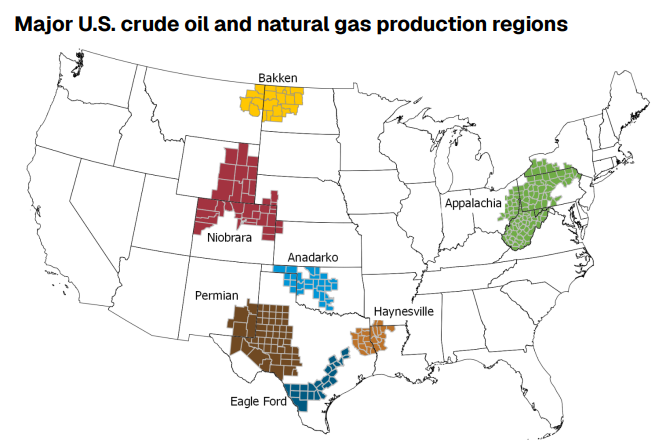
Permian Basin (West Texas and southeastern New Mexico): The largest and most active U.S. shale play, split into the Midland and Delaware sub-basins. Multiple stacked, productive intervals, primarily the Wolfcamp and Spraberry/Bone Spring formations, allow operators to develop several benches from the same acreage. Production is a mix of oil and gas that varies by sub-basin and depth.
Eagle Ford (South Texas): One of the first major shale plays developed, running in bands from an oil-rich window in the north to a dry-gas window near the Mexican border, with a condensate and wet-gas band in between.
Bakken (Williston Basin, North Dakota and Montana): The first shale oil play developed at scale, discovered in the 1950s but not commercially unlocked until the horizontal-drilling era beginning in the late 1990s and 2000s. Predominantly an oil play.
Anadarko Basin (western Oklahoma and Texas Panhandle): A long-producing region whose modern activity is concentrated in the SCOOP and STACK plays, producing a mix of oil and natural gas.
Haynesville (East Texas and northwest Louisiana): A dry-gas play whose development has tracked the buildout of Gulf Coast LNG (liquified natural gas) export capacity.
Appalachian Basin: Marcellus and Utica (Pennsylvania, West Virginia, Ohio): The Marcellus is the largest U.S. natural gas play by volume, dominated by dry gas. The underlying Utica is a hybrid play with more oil production toward its western edge in Ohio.
DJ Basin (Colorado) and Powder River Basin (Wyoming): Home to the Niobrara formation, predominantly oil-producing with associated gas. Smaller, less-developed shale plays extend into the Piceance and Uinta basins of Colorado and Utah, which skew more gas-prone.
California: Hosts significant conventional and legacy oil production, including the geologically complex Monterey Shale, but has seen little unconventional development. A more challenging regulatory environment has limited new activity, and the state is not a common destination for the type of private capital this guide addresses.
Understanding the Asset Class
The value chain
Oil and natural gas share a common value chain, since any given well can produce a mix of the two. The industry splits into three stages, tracing oil and gas from the ground to the end user:
- Upstream refers to finding and producing oil and gas.
- Midstream is moving and processing what’s produced.
- Downstream is turning the commodities into finished products for retail.
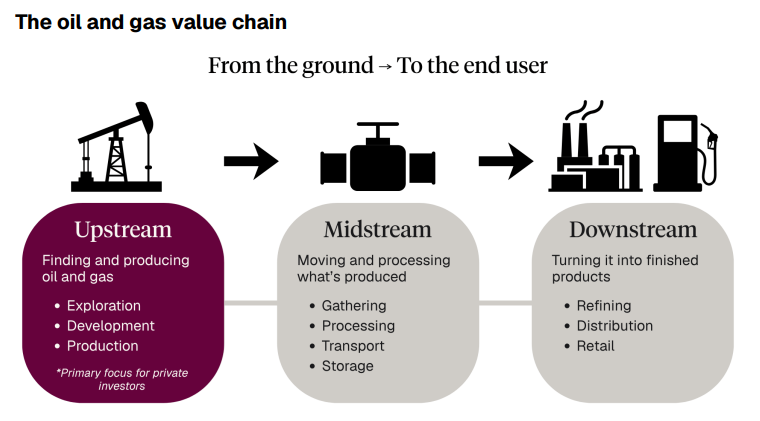
Upstream is the primary focus for private investors because independent operators allow participation in specific segments. Private midstream is accessed mainly through infrastructure funds, though upstream operators sometimes integrate midstream assets to improve economics and make the combined asset more attractive at exit. Midstream and downstream opportunities are largely accessed through public markets (Master Limited Partnerships and individual stocks).
Upstream components
Upstream oil and gas: 4 investable components
Mineral rights
In the United States, ownership of underground minerals is originally assigned to the landowner (e.g., a rancher). The owner may lease these rights directly to an exploration and production operator or sell them separately from the surface rights, creating a standalone asset class. Due to intergenerational inheritance and legacy transactions, mineral rights are often split into fractional shares held by multiple owners. While mineral owners historically received 1/8 of revenue, modern lease shares range up to 1/4. Leases typically run 3–5 years and expire unless the operator begins drilling. Once a well produces, the lease is "Held by Production," meaning it remains in effect for as long as the well produces in paying quantities. If production ceases, the lease can terminate and the rights revert to the mineral owner.
Exploration
Exploration encompasses the search for new reserves through geological analysis and exploratory drilling. It carries the highest risk and highest potential reward across the value chain, driven by “wildcat” wells that are drilled far from proven fields. Exploration plays a much smaller role in private energy today than in past decades, as advanced technology and mapping have improved our understanding of U.S. basin geology.
Exploration-focused companies aren’t normally specialists in long-term operation. Once acreage is proven and producing, it often no longer fits their return objectives, so they sell those assets and reinvest in new prospects. This creates a natural handoff to the development and production strategies covered next.
Development
Development is the drilling of production wells on acreage already proven by nearby wells. Standard U.S. onshore development relies on “unconventional” techniques like horizontal drilling and hydraulic fracturing, which have shortened drilling times, increased production predictability, and front-loaded production volumes. While development still carries geological uncertainty in less proven formations, returns depend primarily on operating costs and commodity prices. Operating costs are driven by basin geology, regional infrastructure (like pipelines and water handling), and operator scale.
Development involves the highest executional complexity in upstream investing. Skilled operators can optimize production and reduce per-barrel costs in the same geology, while using financial hedging to mitigate commodity price volatility.
Production
Production involves the operation of drilled wells over their lifespan. Over time, as pressure in a well drops, its production naturally declines. At the end of a well’s economic life, there is almost always a significant amount of hydrocarbon remaining in a formation. With technological advances, operators have significantly increased the share of the resource that is economically recoverable, using techniques like “artificial lift” and well “recompletion.” These methods are especially valuable for unconventional wells, which generally have much faster decline curves than conventional ones.
Many investments include both development and production, as operators control acreage that includes existing and new wells. Production carries a moderate risk between mineral rights and development, with returns driven by purchase price, decline curves, execution quality, commodity prices, and financial hedging to lock in future sale prices. It is worth noting that a given well’s production tends to decline most steeply initially after drilling and has a shallower decline curve later in life. This means that older wells, while lower in absolute volume, are more predictable in output and can be sold to new purchasers.
Operated vs. non-operated positions
Within both development and production, the economic exposure is often shared across multiple parties through working interests. These are leasehold ownership positions that obligate owners to pay a share of drilling and operating costs in exchange for that same share of net revenue. Private funds participate in working interests in two ways:
Operated positions: The fund manager holds a working interest and directly controls field operations. This grants full oversight of drilling schedules, vendor costs, and well completions. Operated positions require significant in-house technical and operating expertise.
Non-operated positions (Non-Op): The fund buys a working interest as a passive partner, leaving operational decisions to a third-party operator. Non-Op allows funds to deploy capital and diversify across basins without building an operating team. The tradeoffs are less control and slimmer margins.
Asset-Level Return Drivers
Shale well economics
Unlike conventional wells, which carry high search risk and slow payback, shale development in known formations shifts the challenge from finding hydrocarbons to extracting them efficiently and accurately predicting the initial volume and decline rate of a well (collectively known as the “Type Curve” of the well).
A modern shale well typically takes six to twelve months from project commitment to first production, although the actual drilling process is much shorter. Output spikes sharply and drops steeply early on, typically declining around 70% or more in the first year, before settling into a long, low-decline tail that can produce for 30 to 40 years.3
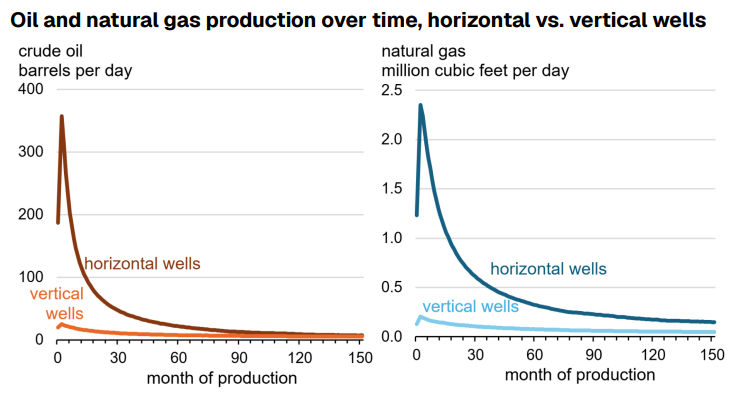
This front-loaded production curve is central to the return profile:
Rapid payback: Initial capital is typically recovered within 12 to 24 months. Short payback windows limit commodity price exposure before cost recovery and allow cash flow from early wells to fund subsequent drilling, making an active development program largely self-financing.
Strong total returns: Over a well's full producing life, distributions typically yield 2.5x to 3.0x on invested capital, with combined acquisition and drilling programs targeting a 20%–30% net IRR.3
Predictable hedging: Because well performance and decline rates in established formations can be modeled within reasonable confidence for well-understood plays, operators can hedge future production at known prices before drilling begins.
Capital discipline: When existing wells keep acreage Held by Production (HBP), operators face no expiring lease deadlines. They can slow development during weak commodity pricing and accelerate when prices recover.
A private fund doesn’t hold wells for their entire 30-to-40-year life. It harvests the steep initial cash flows during the hold period, then exits by selling the long-tail production and remaining undrilled inventory to larger strategic buyers, institutional consolidators, or other private funds pursuing a different return objective.
How managers create value
Well-level economics explain how a single well returns capital, but the primary return driver in an operated strategy is value created across the portfolio lifecycle:
Portfolio assembly
Operating managers acquire acreage, often undeveloped or non-core to its seller, at a price anchored to the asset. A manager then increases position value through:
- Development: drilling initial wells to generate cash flow and prove surrounding location productivity, converting speculative acreage into demonstrated inventory.
- Contiguous blocking: purchasing adjacent parcels to assemble contiguous acreage blocks, enabling longer horizontal wells that significantly lower per-foot drilling costs.
- Infrastructure: building midstream gathering systems and water handling facilities to lower long-term operating costs.
Asset-level operations
Managers generate cash-flow margin expansion through hands-on technical and commercial execution:
- Technical optimization: refining completion design (proppant and fluid mixes), well spacing, and artificial lift timing to maximize total recovery and slow decline rates.
- Procurement scale: leveraging portfolio scale to negotiate lower contract rates for drilling rigs, pressure pumping, tubular goods, and service vendors.
The exit
A large, contiguous acreage block with established production tends to attract higher valuations from strategic corporate buyers than the same assets would attract if fragmented. The manager's role is to assemble scattered parcels into a unified, larger package that draws that valuation. This mirrors "assemblage" in commercial real estate development, where combining adjacent parcels creates value beyond the sum of the parts, and the "multiple arbitrage" of private equity roll-ups.
Market Forces Driving Returns
While asset-level mechanics determine individual well performance, broader market forces shape baseline valuations and sector-wide risk profiles. Private energy returns are fundamentally shaped by two forces:
- Commodity supply and demand
- Capital cycles that set entry valuations
Commodity supply and demand
Oil and natural gas are often discussed together but behave differently as commodities. Oil is globally traded, easy to transport, and priced on a world market. Natural gas has historically been regional, priced by local supply and demand, and expensive to move without pipeline or liquefaction infrastructure. As a result, their prices can move independently, or even inversely, and the forces that move them differ.
Global commodity pricing sets the top-line revenue for every upstream asset. Unlike industries where production can easily pause or scale up, energy markets operate on relatively rigid physical supply constraints:
Oil supply depletion and price floors
Oil and gas wells naturally deplete over time. As global supply and demand forecasts illustrate, even under aggressive low-demand scenarios, the decline of existing fields occurs far faster than global consumption drops. This creates a persistent supply gap.
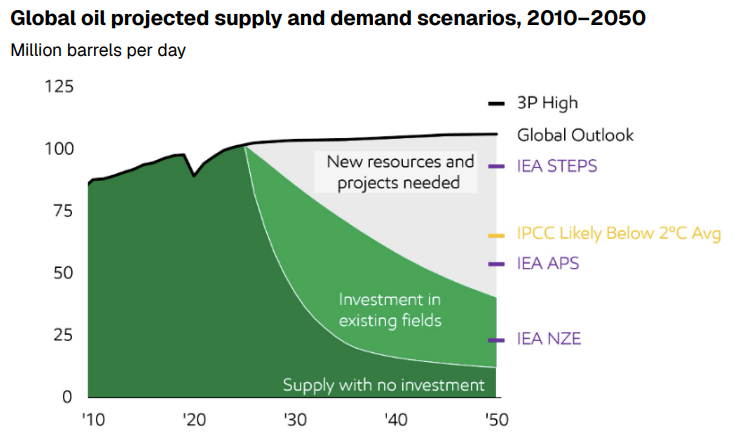
To fill the supply gap and prevent shortfalls, the industry must continuously invest capital into new development. Commodity prices must stay high enough to cover the cost of producing the next essential unit, known as the "marginal barrel." Consequently, ongoing depletion establishes a price floor rooted in the marginal cost of new production.
Natural gas globalization and AI demand
North America holds vast reserves of low-cost natural gas, which have historically been confined to domestic buyers. As more liquefied natural gas export terminals come online, cheap domestic supply will be connected to higher-priced European and Asian markets. Unlocking global demand creates a long-term tailwind for gas-weighted basins.
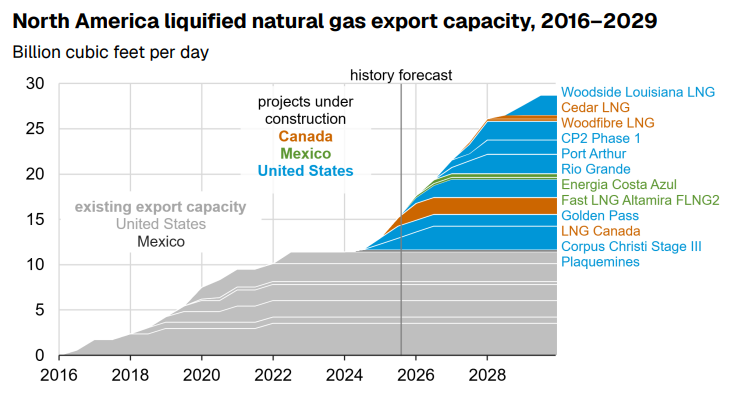
Natural gas demand also has a new driver in the electricity required by AI and data centers. Global data center electricity demand is expected to more than double from 415 TWh in 2024 to 945 TWh by 2030.4 Because solar and wind lack 24/7 reliability and nuclear buildouts require long lead times, gas-fired power generation is the primary scalable solution to meet this demand.
When oil and gas prices move inversely
Gas supplies in North America come from two sources: “dry gas” wells that produce almost exclusively gas, such as in the Haynesville Shale in Louisiana and East Texas, and “associated gas” that is extracted as a byproduct of oil drilling in formations like the Permian Basin in West Texas and New Mexico.
In the current market environment (2H 2026), high global oil prices have led to a spike in Permian drilling. This, in turn, has put significant downward pressure on benchmark U.S. natural gas pricing (known as “Henry Hub” pricing). In some areas of West Texas, local gas pricing has repeatedly turned negative as oil producers have had to pay midstream operators to take away associated gas. When global oil prices retreat, the resulting reduction in associated gas is anticipated to lead to an upward revision in U.S. gas pricing.
Capital cycles and entry multiples
Institutional capital dislocation
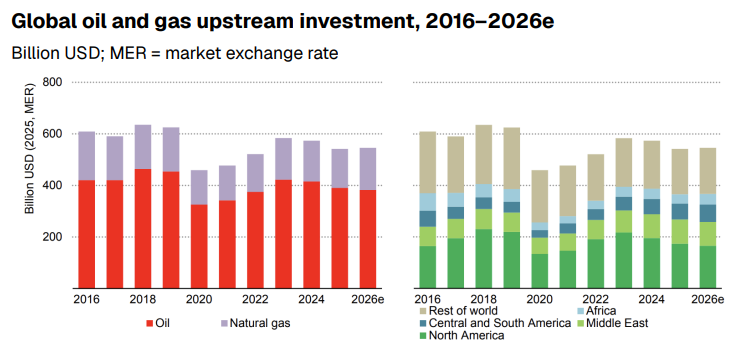
Over the past decade, institutional capital allocation to traditional energy has declined. This scarcity of private and public equity reduces competition for assets, allowing disciplined buyers to acquire producing wells and undrilled inventory at lower cash-flow multiples compared to historical norms.
Capital discipline
Publicly traded operators have shifted from "growth at all costs" to strict capital discipline, prioritizing dividend distributions and debt paydown over aggressive land grabs. Because these major public buyers no longer overbid for acreage to inflate drilling inventory, they add little of the competitive pressure that once pushed acquisition multiples higher.
Seller motivation and valuation discounts
Off-market acquisition opportunities are frequently created by non-operating co-owners seeking liquidity, private equity funds reaching the end of fund lives, public operators divesting non-core acreage, or exploration-focused companies shedding proven assets that no longer fit their mandate. With sector capital constrained, sellers face a smaller pool of competing buyers, reinforcing the discounted entry valuations described above.
Risks and Considerations
Market, cycle, and policy dynamics
Commodity prices: Oil and gas prices are the dominant, uncontrollable variable in returns. Prices are driven by OPEC, geopolitics, and global demand. Hedging can mitigate much of the single-well commodity price risk, given how front-loaded and relatively predictable production is. Generally, prices can be hedged to at least cover the payback period on drilling costs for a new well. However, there remain material downside risks that are difficult to hedge, including:
- Tail production multiple years into the future.
- The risk of lease expiry or the cost of lease extensions on land that cannot be profitably developed during a low price environment.
- Exit pricing to sell consolidated and developed acreage.
Vintage and entry timing: Deploying capital during commodity price peaks can lead to inflated acquisition multiples and elevated development costs, compressing net returns if prices drop later in the fund's lifecycle. Securing disciplined entry valuations during market pullbacks or capital-scarce environments is a key driver of long-term outperformance.
Decarbonization and long-term demand: If the energy transition away from fossil fuels accelerates faster than expected, long-lived assets and terminal exit valuations could suffer. Even though the world needs continued production, the long-term demand path is uncertain.
Regulatory and political risk: The rules governing drilling permits, severance taxes, water disposal, and land access vary by state. Federal policy on leasing, emissions, and tax treatment can shift with administrations. While favorable jurisdictions tend to stay favorable, regulatory relationships and choice of basin affect risk.
Operational mechanics and manager selection
Geologic and dry-hole risk: Exploratory wells can fail to find commercial hydrocarbons. Diversifying across many wells reduces single-well exposure, and established basins remove most uncertainty.
Decline-curve and reinvestment: A shale well's output declines steeply, so total production only holds up if the operator keeps drilling new wells to offset the older ones. That drilling costs capital. Confirm that a fund’s development capex projections budget accordingly. In addition, less-understood formations can carry greater uncertainty about initial levels of production and the shape of the decline curve.
Manager selection risk: The dispersion between the best and worst managers is wide, as operated returns depend heavily on execution, geologic judgment, adequate scale and capitalization, sophisticated hedging, and disciplined acquisition. Manager selection is central to the outcomes of this asset class. Proven multi-fund managers and members of prominent oil families with deep industry connections tend to have access to deal flow, geological understanding, and employee talent that new entrants struggle to match.
Liquidity and exit timing: These are multi-year commitments with no daily liquidity, though front-loaded production returns cash relatively early through distributions. Exit timing is a distinct risk because much of an operated strategy's return is realized at sale.
Tax Considerations
Oil and gas investors typically receive a K-1. The asset class carries tax features uncommon in other investments that may appeal to taxable investors. Tax provisions vary with circumstance and are subject to change. Investors should consult a qualified tax advisor.
Intangible drilling costs: These make up the majority of drilling and completion expenses and are largely deductible in the year incurred. They are typically recaptured as ordinary income on sale, so the benefit is tax deferral, not permanent avoidance.
Tangible costs and depreciation: Tangible drilling costs are recovered over time through depreciation. The One Big Beautiful Bill Act (2025) reinstated 100% bonus depreciation,5 letting a portion of these costs be deducted up front rather than spread over years. This pulls the tax benefit forward to improve after-tax returns.
Depletion allowance: A percentage depletion allowance shelters part of gross production revenue from tax for qualifying producers.
International and tax-exempt investors: Income from a U.S. operating partnership can generate effectively connected income (ECI) for foreign investors and unrelated business taxable income (UBTI) for tax-exempt investors. Some funds address this with a "blocker" or offshore vehicle.
How to Evaluate Opportunities
The manager
Because operated returns depend so heavily on execution, Long Angle typically looks for:
- A proven operating track record in geology, drilling, and production, with realized returns across full cycles rather than only in favorable price environments.
- In-house operating capability, not a purely financial or capital-markets background.
- Strong industry relationships, since the best land transactions are often sourced off-market. This can come from prior funds and familial relationships, as many of the best managers are part of multigenerational oil families.
- A sophisticated approach to hedging, with a clear policy on how much production is hedged and how far out.
- Responsible capital stewardship and a margin of safety, including the discipline to walk away from over-priced acquisitions.
- Substantial GP commitment: capital the sponsor has invested alongside its LPs is among the clearest signals of alignment. GP commitments can be much higher in energy than other industries, reaching tens or hundreds of millions of dollars.
It also helps to understand how a manager sources and screens deals, which are forms of risk control. A wide funnel, deep diligence, and a low win rate signal pricing discipline.
The offering
Offering materials typically cover:
- Target geology
- Recovery and decline assumptions
- Economic model and price assumptions
- Ownership terms
- Risk disclosures
- Fees
The fee structure deserves particular attention, since it determines how the economics are split between investors and the manager. Look closely at how many layers of promote (the manager's share of profits) sit between you and the assets.
Beyond these, ask how the strategy performs in a downside. What would happen with a flat commodity price held for the life of the assets? Investors should be able to differentiate a strategy whose stress case still returns most of invested capital from one where the downside is a substantial loss.
Long Angle’s Perspective
Throughout the 2010s, oversupply, environmental divestment pressure, and debt-fueled growth drove capital out of oil and gas, leaving diminishing inventories. Since then, technological innovation has transformed shale development into a predictable engineering process, lowering the risk of projecting well performance. Yet institutional capital markets have largely stayed away. Because capital remains scarce, today’s investors are being compensated at return expectations typically reserved for far higher-risk asset classes, even as underlying technical underwriting has become significantly more reliable.
The investment thesis for an oil and gas allocation rests on two pillars:
Tactical market opportunity
- Tightening oil supply supports durable prices: The depletion dynamic puts a floor under prices, rooted in the marginal cost of new production. For an investor, that means low-cost producing assets earn durable cash flow across a range of price environments.
- Natural gas export capacity unlocks higher-priced global demand: Cheap U.S. gas has been restricted by a saturated domestic market. As new LNG terminals connect that supply to higher-paying global buyers, gas prices are supported at structurally higher levels. That makes ownership of low-cost gas production an attractive and reliable source of cash flow.
- Capital dislocation creates lower entry points: With institutional capital still absent, disciplined buyers can acquire production at low cash-flow multiples. A lower entry price raises the return on the same future cash flow.
Structural portfolio benefits
- Hard assets and inflation protection: Unlike paper investments whose valuations rely on future earnings multiples, producing reserves are backed by physical energy with global demand. This tangible backing provides a real-asset valuation floor and a natural inflation hedge, as commodity prices tend to increase with inflation.
- Income source: Energy assets distribute cash continuously throughout their operational lifespan, providing steady distributions to a portfolio. The steep initial cash-flow profile of shale wells accelerates payouts, returning capital quickly to reduce duration risk.
- Low correlation with equities: Commodity cash flows are driven by global supply-demand fundamentals as opposed to public equity market sentiment, corporate earnings cycles, or interest rate movements, providing true macro diversification.
The result is a uniquely favorable setup: a capital-starved sector offered at the return profiles of a far riskier asset class, delivered through a hard-asset structure that already earns its place in an institutional portfolio on its own merits.
Long Angle members can reach out to the Investment Team at Investors@longangle.com with any questions about private oil and gas funds and opportunities to invest.
Sources
- U.S. Energy Information Administration (EIA), “Oil and petroleum products explained”
- Petroleum Exploration and Development, Volume 51, Issue 4, 2024, "Geologic characteristics, exploration and production progress of shale oil and gas in the United States: An overview." Data from EIA.
- Long Angle, “How to Invest in Oil and Gas: A Guide for Private Investors.” Figures are based on a Navigating Wealth podcast conversation with Blake London, co-founder of Formentera.
- International Energy Agency (IEA), “Energy and AI Report”
- Grant Thornton, "OBBBA offers new, expanded ways to accelerate depreciation"
Frequently Asked Questions
What is a private oil and gas fund?
A pooled vehicle that buys producing wells and undeveloped acreage across U.S. basins. Investors commit capital, the manager operates or backs the assets, and returns flow back as production income and later as sale proceeds.
How do private investors make money in oil and gas?
Mostly upstream, by owning production. A shale well pays back capital in 12 to 24 months and distributes cash over a long tail, with additional value created by assembling acreage and selling it at a higher valuation.
What returns do private oil and gas investments target?
Full-life distributions typically run 2.5x to 3.0x on invested capital, with combined acquisition and drilling programs targeting a 20% to 30% net IRR. Actual outcomes depend heavily on entry price and manager execution.
What are the main risks of investing in oil and gas?
Commodity prices are the dominant uncontrollable variable, and manager selection is the dominant controllable one. These are illiquid, multi-year commitments whose return is partly realized only at exit.
What are the tax features of oil and gas investing?
Investors typically receive a K-1. Intangible drilling costs are largely deductible in the year incurred, 100% bonus depreciation was reinstated for 2025, and a depletion allowance shelters part of revenue. Consult a qualified tax advisor.
Where in the value chain do private investors focus?
Upstream, which is finding and producing oil and gas. Midstream and downstream are reached mainly through public markets, while independent upstream operators let private capital participate in specific segments.
The best energy managers raise quietly, from people they already know.
Long Angle is a vetted community of high-net-worth founders, executives and investors who share which managers they have used, what they would do again, and what they wish they had known earlier.
Alternative investments